
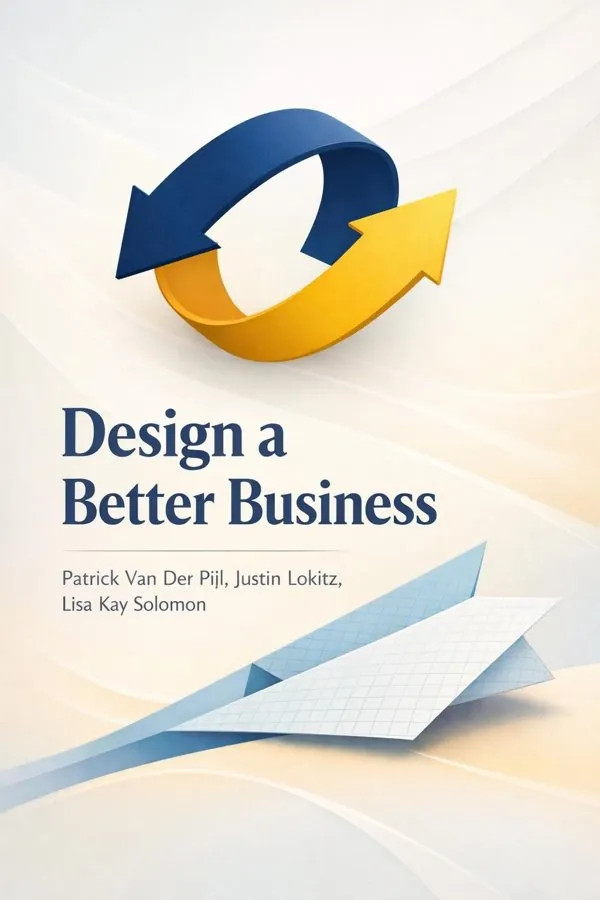
Design a Better Business: New Tools, Skills, and Mindset for Strategy and Innovation: Summary & Key Insights
by Patrick Van Der Pijl, Justin Lokitz, Lisa Kay Solomon
 10 min7 chaptersAudio available
What Is Design a Better Business: New Tools, Skills, and Mindset for Strategy and Innovation About?
Design a Better Business: New Tools, Skills, and Mindset for Strategy and Innovation by Patrick Van Der Pijl, Justin Lokitz, Lisa Kay Solomon is a design book spanning 7 pages. Design a Better Business introduces a comprehensive framework for innovation and strategy using visual thinking, design tools, and business modeling. It provides practical methods for teams to explore new ideas, prototype business models, and create value through design-driven approaches. The book emphasizes experimentation, collaboration, and customer-centric thinking to help organizations navigate uncertainty and build sustainable growth.
This FizzRead summary covers all 7 key chapters of Design a Better Business: New Tools, Skills, and Mindset for Strategy and Innovation in approximately 10 minutes, distilling the most important ideas, arguments, and takeaways from Patrick Van Der Pijl, Justin Lokitz, Lisa Kay Solomon's work. Also available as an audio summary and Key Quotes Podcast.
Design a Better Business: New Tools, Skills, and Mindset for Strategy and Innovation
Design a Better Business introduces a comprehensive framework for innovation and strategy using visual thinking, design tools, and business modeling. It provides practical methods for teams to explore new ideas, prototype business models, and create value through design-driven approaches. The book emphasizes experimentation, collaboration, and customer-centric thinking to help organizations navigate uncertainty and build sustainable growth.
Who Should Read Design a Better Business: New Tools, Skills, and Mindset for Strategy and Innovation?
This book is perfect for anyone interested in design and looking to gain actionable insights in a short read. Whether you're a student, professional, or lifelong learner, the key ideas from Design a Better Business: New Tools, Skills, and Mindset for Strategy and Innovation by Patrick Van Der Pijl, Justin Lokitz, Lisa Kay Solomon will help you think differently.
- ✓Readers who enjoy design and want practical takeaways
- ✓Professionals looking to apply new ideas to their work and life
- ✓Anyone who wants the core insights of Design a Better Business: New Tools, Skills, and Mindset for Strategy and Innovation in just 10 minutes
Want the full summary?
Get instant access to this book summary and 100K+ more with Fizz Moment.
Get Free SummaryAvailable on App Store • Free to download
Key Chapters
At the core of our approach is design thinking — not as a buzzword, but as a deeply human way of solving complex problems. In business, it means starting with empathy, not efficiency. Most traditional strategies begin by asking, 'What can we sell?' Design thinking begins by asking, 'What do people really need and why?' This shift may seem simple, but it changes everything about how companies create, test, and scale their offerings.
Drawing from our experience at Business Models Inc., we’ve seen how teams that adopt a design mindset stop treating strategy as analysis and start treating it as exploration. Instead of predicting the future through spreadsheets, they shape it through prototyping. Visual tools become conversation starters, not static documents. And customers become partners in innovation, not just end targets.
This chapter dives into how design thinking integrates empathy, ideation, and experimentation into strategy. We show how organizations like LEGO, GE, and Airbnb have used these principles to rediscover their customers and reinvent their business models. We emphasize that design thinking is not just for designers — it’s a collaborative mindset that invites diversity, curiosity, and iteration into every level of decision-making. When business strategy becomes a continually evolving design process, companies unlock both creativity and resilience.
One of the most common innovation pitfalls we’ve observed is the split between those exploring the future and those executing today’s business. The Double Loop model bridges this divide. It brings together *exploration* — the search for what’s next — and *execution* — the optimization of what exists — in a continuous cycle of learning.
In the first loop, teams explore emerging trends, identify unmet needs, and generate and test new business models. This is where experimentation reigns — where teams build prototypes, test assumptions, and gather customer insight. The second loop focuses on execution: scaling what works, sustaining operations, and improving efficiency. Most organizations get stuck here, trapped by quarterly goals that prevent them from experimenting.
Our Double Loop framework shows how leading companies like Amazon and Intuit have mastered the rhythm of moving between these loops. The art lies in knowing when to widen the aperture and when to focus it. Rather than treating innovation as a side project, the Double Loop turns it into a systemic capability — so the entire organization is always both learning and executing. The result is a business that can continuously adapt without losing focus.
+ 5 more chapters — available in the FizzRead app
All Chapters in Design a Better Business: New Tools, Skills, and Mindset for Strategy and Innovation
About the Authors
Patrick Van Der Pijl is the CEO of Business Models Inc. and producer of the bestselling book Business Model Generation. Justin Lokitz is a strategy designer and managing director at Business Models Inc. Lisa Kay Solomon is a leadership educator and coauthor of Moments of Impact, focusing on design thinking and innovation in organizations.
Get This Summary in Your Preferred Format
Read or listen to the Design a Better Business: New Tools, Skills, and Mindset for Strategy and Innovation summary by Patrick Van Der Pijl, Justin Lokitz, Lisa Kay Solomon anytime, anywhere. FizzRead offers multiple formats so you can learn on your terms — all free.
Available formats: App · Audio · PDF · EPUB — All included free with FizzRead
Download Design a Better Business: New Tools, Skills, and Mindset for Strategy and Innovation PDF and EPUB Summary
Key Quotes from Design a Better Business: New Tools, Skills, and Mindset for Strategy and Innovation
“At the core of our approach is design thinking — not as a buzzword, but as a deeply human way of solving complex problems.”
“One of the most common innovation pitfalls we’ve observed is the split between those exploring the future and those executing today’s business.”
Frequently Asked Questions about Design a Better Business: New Tools, Skills, and Mindset for Strategy and Innovation
Design a Better Business: New Tools, Skills, and Mindset for Strategy and Innovation by Patrick Van Der Pijl, Justin Lokitz, Lisa Kay Solomon is a design book that explores key ideas across 7 chapters. Design a Better Business introduces a comprehensive framework for innovation and strategy using visual thinking, design tools, and business modeling. It provides practical methods for teams to explore new ideas, prototype business models, and create value through design-driven approaches. The book emphasizes experimentation, collaboration, and customer-centric thinking to help organizations navigate uncertainty and build sustainable growth.
You Might Also Like
The Design of Everyday Things
Don Norman
10 min
The Better Angels of Our Nature
Steven Pinker
10 min
A Designer's Art
Paul Rand
10 min
Architects' Sketchbooks
Various Editors
10 min
Architectural Graphic Standards
The American Institute of Architects
10 min
Design Is Storytelling
Ellen Lupton
10 minBrowse by Category
Ready to read Design a Better Business: New Tools, Skills, and Mindset for Strategy and Innovation?
Get the full summary and 100K+ more books with Fizz Moment.