
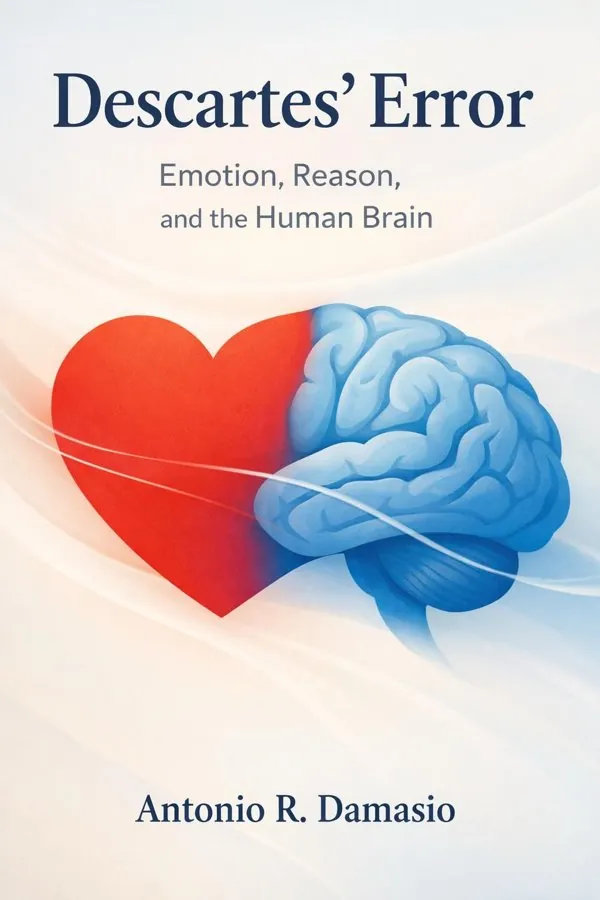
Descartes' Error: Emotion, Reason, and the Human Brain: Summary & Key Insights
 10 min9 chaptersAudio available
Key Takeaways from Descartes' Error: Emotion, Reason, and the Human Brain
Sometimes one damaged brain reveals more about human nature than thousands of normal ones.
A person can sound perfectly rational and still make catastrophically poor choices.
Your body often knows what your conscious mind has not yet articulated.
Emotions are not vague disturbances floating through the mind; they are coordinated biological processes with identifiable neural machinery.
The sharp line between feeling and thinking is one of the most seductive mistakes in intellectual history.
What Is Descartes' Error: Emotion, Reason, and the Human Brain About?
Descartes' Error: Emotion, Reason, and the Human Brain by Antonio R. Damasio is a neuroscience book spanning 9 pages. What if the very feelings we often treat as obstacles to clear thinking are actually essential to good judgment? In Descartes' Error, Antonio R. Damasio overturns one of Western thought’s most enduring assumptions: that reason works best when it is separated from emotion. Drawing on neurology, psychology, philosophy, and vivid clinical case studies, Damasio shows that rationality is not a disembodied process. It depends on signals from the body and on emotional systems that help us evaluate options, anticipate consequences, and make decisions in real life. At the center of the book are striking patients who seem intellectually intact yet make disastrously poor choices because the brain circuits linking emotion and reasoning have been damaged. Through these cases, Damasio develops his influential somatic marker hypothesis, explaining how bodily feelings guide thought long before conscious analysis is complete. The result is a powerful challenge to mind-body dualism and a foundational contribution to modern neuroscience. For readers interested in how the brain creates judgment, selfhood, and consciousness, this book remains both intellectually provocative and deeply relevant.
This FizzRead summary covers all 9 key chapters of Descartes' Error: Emotion, Reason, and the Human Brain in approximately 10 minutes, distilling the most important ideas, arguments, and takeaways from Antonio R. Damasio's work. Also available as an audio summary and Key Quotes Podcast.
Descartes' Error: Emotion, Reason, and the Human Brain
What if the very feelings we often treat as obstacles to clear thinking are actually essential to good judgment? In Descartes' Error, Antonio R. Damasio overturns one of Western thought’s most enduring assumptions: that reason works best when it is separated from emotion. Drawing on neurology, psychology, philosophy, and vivid clinical case studies, Damasio shows that rationality is not a disembodied process. It depends on signals from the body and on emotional systems that help us evaluate options, anticipate consequences, and make decisions in real life.
At the center of the book are striking patients who seem intellectually intact yet make disastrously poor choices because the brain circuits linking emotion and reasoning have been damaged. Through these cases, Damasio develops his influential somatic marker hypothesis, explaining how bodily feelings guide thought long before conscious analysis is complete. The result is a powerful challenge to mind-body dualism and a foundational contribution to modern neuroscience. For readers interested in how the brain creates judgment, selfhood, and consciousness, this book remains both intellectually provocative and deeply relevant.
Who Should Read Descartes' Error: Emotion, Reason, and the Human Brain?
This book is perfect for anyone interested in neuroscience and looking to gain actionable insights in a short read. Whether you're a student, professional, or lifelong learner, the key ideas from Descartes' Error: Emotion, Reason, and the Human Brain by Antonio R. Damasio will help you think differently.
- ✓Readers who enjoy neuroscience and want practical takeaways
- ✓Professionals looking to apply new ideas to their work and life
- ✓Anyone who wants the core insights of Descartes' Error: Emotion, Reason, and the Human Brain in just 10 minutes
Want the full summary?
Get instant access to this book summary and 100K+ more with Fizz Moment.
Get Free SummaryAvailable on App Store • Free to download
Key Chapters
Sometimes one damaged brain reveals more about human nature than thousands of normal ones. Damasio begins with the legendary case of Phineas Gage, the railroad foreman who survived an 1848 accident in which an iron rod blasted through his skull. Before the accident, Gage was disciplined, responsible, and socially effective. Afterward, although he could still speak, remember, and solve ordinary problems, his personality and judgment changed dramatically. He became impulsive, unreliable, and unable to plan his life.
Why does this case matter so much? Because it exposed a crucial truth: intelligence is not the same as wise decision-making. Gage did not simply lose "thinking power" in a general sense. Instead, the injury disrupted brain systems involved in emotion, social conduct, and the ability to attach value to choices. Damasio revisits the case with modern neurological insight and argues that damage to the frontal regions of the brain can leave logic superficially intact while destroying the emotional guidance that makes logic useful.
This is the book’s opening challenge to the traditional picture of reason. If a person can perform well on tests yet fail at life, then rationality must involve more than abstract thought. It must also involve emotional calibration, future-oriented feeling, and bodily feedback.
In everyday life, the lesson is clear. When evaluating competence in ourselves or others, do not confuse raw intellect with judgment. Pay attention to emotional awareness, impulse control, and social sensitivity. Actionable takeaway: when making a major decision, ask not only "Does this make sense on paper?" but also "What does my emotional response reveal about the real-world consequences?"
Your body often knows what your conscious mind has not yet articulated. This is the core of Damasio’s somatic marker hypothesis, his most influential contribution in the book. A somatic marker is a bodily-based emotional signal linked to past experience. When you face a decision, these markers help narrow the field by tagging some options as attractive, risky, or dangerous before full conscious reasoning is complete.
Damasio is not saying that gut feelings are magical or always correct. Rather, he argues that emotional learning stores patterns in the brain and body. Over time, outcomes become associated with bodily states: tension, ease, dread, excitement, relief. When similar situations appear again, the brain reactivates these signals, allowing faster and often smarter judgment. This is especially useful when decisions are too complex for exhaustive calculation.
Imagine choosing a business partner. You may not be able to list every reason for your hesitation, yet something feels wrong. That feeling might reflect subtle cues your brain has integrated from past experience. Or think of driving: you often react to danger before consciously analyzing it. Somatic markers help guide attention and action under uncertainty.
At the same time, Damasio recognizes that somatic markers can be shaped by trauma, bias, or poor learning. They should inform reasoning, not replace it. The ideal decision process combines emotional signaling with reflective evaluation.
Actionable takeaway: when facing a complex choice, write down both the factual pros and cons and the bodily/emotional reactions each option triggers. If one option repeatedly produces unease or clarity, treat that signal as data to investigate rather than noise to suppress.
Emotions are not vague disturbances floating through the mind; they are coordinated biological processes with identifiable neural machinery. Damasio maps emotion onto brain systems that link perception, bodily regulation, memory, and action. Regions in the frontal lobes, limbic structures, brainstem nuclei, and body-monitoring pathways work together to generate emotional states and represent them in consciousness.
This matters because it places emotion inside science without reducing it to something trivial. An emotion is not just a feeling in the abstract. It involves changes in heart rate, hormone release, posture, facial expression, attention, and patterns of thought. The brain detects meaningful events, triggers bodily responses, and then monitors those responses. Feeling, in Damasio’s framework, is the mental experience of these body-related changes.
That means emotion and cognition are deeply intertwined. Memory becomes more salient when emotionally charged. Attention narrows around threats or opportunities. Social cues gain importance because they carry survival value. Even moral judgment depends partly on circuits that register bodily and emotional significance.
In practical settings, this helps explain why stress alters thinking, why public speaking can impair recall, and why emotionally meaningful teaching tends to improve learning. It also suggests that good decisions depend partly on managing the bodily conditions under which the brain operates.
Actionable takeaway: treat your physical state as part of your thinking system. Before important conversations or choices, regulate the body first through sleep, movement, breathing, or a brief pause. A calmer body often produces a more coherent emotional signal and better reasoning.
The sharp line between feeling and thinking is one of the most seductive mistakes in intellectual history. Damasio argues that reason is not a pure faculty operating above emotion. Instead, effective reasoning depends on emotional processes that assign value, highlight relevance, and connect abstract possibilities to lived consequences.
Consider what reason actually requires in everyday life. We must choose among countless options, estimate risk, care about outcomes, and sustain commitment over time. Pure logic can compare structures, but it cannot by itself tell us what matters, what is urgent, or why one path should outweigh another. Emotion supplies this weighting function. It helps us distinguish trivial from meaningful, safe from dangerous, and acceptable from intolerable.
Damasio’s patients make this vivid. They can still discuss logical rules, yet they fail to prioritize or act wisely because decisions no longer carry appropriate emotional value. This suggests that rationality is not diminished by emotion per se; it is diminished by the wrong emotional pattern, or by the absence of emotion where it is needed.
The idea applies to business, medicine, parenting, and public policy. A doctor needs empathy to judge how treatment will affect a patient’s life. A manager needs emotional insight to understand morale and trust. A parent uses feeling to shape values, not merely enforce rules.
Actionable takeaway: when you are evaluating a difficult situation, include a values check alongside your analysis. Ask, "What outcome feels most aligned with what I care about?" This does not weaken rationality; it gives rationality a meaningful direction.
We do not think with the brain alone. One of Damasio’s most radical and enduring claims is that the mind is grounded in the living body. Mental life depends on continuous signals flowing between brain and body: from internal organs, muscles, hormones, the immune system, and the overall regulation of the organism. The brain does not float above the body; it maps the body and uses those maps to generate feeling, identity, and judgment.
This is why Damasio resists the idea that the mind can be understood as pure computation. The body provides a reference point for value. Hunger, pain, tension, calm, fatigue, and pleasure all shape cognition. Even our sense of self emerges partly from the brain’s representation of the body in relation to the world. Emotion is one of the main ways the organism monitors whether life is going well or badly.
In practical terms, this helps explain familiar experiences. A decision can look worse when you are exhausted. Conflict can feel more threatening when your body is already stressed. Exercise can improve not just mood but clarity. Chronic illness can alter emotional tone and cognitive performance because body-state is integral to mind-state.
Damasio’s view also has implications for therapy, education, and performance. If the body helps shape thought, then interventions that regulate bodily state are not peripheral; they are cognitive tools.
Actionable takeaway: build body awareness into your decision process. Before assuming a problem is purely mental, ask how sleep, stress, diet, illness, or physical tension may be influencing your interpretation. Sometimes better thinking begins with better regulation of the organism.
The error in Descartes’ Error is not that Descartes valued thinking, but that he placed mind and body in separate conceptual worlds. Damasio challenges the Cartesian legacy that treats reason as a disembodied faculty and the body as a mechanical appendage. He argues that this split distorted both philosophy and science by encouraging people to see emotion, flesh, and physiology as lesser forces that interfere with true thought.
Damasio does not deny the brilliance of Descartes. Instead, he shows the cost of dualism. Once mind is imagined as detached from bodily life, it becomes easier to misunderstand mental illness, undervalue emotion, and ignore how physiological regulation supports cognition. It also reinforces a cultural bias that praises cold rationality while treating feeling as weakness.
By reuniting mind and body, Damasio offers a more biologically realistic model of human nature. Thought emerges from a living organism struggling to maintain itself, navigate danger, pursue reward, and form social bonds. In this model, feeling is not an embarrassing residue of animal life. It is one of the foundations of intelligence.
This perspective has broad appeal today. Debates about artificial intelligence, mental health, burnout, and moral responsibility all benefit from asking whether cognition can truly be separated from embodiment and affect. Damasio suggests the answer is no.
Actionable takeaway: challenge any personal or professional habit that treats emotion as the opposite of intelligence. Instead, ask how bodily state, feeling, and reasoning are interacting. Better decisions often begin when we stop forcing these systems into false opposition.
To understand consciousness, Damasio suggests, we must first understand feeling. The book moves beyond decision-making to a larger philosophical question: how does the brain generate a sense of self aware of the world? Damasio proposes that consciousness is deeply tied to the brain’s ability to represent the body and track how the organism is being affected by objects, events, and thoughts.
In this framework, feelings are not just add-ons to awareness. They are central ingredients. When the brain maps changes in the body caused by interaction with the world, it creates a basic perspective: something is happening to me. This organism-centered mapping helps form the primitive roots of selfhood. From there, more complex layers of memory, language, and reflection can develop.
This approach is important because it grounds consciousness in biology rather than abstract metaphysics alone. It also links self-awareness to regulation and survival. The organism must monitor its own state to remain alive, and this monitoring may be one of the foundations from which conscious experience emerges.
For readers, the practical relevance lies in appreciating that self-knowledge is not purely verbal or intellectual. Sometimes we know ourselves first through feeling, tension, attraction, fatigue, or unease before we can explain those states in words.
Actionable takeaway: strengthen self-awareness by noticing how experiences alter your bodily and emotional state. A brief daily check-in such as "What am I feeling in my body right now, and what might it be responding to?" can deepen insight in ways abstract reflection alone often misses.
If emotion is essential to reason, then morality, law, and social life cannot be understood as purely rational systems. Damasio extends his argument into ethics and society by suggesting that moral judgment depends heavily on emotional capacities such as empathy, aversion to harm, attachment, and the ability to imagine consequences vividly. A person who cannot feel appropriate emotion may still recite moral rules yet fail to behave morally in practice.
This has major implications. In education, character cannot be formed by logic instruction alone; emotional development matters. In law, responsibility may need to consider neurological impairments that damage emotional judgment. In leadership, trust and social cohesion depend on emotional intelligence, not merely strategic calculation. In public discourse, policies that ignore fear, dignity, grief, or belonging often fail even if technically sound.
Damasio’s work also cautions against simplistic models of human behavior in economics and politics. People are not detached utility calculators. They are embodied organisms whose choices are shaped by feeling, habit, social bonds, and biological regulation. A humane society must account for this complexity.
At the same time, the book does not imply that all feelings should rule. Emotional reactions can be biased, tribal, or manipulated. The goal is integration: ethical life works best when emotional concern and reflective reasoning correct and strengthen one another.
Actionable takeaway: in any discussion about what people should do, ask not only what is logically defensible but also what emotional capacities the situation requires. Better institutions are designed for the humans we actually are, not the emotionless idealizations we imagine.
All Chapters in Descartes' Error: Emotion, Reason, and the Human Brain
About the Author
Antonio R. Damasio is a Portuguese-American neuroscientist celebrated for his work on the biological foundations of emotion, decision-making, selfhood, and consciousness. Trained in medicine and neurology, he built an influential research career studying how brain injuries affect behavior, especially in patients whose emotional processing was disrupted despite preserved intelligence. His findings helped reshape modern neuroscience by showing that feeling is central to reasoning rather than separate from it. Damasio has held major academic appointments, including at the University of Iowa and the University of Southern California, where he became a leading voice in neuroscience and philosophy of mind. Through books such as Descartes' Error, The Feeling of What Happens, and Self Comes to Mind, he has brought complex scientific ideas to a broad readership.
Get This Summary in Your Preferred Format
Read or listen to the Descartes' Error: Emotion, Reason, and the Human Brain summary by Antonio R. Damasio anytime, anywhere. FizzRead offers multiple formats so you can learn on your terms — all free.
Available formats: App · Audio · PDF · EPUB — All included free with FizzRead
Download Descartes' Error: Emotion, Reason, and the Human Brain PDF and EPUB Summary
Key Quotes from Descartes' Error: Emotion, Reason, and the Human Brain
“Sometimes one damaged brain reveals more about human nature than thousands of normal ones.”
“A person can sound perfectly rational and still make catastrophically poor choices.”
“Your body often knows what your conscious mind has not yet articulated.”
“Emotions are not vague disturbances floating through the mind; they are coordinated biological processes with identifiable neural machinery.”
“The sharp line between feeling and thinking is one of the most seductive mistakes in intellectual history.”
Frequently Asked Questions about Descartes' Error: Emotion, Reason, and the Human Brain
Descartes' Error: Emotion, Reason, and the Human Brain by Antonio R. Damasio is a neuroscience book that explores key ideas across 9 chapters. What if the very feelings we often treat as obstacles to clear thinking are actually essential to good judgment? In Descartes' Error, Antonio R. Damasio overturns one of Western thought’s most enduring assumptions: that reason works best when it is separated from emotion. Drawing on neurology, psychology, philosophy, and vivid clinical case studies, Damasio shows that rationality is not a disembodied process. It depends on signals from the body and on emotional systems that help us evaluate options, anticipate consequences, and make decisions in real life. At the center of the book are striking patients who seem intellectually intact yet make disastrously poor choices because the brain circuits linking emotion and reasoning have been damaged. Through these cases, Damasio develops his influential somatic marker hypothesis, explaining how bodily feelings guide thought long before conscious analysis is complete. The result is a powerful challenge to mind-body dualism and a foundational contribution to modern neuroscience. For readers interested in how the brain creates judgment, selfhood, and consciousness, this book remains both intellectually provocative and deeply relevant.
You Might Also Like
Anxious
Joseph LeDoux
10 min
Hallucinations
Oliver Sacks
10 min
The Biological Mind: How Brain, Body, and Environment Collaborate to Make Us Who We Are
Alan Jasanoff
10 min
The Feeling of Life Itself: Why Consciousness Is Widespread but Can't Be Computed
Christof Koch
10 min
The No-Nonsense Meditation Book
Steven Laureys
10 min
A General Theory of Love
Thomas Lewis, Fari Amini, Richard Lannon
10 minBrowse by Category
Ready to read Descartes' Error: Emotion, Reason, and the Human Brain?
Get the full summary and 100K+ more books with Fizz Moment.