
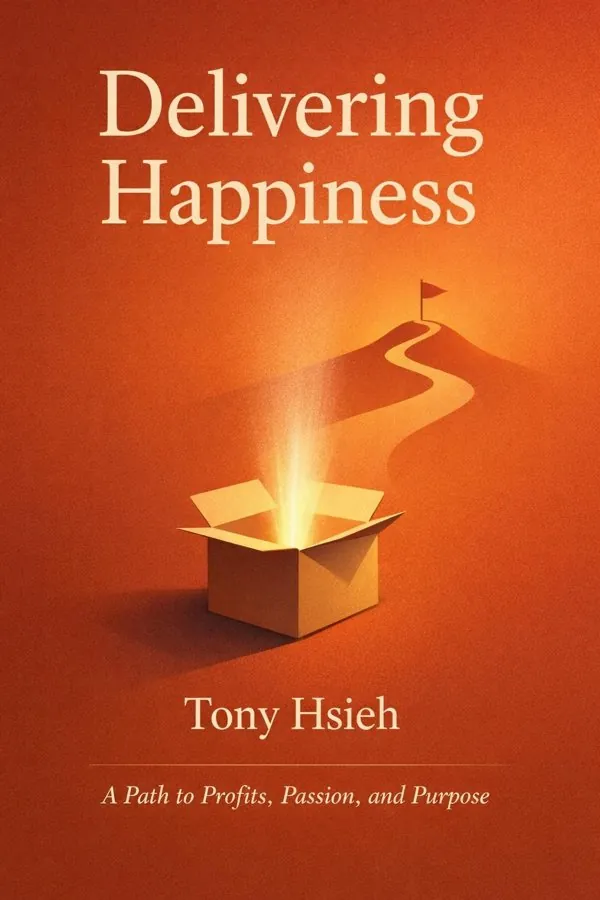
Delivering Happiness: A Path to Profits, Passion, and Purpose: Summary & Key Insights
by Tony Hsieh
 10 min9 chaptersAudio available
Key Takeaways from Delivering Happiness: A Path to Profits, Passion, and Purpose
Most companies treat happiness as a soft benefit, but Tony Hsieh presents it as a serious competitive advantage.
Many organizations say culture matters, yet they behave as if culture will somehow take care of itself.
In crowded markets, products can be copied, prices can be undercut, and features can quickly become standard.
Money can motivate people for a while, but Hsieh argues that it rarely provides lasting energy or fulfillment.
A recurring pattern in Hsieh’s story is that success rarely arrives through a perfectly linear plan.
What Is Delivering Happiness: A Path to Profits, Passion, and Purpose About?
Delivering Happiness: A Path to Profits, Passion, and Purpose by Tony Hsieh is a leadership book. Delivering Happiness is part memoir, part business playbook, and part manifesto for a more human way of building companies. In this book, Tony Hsieh recounts his journey from running a worm farm as a child to leading Zappos, the online shoe retailer that became famous for legendary customer service and a deeply intentional company culture. But this is not just a startup success story. Hsieh argues that lasting business success comes from aligning profits with passion and purpose, and from creating an environment where employees feel connected, empowered, and inspired. The book matters because it challenges a narrow view of business as a machine for short-term gains. Instead, Hsieh shows how culture, values, and customer experience can become strategic advantages that are difficult for competitors to copy. His authority comes not from theory alone, but from lived experience: he co-founded LinkExchange, sold it to Microsoft, then helped transform Zappos into a billion-dollar brand before its acquisition by Amazon. For leaders, entrepreneurs, and anyone interested in meaningful work, Delivering Happiness offers a compelling case that great businesses are built from the inside out.
This FizzRead summary covers all 9 key chapters of Delivering Happiness: A Path to Profits, Passion, and Purpose in approximately 10 minutes, distilling the most important ideas, arguments, and takeaways from Tony Hsieh's work. Also available as an audio summary and Key Quotes Podcast.
Delivering Happiness: A Path to Profits, Passion, and Purpose
Delivering Happiness is part memoir, part business playbook, and part manifesto for a more human way of building companies. In this book, Tony Hsieh recounts his journey from running a worm farm as a child to leading Zappos, the online shoe retailer that became famous for legendary customer service and a deeply intentional company culture. But this is not just a startup success story. Hsieh argues that lasting business success comes from aligning profits with passion and purpose, and from creating an environment where employees feel connected, empowered, and inspired.
The book matters because it challenges a narrow view of business as a machine for short-term gains. Instead, Hsieh shows how culture, values, and customer experience can become strategic advantages that are difficult for competitors to copy. His authority comes not from theory alone, but from lived experience: he co-founded LinkExchange, sold it to Microsoft, then helped transform Zappos into a billion-dollar brand before its acquisition by Amazon. For leaders, entrepreneurs, and anyone interested in meaningful work, Delivering Happiness offers a compelling case that great businesses are built from the inside out.
Who Should Read Delivering Happiness: A Path to Profits, Passion, and Purpose?
This book is perfect for anyone interested in leadership and looking to gain actionable insights in a short read. Whether you're a student, professional, or lifelong learner, the key ideas from Delivering Happiness: A Path to Profits, Passion, and Purpose by Tony Hsieh will help you think differently.
- ✓Readers who enjoy leadership and want practical takeaways
- ✓Professionals looking to apply new ideas to their work and life
- ✓Anyone who wants the core insights of Delivering Happiness: A Path to Profits, Passion, and Purpose in just 10 minutes
Want the full summary?
Get instant access to this book summary and 100K+ more with Fizz Moment.
Get Free SummaryAvailable on App Store • Free to download
Key Chapters
Most companies treat happiness as a soft benefit, but Tony Hsieh presents it as a serious competitive advantage. The central insight of Delivering Happiness is that when a company genuinely improves the lives of customers and employees, better business results often follow. Happiness is not framed as superficial cheerfulness or office perks. It is about creating experiences that people remember, trust, and want to return to.
Hsieh connects this idea to Zappos’s rise. Instead of competing only on price or product selection, Zappos focused intensely on customer service. Representatives were encouraged to spend as much time as needed helping a customer, even if that meant recommending another retailer. The logic was simple: if customers felt cared for, they would become loyal, spread positive word of mouth, and return again and again. In the same way, if employees felt respected and emotionally connected to the company, they would bring more energy and creativity to their work.
This approach challenges the assumption that profit must come before people. Hsieh argues that profits are stronger and more sustainable when they are built on trust, relationships, and genuine value. A company that delivers happiness creates emotional resonance, and emotional resonance is hard to replicate.
In practice, this means leaders should examine every part of the business through a human lens. Are customers being processed efficiently, or truly helped? Are employees simply completing tasks, or feeling meaning in what they do? Happiness becomes strategic when it influences hiring, training, customer interactions, and decision-making.
Actionable takeaway: Identify one area where your organization can create a more memorable human experience this week, and treat that improvement not as a perk, but as a core business investment.
Many organizations say culture matters, yet they behave as if culture will somehow take care of itself. Hsieh’s experience at Zappos shows the opposite: culture must be deliberately designed, protected, and reinforced. A strong culture is not a slogan on a wall. It is the repeated pattern of behaviors a company rewards, tolerates, and celebrates.
At Zappos, this meant articulating core values and using them as real operating principles. These values influenced hiring decisions, onboarding, performance reviews, and even who was invited to stay. Hsieh believed that if culture was taken seriously enough, it would guide decisions better than rules alone. Employees would know how to act not because they were following scripts, but because they understood the spirit of the organization.
One of the most famous examples is Zappos offering new hires money to quit after training. The idea was counterintuitive but powerful: if someone was only there for a paycheck, it was better to find out early. The company wanted people who genuinely wanted to be part of the culture. This protected the organization from slow erosion caused by disengaged employees.
Culture by design also means leaders must model what they want to see. If executives preach openness but act defensively, the culture will become fearful. If they praise innovation but punish mistakes, employees will stop taking initiative. Culture spreads through observation more than instruction.
For teams of any size, the lesson is clear. Define the principles that matter most, then make them visible in everyday systems. Hiring, recognition, meetings, and promotion criteria should all reflect them. Culture becomes real when it shapes consequences.
Actionable takeaway: Write down three values your team claims to believe, then identify one policy or habit that proves each value is truly being lived.
In crowded markets, products can be copied, prices can be undercut, and features can quickly become standard. What often cannot be copied as easily is the emotional connection a company creates through service. Hsieh understood that customer service was not a support function at Zappos; it was the brand itself.
This led to practices that seemed unconventional in a world obsessed with efficiency metrics. Call center employees were not pushed to end calls quickly. Instead, they were encouraged to do whatever was necessary to help the customer, even if the conversation lasted far longer than industry norms. The objective was not to minimize call time, but to maximize trust and delight. Over time, this created stories customers wanted to retell, and those stories became marketing more powerful than advertisements.
Hsieh’s larger point is that service should not be reduced to scripts or damage control. It is a chance to surprise people, solve problems creatively, and make them feel seen. A company that consistently does this earns loyalty that survives small mistakes and minor price differences.
This idea applies beyond retail. A software company can respond quickly and honestly to user confusion. A manager can treat internal colleagues like valued customers by communicating clearly and respectfully. A freelancer can create memorable follow-up after a project is delivered. Service is simply the quality of care in the relationship.
Great customer service also requires trust in employees. If every exception needs approval, service becomes robotic. Zappos empowered people to make decisions, which made interactions more human and more responsive.
Actionable takeaway: Review your customer experience and remove one rule, metric, or script that makes service more mechanical than helpful, replacing it with a principle that gives people room to genuinely care.
Money can motivate people for a while, but Hsieh argues that it rarely provides lasting energy or fulfillment. One of the deeper themes in Delivering Happiness is that people and organizations perform better over time when they are driven by a sense of purpose. Profit matters, but profit alone is too thin to sustain commitment, creativity, and resilience.
Hsieh learned this lesson after achieving conventional success early in life. Selling LinkExchange to Microsoft brought wealth, but not the enduring satisfaction he expected. That experience forced him to ask harder questions about what made work meaningful. At Zappos, he found a stronger answer: building a business that created happiness for customers, employees, and the surrounding community.
Purpose does not have to sound grand or abstract. It becomes powerful when people can see how their work contributes to something worthwhile. A warehouse employee is not just moving boxes; they are helping fulfill a promise to a customer. A team leader is not just managing output; they are creating an environment where others can do their best work. When purpose is clear, even routine tasks gain significance.
This perspective is especially important during difficult periods. Companies centered only on financial targets often lose morale when results dip. Companies with a broader mission have something steadier to organize around. Purpose gives people a reason to continue improving when external rewards are delayed.
Leaders should therefore communicate more than goals. They should explain why the work matters, who it benefits, and how success improves lives. When people believe in the mission, motivation becomes more durable and authentic.
Actionable takeaway: In one sentence, define how your work makes life better for someone else, then share that purpose regularly until it becomes part of everyday language.
A recurring pattern in Hsieh’s story is that success rarely arrives through a perfectly linear plan. Instead, it emerges through experimentation, mistakes, and constant adaptation. From childhood businesses to LinkExchange to Zappos, Hsieh demonstrates that entrepreneurship is less about always being right and more about learning faster than others.
This mindset matters because many individuals and companies become trapped by the need to appear certain. They wait for ideal conditions, overanalyze decisions, or cling to past models that no longer fit reality. Hsieh shows another path: test ideas, observe what happens, and keep adjusting. Zappos itself began with a relatively simple hypothesis that people might buy shoes online if trust and service barriers could be overcome. That idea became transformative because the team kept refining the model.
Experimentation also requires emotional resilience. Not every effort works, and some lessons are expensive. Hsieh’s account of LinkExchange reveals how growth can create new problems, including cultural deterioration and loss of joy. Rather than treating that as pure failure, he used it as insight for building Zappos differently. Reinvention became possible because he reflected honestly on what had gone wrong.
Teams can apply this by making learning visible. Pilot new processes before full rollout. Gather customer feedback early. Review failures without blame. Reward useful insight, not just successful outcomes. When experimentation becomes normal, innovation stops depending on a few heroic ideas and becomes part of the operating system.
The broader leadership lesson is that adaptability is a cultural habit. Organizations that stay curious and humble can keep evolving long after their initial breakthrough.
Actionable takeaway: Choose one important assumption in your work, design a small low-risk test to challenge it, and use the results to guide your next decision.
Skills can often be taught faster than character, attitude, and alignment. Hsieh makes a strong case that hiring should focus not only on competence but also on whether someone genuinely fits the company’s values and way of working. A brilliant employee who damages morale or undermines culture can cost more than they contribute.
At Zappos, hiring was intentionally rigorous on cultural fit. Candidates were assessed for how they interacted with others, how they handled service, and whether they would thrive in an environment built on openness, fun, humility, and strong customer focus. This was not about hiring people who were all the same. It was about protecting the shared behaviors that made the company distinctive.
The importance of values-based hiring becomes especially clear as organizations scale. In a small team, founders can personally influence daily behavior. In a larger organization, culture must spread through the people who join. Every hire either strengthens or weakens the existing environment. If hiring prioritizes résumé prestige alone, the organization may gain talent while losing cohesion.
This principle also extends to development and retention. Once people are hired, they need support to grow into their roles. But if someone consistently violates core values, keeping them sends a message that culture is optional. Hsieh believed that this kind of compromise creates long-term damage.
For practical use, organizations should define the non-negotiable behaviors they want to preserve. Interview questions, reference checks, and trial projects can all be designed to surface those traits. Leaders should also be honest about the culture so candidates can self-select.
Actionable takeaway: Add one values-based question to your hiring process that reveals how a candidate behaves under pressure, not just what they have achieved on paper.
People do their best work when they feel they belong to something larger than themselves. Hsieh’s vision for Zappos went beyond building an efficient company; he wanted to create a community. That distinction matters. A team may share tasks, but a community shares identity, values, and mutual care.
This sense of alignment reduces friction and increases trust. When people understand the mission and feel connected to one another, collaboration becomes easier. They do not need endless supervision because they are oriented toward the same goals. At Zappos, culture was strengthened through shared rituals, storytelling, openness, and an emphasis on relationships. Work was not treated as separate from human connection.
Community also improves resilience. In environments where people feel isolated, stress becomes more draining and setbacks more divisive. In aligned teams, challenges are more likely to be interpreted as shared problems to solve together. Morale does not depend only on outcomes; it also depends on whether people feel supported through the process.
This does not mean every workplace should become overly social or blur all boundaries. The deeper point is that belonging drives engagement. People want to know they matter, that their voice counts, and that they are contributing to a culture they can be proud of. Leaders who ignore this often wonder why their teams seem detached even when compensation is competitive.
Building community can start with simple practices: transparent communication, celebration of wins, cross-functional understanding, and rituals that reinforce shared identity. Over time, these practices create a workplace people do not just work for, but believe in.
Actionable takeaway: Introduce one recurring team ritual that strengthens belonging, such as storytelling, peer recognition, or a weekly reflection on how the team’s work helped others.
One of Hsieh’s most important leadership lessons is that what looks inefficient in the short term can be extraordinarily valuable over time. Zappos often made decisions that would puzzle a company focused only on quarterly metrics: longer customer calls, generous returns, deeper investment in culture, and careful hiring. Yet these choices built trust, loyalty, and brand strength that compounded over the years.
Short-term optimization often creates hidden costs. Cutting service staff may improve immediate margins but damage customer relationships. Hiring quickly to fill seats may solve today’s workload but weaken culture tomorrow. Pushing employees for output without investing in engagement may deliver a burst of productivity followed by burnout and turnover. Hsieh’s approach reminds leaders to evaluate not only visible costs, but also downstream effects.
Long-term thinking requires patience and conviction. It is easier to defend decisions with immediate measurable payoff than investments in culture or trust. But Hsieh argues that enduring companies are built by nurturing assets that compound: reputation, community, employee commitment, and customer advocacy.
This principle can guide choices at any level. A manager might spend extra time coaching a new employee, knowing that capability and confidence will pay off later. A founder might decline a growth shortcut that would dilute the brand. A service team might absorb a short-term expense to preserve a long-term relationship.
The core question is not simply, “What is cheapest right now?” but, “What creates the most value over time?” Leaders who ask that consistently make different decisions.
Actionable takeaway: Before making your next major decision, list one short-term benefit and three long-term consequences, and choose the option that strengthens trust, culture, or loyalty over time.
Many people chase achievement assuming it will automatically lead to fulfillment, but Hsieh’s personal story complicates that belief. He reached milestones that many admire, including financial success and major business exits, yet discovered that achievement without meaning can feel strangely empty. This realization gives Delivering Happiness much of its emotional depth.
The book suggests that true success involves a progression. People often begin by pursuing pleasure, then move toward passion, and ultimately seek purpose. Pleasure is enjoyable but temporary. Passion adds engagement and intensity. Purpose creates lasting meaning because it connects individual effort to something beyond the self. Hsieh does not dismiss ambition; he reframes it. Achievement becomes most satisfying when it contributes to a life and a business aligned with deeper values.
This message is particularly relevant in high-performance cultures where identity is tied to titles, income, or status. Those markers can be motivating, but they are unstable sources of self-worth. When setbacks come, people who rely only on external validation may feel lost. Purpose provides a more durable foundation.
The practical implication is that leaders should not build organizations that win outwardly while draining people inwardly. They should design work that combines challenge, growth, connection, and contribution. Individuals, meanwhile, should periodically ask whether their goals still reflect what matters to them.
Hsieh’s broader invitation is to redefine what a successful life and career look like. The point is not only to build something impressive, but to build something meaningful.
Actionable takeaway: Reflect on one goal you are pursuing and ask whether it offers only achievement, or also passion and purpose; if it falls short, adjust it before success arrives empty.
All Chapters in Delivering Happiness: A Path to Profits, Passion, and Purpose
About the Author
Tony Hsieh was an entrepreneur and business leader best known for transforming Zappos into one of the most admired customer-service brands in the world. After graduating from Harvard University, he co-founded LinkExchange, an online advertising network that was later acquired by Microsoft. He then joined Zappos, where he helped grow the company from a small online shoe retailer into a billion-dollar business eventually acquired by Amazon. Hsieh became widely recognized for his belief that strong company culture, employee engagement, and customer happiness are essential to long-term success. Through Delivering Happiness, he shared his personal journey and leadership philosophy, influencing entrepreneurs, executives, and managers around the world.
Get This Summary in Your Preferred Format
Read or listen to the Delivering Happiness: A Path to Profits, Passion, and Purpose summary by Tony Hsieh anytime, anywhere. FizzRead offers multiple formats so you can learn on your terms — all free.
Available formats: App · Audio · PDF · EPUB — All included free with FizzRead
Download Delivering Happiness: A Path to Profits, Passion, and Purpose PDF and EPUB Summary
Key Quotes from Delivering Happiness: A Path to Profits, Passion, and Purpose
“Most companies treat happiness as a soft benefit, but Tony Hsieh presents it as a serious competitive advantage.”
“Many organizations say culture matters, yet they behave as if culture will somehow take care of itself.”
“In crowded markets, products can be copied, prices can be undercut, and features can quickly become standard.”
“Money can motivate people for a while, but Hsieh argues that it rarely provides lasting energy or fulfillment.”
“A recurring pattern in Hsieh’s story is that success rarely arrives through a perfectly linear plan.”
Frequently Asked Questions about Delivering Happiness: A Path to Profits, Passion, and Purpose
Delivering Happiness: A Path to Profits, Passion, and Purpose by Tony Hsieh is a leadership book that explores key ideas across 9 chapters. Delivering Happiness is part memoir, part business playbook, and part manifesto for a more human way of building companies. In this book, Tony Hsieh recounts his journey from running a worm farm as a child to leading Zappos, the online shoe retailer that became famous for legendary customer service and a deeply intentional company culture. But this is not just a startup success story. Hsieh argues that lasting business success comes from aligning profits with passion and purpose, and from creating an environment where employees feel connected, empowered, and inspired. The book matters because it challenges a narrow view of business as a machine for short-term gains. Instead, Hsieh shows how culture, values, and customer experience can become strategic advantages that are difficult for competitors to copy. His authority comes not from theory alone, but from lived experience: he co-founded LinkExchange, sold it to Microsoft, then helped transform Zappos into a billion-dollar brand before its acquisition by Amazon. For leaders, entrepreneurs, and anyone interested in meaningful work, Delivering Happiness offers a compelling case that great businesses are built from the inside out.
You Might Also Like

Extreme Ownership
Jocko Willink
10 min
Dare to Lead
Brene Brown
10 min
Leaders Eat Last
Simon Sinek
10 min
The 21 Irrefutable Laws of Leadership
John Maxwell
10 min
Start With Why
Simon Sinek
10 min
How to Lead When You're Not in Charge
Clay Scroggins
10 minBrowse by Category
Ready to read Delivering Happiness: A Path to Profits, Passion, and Purpose?
Get the full summary and 100K+ more books with Fizz Moment.