
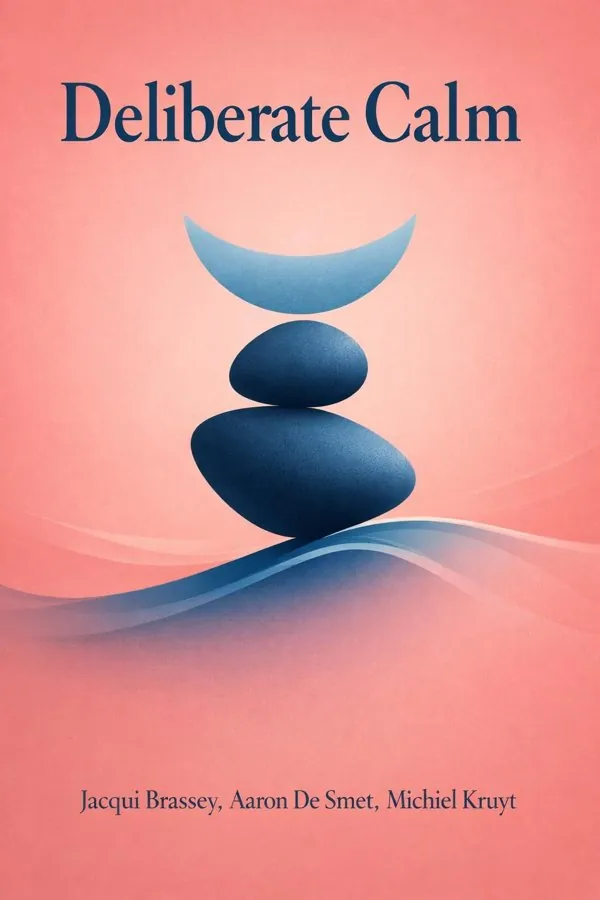
Deliberate Calm: How to Learn and Lead in a Volatile World: Summary & Key Insights
by Jacqui Brassey, Aaron De Smet, Michiel Kruyt
 10 min5 chaptersAudio available
What Is Deliberate Calm: How to Learn and Lead in a Volatile World About?
Deliberate Calm: How to Learn and Lead in a Volatile World by Jacqui Brassey, Aaron De Smet, Michiel Kruyt is a leadership book spanning 5 pages. Deliberate Calm explores how leaders can develop the ability to stay composed and effective under pressure. Drawing on neuroscience, psychology, and leadership research, the authors present a framework for learning agility and emotional regulation that helps individuals and organizations thrive amid uncertainty and change.
This FizzRead summary covers all 5 key chapters of Deliberate Calm: How to Learn and Lead in a Volatile World in approximately 10 minutes, distilling the most important ideas, arguments, and takeaways from Jacqui Brassey, Aaron De Smet, Michiel Kruyt's work. Also available as an audio summary and Key Quotes Podcast.
Deliberate Calm: How to Learn and Lead in a Volatile World
Deliberate Calm explores how leaders can develop the ability to stay composed and effective under pressure. Drawing on neuroscience, psychology, and leadership research, the authors present a framework for learning agility and emotional regulation that helps individuals and organizations thrive amid uncertainty and change.
Who Should Read Deliberate Calm: How to Learn and Lead in a Volatile World?
This book is perfect for anyone interested in leadership and looking to gain actionable insights in a short read. Whether you're a student, professional, or lifelong learner, the key ideas from Deliberate Calm: How to Learn and Lead in a Volatile World by Jacqui Brassey, Aaron De Smet, Michiel Kruyt will help you think differently.
- ✓Readers who enjoy leadership and want practical takeaways
- ✓Professionals looking to apply new ideas to their work and life
- ✓Anyone who wants the core insights of Deliberate Calm: How to Learn and Lead in a Volatile World in just 10 minutes
Want the full summary?
Get instant access to this book summary and 100K+ more with Fizz Moment.
Get Free SummaryAvailable on App Store • Free to download
Key Chapters
When we face challenge or ambiguity, our brain’s limbic system—the emotional center—activates a primal response: fight, flight, or freeze. This reflex evolved to protect us from physical threats, but in today’s cognitive world, it often misfires. A tough meeting, a strategic crisis, or a market downturn can trigger the same physiological alarm bells as a tiger in the wild. In this state, our thinking narrows, creativity diminishes, and relational trust erodes. We may appear decisive, but more often than not, our actions spring from fear or ego rather than genuine insight.
Deliberate calm begins with acknowledging this biology, not fighting it. Through our research, we found that the most effective leaders train their nervous systems, much like athletes train their muscles. They use mindfulness and reflection to build a pause between stimulus and response. Neuroscientifically, this pause allows the prefrontal cortex—responsible for reasoning, empathy, and learning—to stay online even when the amygdala is activated. This self-regulation is the foundation of calm, but also of agility to adapt when conditions shift rapidly.
I recall a senior executive who, during a major merger, found himself in daily conflict with his counterpart. Tension ran high, and every meeting risked devolving into argument. Instead of escalating, he began practicing deliberate calm — taking a few minutes each morning to center himself through breathing and visualization, reminding himself of his higher purpose. This daily ritual transformed his responses; where once he reacted defensively, he began asking deeper questions. Over time, his calm presence became contagious, helping both teams find common ground. His transformation illustrates how calm is not passivity but mastery: awareness in action.
Our biology and psychology both push us to stay within the familiar — to perform well in conditions we already understand. We call this the performance zone, where our skills are optimized for known challenges. Here, confidence is high and efficiency is prized. But when the environment changes, when the rules no longer fit, leaders need a different mode: the learning zone. In this zone, curiosity replaces certainty, and experimentation replaces control.
Through our studies, we observed that many leaders unconsciously remain in the performance zone even when the world demands learning. This mismatch erodes effectiveness. By contrast, those who develop deliberate calm are able to sense this shift — they notice the discomfort, the confusion — and instead of resisting it, they choose to step into the learning zone. Here, the ego quiets, humility surfaces, and new insights emerge.
Imagine a surgeon leading a hospital team through a sudden technology disruption. If she insists on perfection based on past methods, she stays stuck in performance mode. But if she admits what she doesn’t know and invites the team to explore solutions together, she activates collective learning. This is what we mean by the deliberate aspect of deliberate calm — a conscious decision to move into the space where growth occurs.
In practice, cultivating learning agility requires courage. It means admitting uncertainty in front of others and accepting that the path forward may be unclear. Yet leaders who model this posture signal psychological safety; they invite their people to do the same. Over time, this collective habit becomes the organization’s competitive advantage.
+ 3 more chapters — available in the FizzRead app
All Chapters in Deliberate Calm: How to Learn and Lead in a Volatile World
About the Authors
Jacqui Brassey is a director of learning at McKinsey & Company and an expert in sustainable human development. Aaron De Smet is a senior partner at McKinsey specializing in organizational design and leadership. Michiel Kruyt is CEO of IMAGINE and a former McKinsey partner focused on leadership transformation.
Get This Summary in Your Preferred Format
Read or listen to the Deliberate Calm: How to Learn and Lead in a Volatile World summary by Jacqui Brassey, Aaron De Smet, Michiel Kruyt anytime, anywhere. FizzRead offers multiple formats so you can learn on your terms — all free.
Available formats: App · Audio · PDF · EPUB — All included free with FizzRead
Download Deliberate Calm: How to Learn and Lead in a Volatile World PDF and EPUB Summary
Key Quotes from Deliberate Calm: How to Learn and Lead in a Volatile World
“When we face challenge or ambiguity, our brain’s limbic system—the emotional center—activates a primal response: fight, flight, or freeze.”
“Our biology and psychology both push us to stay within the familiar — to perform well in conditions we already understand.”
Frequently Asked Questions about Deliberate Calm: How to Learn and Lead in a Volatile World
Deliberate Calm: How to Learn and Lead in a Volatile World by Jacqui Brassey, Aaron De Smet, Michiel Kruyt is a leadership book that explores key ideas across 5 chapters. Deliberate Calm explores how leaders can develop the ability to stay composed and effective under pressure. Drawing on neuroscience, psychology, and leadership research, the authors present a framework for learning agility and emotional regulation that helps individuals and organizations thrive amid uncertainty and change.
You Might Also Like

Extreme Ownership
Jocko Willink
10 min
Dare to Lead
Brene Brown
10 min
Leaders Eat Last
Simon Sinek
10 min
The 21 Irrefutable Laws of Leadership
John Maxwell
10 min
Start With Why
Simon Sinek
10 min
How to Lead When You're Not in Charge
Clay Scroggins
10 minBrowse by Category
Ready to read Deliberate Calm: How to Learn and Lead in a Volatile World?
Get the full summary and 100K+ more books with Fizz Moment.