
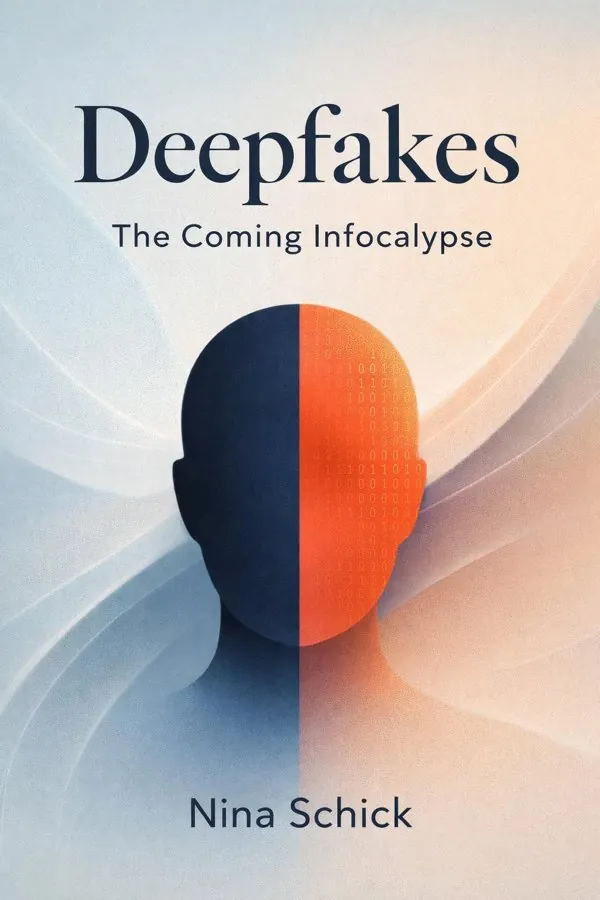
Deepfakes: The Coming Infocalypse: Summary & Key Insights
by Nina Schick
 10 min7 chaptersAudio available
What Is Deepfakes: The Coming Infocalypse About?
Deepfakes: The Coming Infocalypse by Nina Schick is a digital_culture book spanning 7 pages. Deepfakes: The Coming Infocalypse examines how artificial intelligence is transforming the creation and spread of information through synthetic media. Nina Schick explores the rise of deepfakes—realistic fake videos and images—and their potential to disrupt truth, democracy, and society. The book provides insight into how individuals, governments, and institutions can respond to this emerging threat to information integrity.
This FizzRead summary covers all 7 key chapters of Deepfakes: The Coming Infocalypse in approximately 10 minutes, distilling the most important ideas, arguments, and takeaways from Nina Schick's work. Also available as an audio summary and Key Quotes Podcast.
Deepfakes: The Coming Infocalypse
Deepfakes: The Coming Infocalypse examines how artificial intelligence is transforming the creation and spread of information through synthetic media. Nina Schick explores the rise of deepfakes—realistic fake videos and images—and their potential to disrupt truth, democracy, and society. The book provides insight into how individuals, governments, and institutions can respond to this emerging threat to information integrity.
Who Should Read Deepfakes: The Coming Infocalypse?
This book is perfect for anyone interested in digital_culture and looking to gain actionable insights in a short read. Whether you're a student, professional, or lifelong learner, the key ideas from Deepfakes: The Coming Infocalypse by Nina Schick will help you think differently.
- ✓Readers who enjoy digital_culture and want practical takeaways
- ✓Professionals looking to apply new ideas to their work and life
- ✓Anyone who wants the core insights of Deepfakes: The Coming Infocalypse in just 10 minutes
Want the full summary?
Get instant access to this book summary and 100K+ more with Fizz Moment.
Get Free SummaryAvailable on App Store • Free to download
Key Chapters
The story of deepfakes begins with artificial intelligence itself. Generative adversarial networks, or GANs, made it possible for machines to learn not only to recognize patterns but to create them. Imagine two AIs playing a cat-and-mouse game—the first generates an image, the second judges it. Over countless iterations, the generator learns to produce results so realistic that even its counterpart, trained to spot fakes, struggles to tell the difference. It was a revolution in computation. Suddenly, the ability to forge visual truth had been democratized.
For much of history, media manipulation required painstaking effort. Retouching photographs or editing films required specialists. But by 2017, when the first public deepfake software appeared on Reddit, that barrier collapsed. The same algorithms that once required enormous computing resources became accessible to anyone with a modern laptop. The immediate effect was seen in pornography, where the faces of famous women were grafted onto explicit content, violating consent in ways few could imagine. Soon, the implications spread far beyond entertainment or personal harm—it became clear that this technology could alter politics, influence elections, and sow social discord on a massive scale.
As I traveled the world advising leaders on disinformation, I saw how easily trust could crumble. A single convincing video could spread faster than any official correction. And it is not merely the falsehoods that matter—it’s the doubt. Deepfakes introduce a universal uncertainty into the information ecosystem. When anything can be faked, everything becomes suspect. That’s the essential vulnerability AI introduces: the collapse of visual verification itself.
To truly grasp why deepfakes mark such a critical turning point, we must remember that manipulation has always accompanied media. Every tool humans have used to capture reality—painting, photography, film—has also enabled deception. Propaganda and doctored photos long preceded AI. Stalin’s regime famously erased political rivals from photographs, while 20th-century advertisers perfected the art of image manipulation through analog and digital editing. But what sets deepfakes apart is scale and believability. It is not just what can be falsified, but how effortlessly and convincingly it can be done.
Deep learning changed everything. With machine vision capable of analyzing millions of data points, computers learned nuances humans never consciously perceive—the micro-expressions that define emotion, the shadows that shape authenticity. This learning gave rise to synthetic faces and voices that behaved naturally enough to deceive an experienced observer. The evolution from simple photo tampering to fully automated video fabrication marks a qualitative leap in misinformation. For the first time, visual content could be manufactured en masse, personalized, and released into social networks with zero oversight.
Reflecting on this historical arc allows us to understand why the coming infocalypse feels different. It is not merely technological progress—it is an evolution in cognitive warfare. Where once propaganda needed centralized production, now anyone can wage disinformation campaigns from anywhere. The line between amateur and state-sponsored manipulation has vanished. Visual evidence, the cornerstone of modern truth, is becoming obsolete in its traditional sense. And in that vanishing lies the reason society must urgently rethink how it defines authenticity.
+ 5 more chapters — available in the FizzRead app
All Chapters in Deepfakes: The Coming Infocalypse
About the Author
Nina Schick is a political commentator, author, and expert on technology and geopolitics. She has advised global leaders on issues related to disinformation, artificial intelligence, and emerging technologies. Schick is recognized for her work on the intersection of technology and democracy, particularly in the context of synthetic media and deepfakes.
Get This Summary in Your Preferred Format
Read or listen to the Deepfakes: The Coming Infocalypse summary by Nina Schick anytime, anywhere. FizzRead offers multiple formats so you can learn on your terms — all free.
Available formats: App · Audio · PDF · EPUB — All included free with FizzRead
Download Deepfakes: The Coming Infocalypse PDF and EPUB Summary
Key Quotes from Deepfakes: The Coming Infocalypse
“The story of deepfakes begins with artificial intelligence itself.”
“To truly grasp why deepfakes mark such a critical turning point, we must remember that manipulation has always accompanied media.”
Frequently Asked Questions about Deepfakes: The Coming Infocalypse
Deepfakes: The Coming Infocalypse by Nina Schick is a digital_culture book that explores key ideas across 7 chapters. Deepfakes: The Coming Infocalypse examines how artificial intelligence is transforming the creation and spread of information through synthetic media. Nina Schick explores the rise of deepfakes—realistic fake videos and images—and their potential to disrupt truth, democracy, and society. The book provides insight into how individuals, governments, and institutions can respond to this emerging threat to information integrity.
You Might Also Like

An Ugly Truth: Inside Facebook’s Battle for Domination
Sheera Frenkel, Cecilia Kang
10 min
Cyber Citizens
Ian Goodfellow
10 min
Digital Minimalism: Choosing a Focused Life in a Noisy World
Cal Newport
10 min
E‑Books & Beyond
Various Authors
10 min
The Future of Media
Various Authors
10 min
This Is Why We Can't Have Nice Things
Whitney Phillips
10 minBrowse by Category
Ready to read Deepfakes: The Coming Infocalypse?
Get the full summary and 100K+ more books with Fizz Moment.