
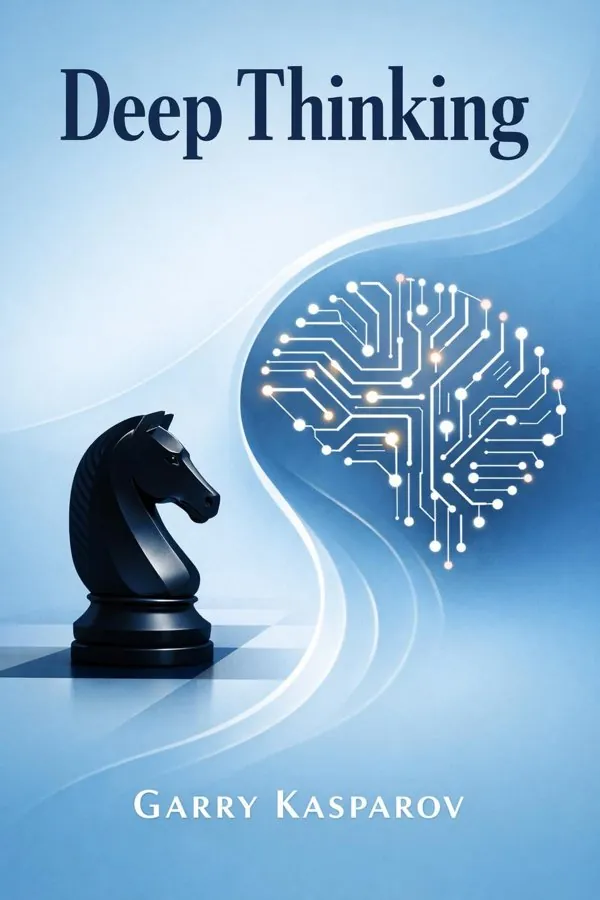
Deep Thinking: Where Machine Intelligence Ends and Human Creativity Begins: Summary & Key Insights
 10 min5 chaptersAudio available
What Is Deep Thinking: Where Machine Intelligence Ends and Human Creativity Begins About?
Deep Thinking: Where Machine Intelligence Ends and Human Creativity Begins by Garry Kasparov is a ai_ml book spanning 5 pages. In this book, Garry Kasparov, the former world chess champion, recounts his historic 1997 match against IBM's Deep Blue supercomputer and explores the broader implications of artificial intelligence. He reflects on the nature of human creativity, strategic thinking, and the evolving relationship between humans and machines, offering insights into how technology challenges and complements human intellect.
This FizzRead summary covers all 5 key chapters of Deep Thinking: Where Machine Intelligence Ends and Human Creativity Begins in approximately 10 minutes, distilling the most important ideas, arguments, and takeaways from Garry Kasparov's work. Also available as an audio summary and Key Quotes Podcast.
Deep Thinking: Where Machine Intelligence Ends and Human Creativity Begins
In this book, Garry Kasparov, the former world chess champion, recounts his historic 1997 match against IBM's Deep Blue supercomputer and explores the broader implications of artificial intelligence. He reflects on the nature of human creativity, strategic thinking, and the evolving relationship between humans and machines, offering insights into how technology challenges and complements human intellect.
Who Should Read Deep Thinking: Where Machine Intelligence Ends and Human Creativity Begins?
This book is perfect for anyone interested in ai_ml and looking to gain actionable insights in a short read. Whether you're a student, professional, or lifelong learner, the key ideas from Deep Thinking: Where Machine Intelligence Ends and Human Creativity Begins by Garry Kasparov will help you think differently.
- ✓Readers who enjoy ai_ml and want practical takeaways
- ✓Professionals looking to apply new ideas to their work and life
- ✓Anyone who wants the core insights of Deep Thinking: Where Machine Intelligence Ends and Human Creativity Begins in just 10 minutes
Want the full summary?
Get instant access to this book summary and 100K+ more with Fizz Moment.
Get Free SummaryAvailable on App Store • Free to download
Key Chapters
When computers first touched chess, they were crude and naive. In the early decades, these programs relied on brute calculation—searching through countless possible moves but without any understanding of strategy or nuance. I remember programmers excitedly claiming that one day, computers would beat grandmasters, but most chess players, myself included, dismissed such forecasts as science fiction. After all, chess is not only about calculation—it’s about intuition, pattern recognition, and the understanding of human psychology.
Yet progress arrived faster than any of us expected. Machines became more powerful; their processors faster, their algorithms more sophisticated. Early programs struggled against club players, but by the late 1980s and early 1990s, they were defeating masters and eventually competing at the highest levels. These advances weren’t only about hardware—they embodied conceptual leaps, such as pruning irrelevant branches in the search tree and weighting positions based on prior learning. In essence, computers began to ‘think’ differently.
This period was electrifying because it marked the intersection of two domains—the rational architecture of machines and the intuitive artistry of humans. Researchers and engineers were not simply coding chess algorithms; they were exploring the essence of intelligence itself. Through chess, they asked: how does one make decisions under complexity? How does one evaluate risk, foresee consequences, and balance short-term and long-term gain? These are questions at the heart of both machine learning and human cognition.
As I observed the development of computer chess throughout the 1980s and early 1990s, I realized that the field was asking much more than whether a computer could play better—it was searching for what intelligence means. And so, when IBM approached me with the possibility of competing against its supercomputer Deep Blue, I saw the match as a symbolic moment: not man versus machine, but mankind confronting its own creation.
The first match against Deep Blue in 1996 felt like entering a new dimension. I prepared as if facing an alien opponent—one immune to psychological warfare, fatigue, or fear. Computers, unlike humans, don’t doubt their choices; they execute them relentlessly. But they also lack flexibility, and that was my advantage. I sought positions rich in complexity, hoping to lure the machine into realms where calculation alone could not guide it.
My victory in that match gave me confidence. I proved that intuition—the ability to see patterns, understand long-term dynamics, and feel the pulse of the position—was still superior to mechanical brute force. The world celebrated this victory as proof of human ingenuity. Yet, behind that triumph lingered a silent awareness: technology learns quickly.
By 1997, IBM’s team had enhanced Deep Blue dramatically. It didn’t merely calculate faster; it evaluated better. Its openings were refined with expert input, its hardware upgraded to analyze hundreds of millions of positions per second. As the rematch began, I soon felt the tide turning. The machine played with a consistency and precision that unsettled even my seasoned nerves. It made no mistakes in preparation, no emotional blunders in tension.
In Game Two, an unexpected move—what I initially perceived as a human-like bluff—shook my confidence. I began questioning whether the machine was operating under hidden human guidance, a suspicion that reflected both the intensity and confusion of the moment. Those psychological pressures proved decisive. My own creativity became entangled with insecurity; my intuition clouded by doubt.
When the match ended and Deep Blue prevailed, it was not simply a defeat—it was a revelation. Humanity had crossed a threshold. A machine had bested the world chess champion, not in one isolated game but over an entire match. Yet, instead of despair, I felt a profound curiosity: What did this tell us about intelligence, and about the future of human endeavor?
+ 3 more chapters — available in the FizzRead app
All Chapters in Deep Thinking: Where Machine Intelligence Ends and Human Creativity Begins
About the Author
Garry Kasparov is a Russian chess grandmaster, former world chess champion, writer, and political activist. Known for his deep strategic insight and advocacy for human rights and democracy, Kasparov has authored several books on chess, politics, and artificial intelligence.
Get This Summary in Your Preferred Format
Read or listen to the Deep Thinking: Where Machine Intelligence Ends and Human Creativity Begins summary by Garry Kasparov anytime, anywhere. FizzRead offers multiple formats so you can learn on your terms — all free.
Available formats: App · Audio · PDF · EPUB — All included free with FizzRead
Download Deep Thinking: Where Machine Intelligence Ends and Human Creativity Begins PDF and EPUB Summary
Key Quotes from Deep Thinking: Where Machine Intelligence Ends and Human Creativity Begins
“When computers first touched chess, they were crude and naive.”
“The first match against Deep Blue in 1996 felt like entering a new dimension.”
Frequently Asked Questions about Deep Thinking: Where Machine Intelligence Ends and Human Creativity Begins
Deep Thinking: Where Machine Intelligence Ends and Human Creativity Begins by Garry Kasparov is a ai_ml book that explores key ideas across 5 chapters. In this book, Garry Kasparov, the former world chess champion, recounts his historic 1997 match against IBM's Deep Blue supercomputer and explores the broader implications of artificial intelligence. He reflects on the nature of human creativity, strategic thinking, and the evolving relationship between humans and machines, offering insights into how technology challenges and complements human intellect.
You Might Also Like
Life 3.0
Max Tegmark
10 min
Superintelligence
Nick Bostrom
10 min
TensorFlow in Action
Thushan Ganegedara
10 min
AI Made Simple: A Beginner’s Guide to Generative AI, ChatGPT, and the Future of Work
Rajeev Kapur
10 min
AI Snake Oil
Arvind Narayanan, Sayash Kapoor
10 min
AI Superpowers: China, Silicon Valley, and the New World Order
Kai-Fu Lee
10 minBrowse by Category
Ready to read Deep Thinking: Where Machine Intelligence Ends and Human Creativity Begins?
Get the full summary and 100K+ more books with Fizz Moment.