
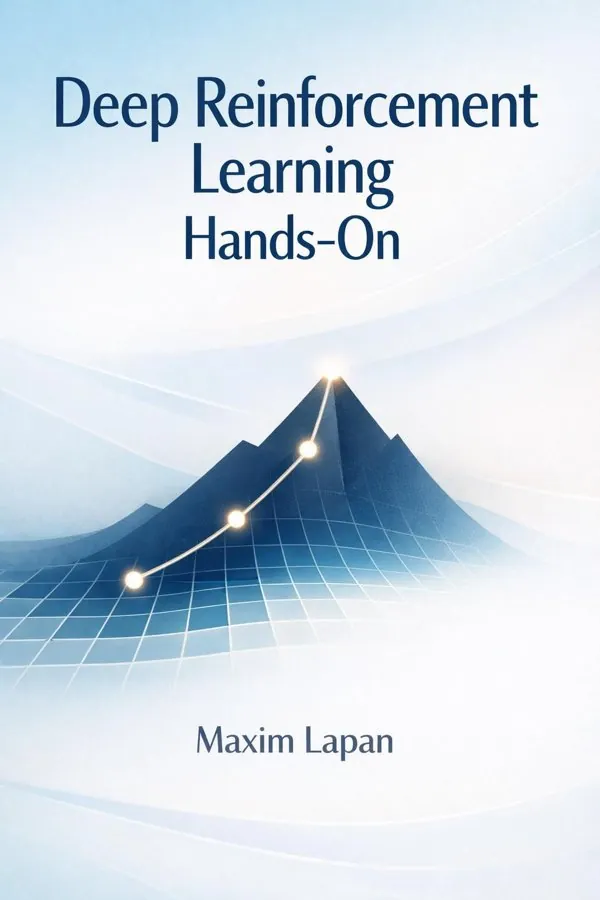
Deep Reinforcement Learning Hands‑On: Apply Modern RL Methods, with Deep Q‑Networks, Value Iteration, Policy Gradients, TRPO, AlphaGo Zero and More: Summary & Key Insights
by Maxim Lapan
 10 min6 chaptersAudio available
What Is Deep Reinforcement Learning Hands‑On: Apply Modern RL Methods, with Deep Q‑Networks, Value Iteration, Policy Gradients, TRPO, AlphaGo Zero and More About?
Deep Reinforcement Learning Hands‑On: Apply Modern RL Methods, with Deep Q‑Networks, Value Iteration, Policy Gradients, TRPO, AlphaGo Zero and More by Maxim Lapan is a ai_ml book spanning 6 pages. This book provides a practical introduction to deep reinforcement learning (RL) using Python and PyTorch. It covers key algorithms such as Deep Q‑Networks (DQN), policy gradients, actor‑critic methods, and advanced topics like Proximal Policy Optimization (PPO) and AlphaGo Zero. The author guides readers through building RL agents step by step, emphasizing hands‑on implementation and understanding of the underlying principles.
This FizzRead summary covers all 6 key chapters of Deep Reinforcement Learning Hands‑On: Apply Modern RL Methods, with Deep Q‑Networks, Value Iteration, Policy Gradients, TRPO, AlphaGo Zero and More in approximately 10 minutes, distilling the most important ideas, arguments, and takeaways from Maxim Lapan's work. Also available as an audio summary and Key Quotes Podcast.
Deep Reinforcement Learning Hands‑On: Apply Modern RL Methods, with Deep Q‑Networks, Value Iteration, Policy Gradients, TRPO, AlphaGo Zero and More
This book provides a practical introduction to deep reinforcement learning (RL) using Python and PyTorch. It covers key algorithms such as Deep Q‑Networks (DQN), policy gradients, actor‑critic methods, and advanced topics like Proximal Policy Optimization (PPO) and AlphaGo Zero. The author guides readers through building RL agents step by step, emphasizing hands‑on implementation and understanding of the underlying principles.
Who Should Read Deep Reinforcement Learning Hands‑On: Apply Modern RL Methods, with Deep Q‑Networks, Value Iteration, Policy Gradients, TRPO, AlphaGo Zero and More?
This book is perfect for anyone interested in ai_ml and looking to gain actionable insights in a short read. Whether you're a student, professional, or lifelong learner, the key ideas from Deep Reinforcement Learning Hands‑On: Apply Modern RL Methods, with Deep Q‑Networks, Value Iteration, Policy Gradients, TRPO, AlphaGo Zero and More by Maxim Lapan will help you think differently.
- ✓Readers who enjoy ai_ml and want practical takeaways
- ✓Professionals looking to apply new ideas to their work and life
- ✓Anyone who wants the core insights of Deep Reinforcement Learning Hands‑On: Apply Modern RL Methods, with Deep Q‑Networks, Value Iteration, Policy Gradients, TRPO, AlphaGo Zero and More in just 10 minutes
Want the full summary?
Get instant access to this book summary and 100K+ more with Fizz Moment.
Get Free SummaryAvailable on App Store • Free to download
Key Chapters
Reinforcement learning begins with the interaction between an agent and its environment. In the early chapters, I focus on making this setup intuitive before we touch mathematics. We start with the idea of state, action, and reward—the triad that forms the center of every RL system. The agent perceives the state, chooses an action, and receives a reward; through repeated experience, it learns to maximize future gains. You’ll see that this formulation is essentially a feedback loop, driven by the difference between what the agent expects and what actually happens.
From there, we explore the fundamental algorithms that have long defined classical RL. Tabular methods like Q-learning play a key role here, serving as our first encounter with value-based reasoning. We study how to store cumulative reward estimates in a table of state-action pairs and how incremental updates combine exploration and exploitation.
Once you implement your first Q-learning agent using Python, something profound occurs: you realize how learning depends on representation. This realization becomes the gateway to deep reinforcement learning. Tabular approaches falter when the state space grows too large—just imagine trying to encode every possible pixel combination of an image. That’s when neural networks step in, serving as powerful function approximators.
In transitioning from tables to networks, we transform the Q-function into a prediction problem solvable by deep learning. PyTorch allows us to define models that estimate value directly from sensory input, enabling agents to handle continuous or high-dimensional environments like Atari or robotic control. This shift illustrates a core message of the book: complexity is not the enemy, but the catalyst for innovation in model design.
Deep Q-Networks (DQN) mark the true beginning of deep RL practice. In this section, I guide readers through implementing DQN, carefully noting its challenges. We introduce experience replay—the technique of breaking correlation among subsequent experiences by randomly sampling mini-batches from memory—and the idea of target networks, which stabilize learning by maintaining a delayed version of the main network.
Here you understand that instability in RL comes from the agent’s feedback loop itself: as it learns, the data distribution shifts, leading to moving targets. Every step of stabilization, from replay buffers to target synchronization, is designed to tame that feedback volatility.
We also enhance DQN with variants like Double DQN and Dueling DQN. Double DQN corrects the tendency of overestimation by decoupling action selection and value evaluation, while the Dueling architecture separates state value from action advantage, boosting efficiency in environments with many redundant actions.
Throughout this process, the book insists that you think experimentally. These algorithms are not black boxes—they are responsive systems whose performance depends on your hyperparameters, training schedules, and environment settings. Practical code examples throughout the chapter reveal how subtle changes in replay buffer size or gradient clipping can decide between convergence and collapse. This emphasis on stability defines the engineering mindset behind deep RL.
+ 4 more chapters — available in the FizzRead app
All Chapters in Deep Reinforcement Learning Hands‑On: Apply Modern RL Methods, with Deep Q‑Networks, Value Iteration, Policy Gradients, TRPO, AlphaGo Zero and More
About the Author
Maxim Lapan is a software engineer and machine learning practitioner with extensive experience in reinforcement learning and deep learning. He has worked on AI systems and authored several technical books focused on practical applications of machine learning.
Get This Summary in Your Preferred Format
Read or listen to the Deep Reinforcement Learning Hands‑On: Apply Modern RL Methods, with Deep Q‑Networks, Value Iteration, Policy Gradients, TRPO, AlphaGo Zero and More summary by Maxim Lapan anytime, anywhere. FizzRead offers multiple formats so you can learn on your terms — all free.
Available formats: App · Audio · PDF · EPUB — All included free with FizzRead
Download Deep Reinforcement Learning Hands‑On: Apply Modern RL Methods, with Deep Q‑Networks, Value Iteration, Policy Gradients, TRPO, AlphaGo Zero and More PDF and EPUB Summary
Key Quotes from Deep Reinforcement Learning Hands‑On: Apply Modern RL Methods, with Deep Q‑Networks, Value Iteration, Policy Gradients, TRPO, AlphaGo Zero and More
“Reinforcement learning begins with the interaction between an agent and its environment.”
“Deep Q-Networks (DQN) mark the true beginning of deep RL practice.”
Frequently Asked Questions about Deep Reinforcement Learning Hands‑On: Apply Modern RL Methods, with Deep Q‑Networks, Value Iteration, Policy Gradients, TRPO, AlphaGo Zero and More
Deep Reinforcement Learning Hands‑On: Apply Modern RL Methods, with Deep Q‑Networks, Value Iteration, Policy Gradients, TRPO, AlphaGo Zero and More by Maxim Lapan is a ai_ml book that explores key ideas across 6 chapters. This book provides a practical introduction to deep reinforcement learning (RL) using Python and PyTorch. It covers key algorithms such as Deep Q‑Networks (DQN), policy gradients, actor‑critic methods, and advanced topics like Proximal Policy Optimization (PPO) and AlphaGo Zero. The author guides readers through building RL agents step by step, emphasizing hands‑on implementation and understanding of the underlying principles.
You Might Also Like
Life 3.0
Max Tegmark
10 min
Superintelligence
Nick Bostrom
10 min
TensorFlow in Action
Thushan Ganegedara
10 min
AI Made Simple: A Beginner’s Guide to Generative AI, ChatGPT, and the Future of Work
Rajeev Kapur
10 min
AI Snake Oil
Arvind Narayanan, Sayash Kapoor
10 min
AI Superpowers: China, Silicon Valley, and the New World Order
Kai-Fu Lee
10 minBrowse by Category
Ready to read Deep Reinforcement Learning Hands‑On: Apply Modern RL Methods, with Deep Q‑Networks, Value Iteration, Policy Gradients, TRPO, AlphaGo Zero and More?
Get the full summary and 100K+ more books with Fizz Moment.