
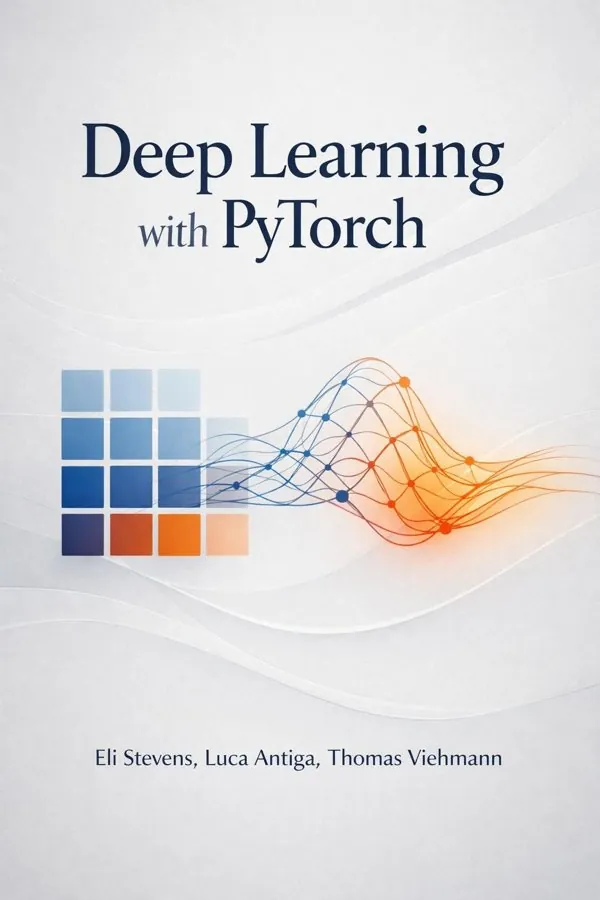
Deep Learning with PyTorch: Summary & Key Insights
by Eli Stevens, Luca Antiga, Thomas Viehmann
 10 min6 chaptersAudio available
What Is Deep Learning with PyTorch About?
Deep Learning with PyTorch by Eli Stevens, Luca Antiga, Thomas Viehmann is a ai_ml book spanning 6 pages. Deep Learning with PyTorch introduces the PyTorch framework and guides readers through building deep learning models from scratch. It covers fundamental concepts such as tensors, automatic differentiation, and neural network design, progressing to advanced topics like generative models and deployment. The book emphasizes practical implementation and understanding of deep learning principles using real-world examples.
This FizzRead summary covers all 6 key chapters of Deep Learning with PyTorch in approximately 10 minutes, distilling the most important ideas, arguments, and takeaways from Eli Stevens, Luca Antiga, Thomas Viehmann's work. Also available as an audio summary and Key Quotes Podcast.
Deep Learning with PyTorch
Deep Learning with PyTorch introduces the PyTorch framework and guides readers through building deep learning models from scratch. It covers fundamental concepts such as tensors, automatic differentiation, and neural network design, progressing to advanced topics like generative models and deployment. The book emphasizes practical implementation and understanding of deep learning principles using real-world examples.
Who Should Read Deep Learning with PyTorch?
This book is perfect for anyone interested in ai_ml and looking to gain actionable insights in a short read. Whether you're a student, professional, or lifelong learner, the key ideas from Deep Learning with PyTorch by Eli Stevens, Luca Antiga, Thomas Viehmann will help you think differently.
- ✓Readers who enjoy ai_ml and want practical takeaways
- ✓Professionals looking to apply new ideas to their work and life
- ✓Anyone who wants the core insights of Deep Learning with PyTorch in just 10 minutes
Want the full summary?
Get instant access to this book summary and 100K+ more with Fizz Moment.
Get Free SummaryAvailable on App Store • Free to download
Key Chapters
Every concept in deep learning rests upon one elemental construct: the tensor. In PyTorch, tensors are more than arrays — they are living numerical entities that can move across CPUs and GPUs, support automatic differentiation, and form the foundation for all computations. Understanding tensors is like learning the grammar of the language in which neural networks think.
We begin with creation. Tensors can arise from raw data, numpy arrays, or random initialization. What makes PyTorch shine is the intuitive consistency of its tensor API: operations feel natural and expressive, much like NumPy, but with performance ready for modern hardware. Manipulating tensors — slicing, reshaping, broadcasting — teaches you how data geometry affects computation. Through visual and interactive exploration, you begin to intuit how dimensions align in matrix multiplication or convolution.
But tensors are not mere data containers; they're vehicles for gradients. Every operation in PyTorch can be recorded as a node in a dynamic computation graph. This design makes PyTorch both flexible and transparent. You can experiment freely — change the network structure, feed in different shapes, or debug by inspecting intermediate outputs. The immediacy of eager execution, where each operation runs as soon as written, transforms abstract theory into tangible understanding. That is why working with tensors is not only the technical starting point — it’s the conceptual gateway.
Learning in neural networks depends on a simple but profound idea: optimization through gradient descent. PyTorch’s autograd system turns this mathematical abstraction into an effortless computational process. When you perform operations on tensors with `requires_grad=True`, PyTorch automatically builds a dynamic computation graph that records what happens. When it’s time to update parameters, the backward pass traverses this graph and computes derivatives with respect to each parameter.
This automation allows you to focus on higher-level design. You define what your model should do, and autograd determines how learning happens. The system’s automatic differentiation is not a black box — you can inspect gradients, detach computations, or freeze parts of the model. Understanding autograd deepens your appreciation of how information flows backward through a network, revealing why certain architectures learn effectively while others stall.
From a practitioner’s view, autograd embodies trust and experimentation. You trust PyTorch to handle the calculus, while you explore creative architectures and loss functions. You learn to debug by checking gradient magnitudes, to regularize by controlling their flow, and to stabilize training through normalization and initialization. Gradually, you move from wielding gradients as tools to conversing with them as signals that narrate your model’s inner story.
+ 4 more chapters — available in the FizzRead app
All Chapters in Deep Learning with PyTorch
About the Authors
Eli Stevens is a software engineer with extensive experience in machine learning and deep learning. Luca Antiga is the CTO of Orobix and a core developer of PyTorch. Thomas Viehmann is a machine learning researcher and PyTorch contributor.
Get This Summary in Your Preferred Format
Read or listen to the Deep Learning with PyTorch summary by Eli Stevens, Luca Antiga, Thomas Viehmann anytime, anywhere. FizzRead offers multiple formats so you can learn on your terms — all free.
Available formats: App · Audio · PDF · EPUB — All included free with FizzRead
Download Deep Learning with PyTorch PDF and EPUB Summary
Key Quotes from Deep Learning with PyTorch
“Every concept in deep learning rests upon one elemental construct: the tensor.”
“Learning in neural networks depends on a simple but profound idea: optimization through gradient descent.”
Frequently Asked Questions about Deep Learning with PyTorch
Deep Learning with PyTorch by Eli Stevens, Luca Antiga, Thomas Viehmann is a ai_ml book that explores key ideas across 6 chapters. Deep Learning with PyTorch introduces the PyTorch framework and guides readers through building deep learning models from scratch. It covers fundamental concepts such as tensors, automatic differentiation, and neural network design, progressing to advanced topics like generative models and deployment. The book emphasizes practical implementation and understanding of deep learning principles using real-world examples.
You Might Also Like
Life 3.0
Max Tegmark
10 min
Superintelligence
Nick Bostrom
10 min
TensorFlow in Action
Thushan Ganegedara
10 min
AI Made Simple: A Beginner’s Guide to Generative AI, ChatGPT, and the Future of Work
Rajeev Kapur
10 min
AI Snake Oil
Arvind Narayanan, Sayash Kapoor
10 min
AI Superpowers: China, Silicon Valley, and the New World Order
Kai-Fu Lee
10 minBrowse by Category
Ready to read Deep Learning with PyTorch?
Get the full summary and 100K+ more books with Fizz Moment.