
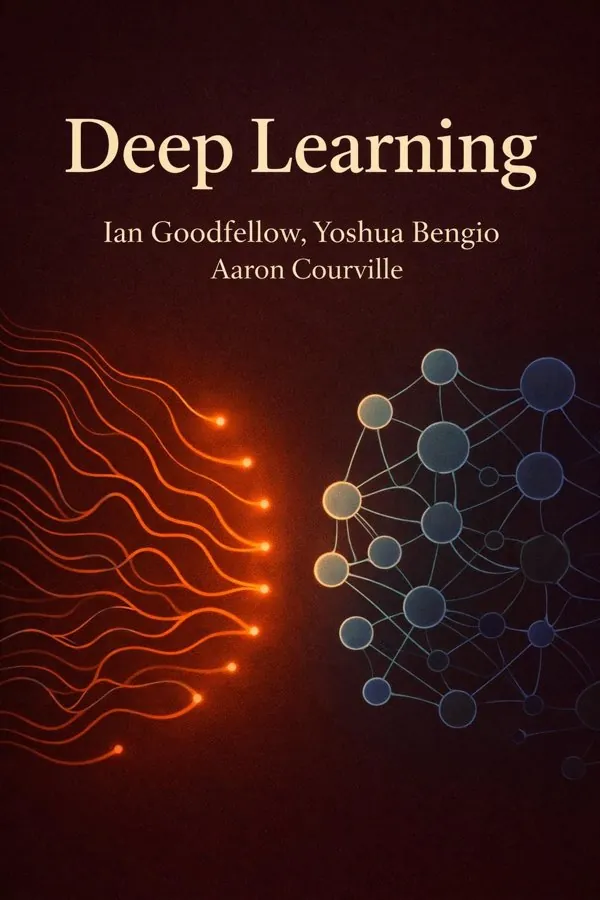
Deep Learning: Summary & Key Insights
by Ian Goodfellow, Yoshua Bengio, Aaron Courville
 10 min7 chaptersAudio available
What Is Deep Learning About?
Deep Learning by Ian Goodfellow, Yoshua Bengio, Aaron Courville is a ai_ml book spanning 7 pages. Deep Learning is a comprehensive textbook that introduces the foundations and techniques of deep learning, a subfield of machine learning focused on algorithms inspired by the structure and function of the brain. It covers topics such as linear algebra, probability, numerical computation, and machine learning basics, before delving into deep feedforward networks, regularization, optimization, convolutional networks, sequence modeling, and practical methodologies. The book also explores deep generative models and the theoretical underpinnings of deep learning systems.
This FizzRead summary covers all 7 key chapters of Deep Learning in approximately 10 minutes, distilling the most important ideas, arguments, and takeaways from Ian Goodfellow, Yoshua Bengio, Aaron Courville's work. Also available as an audio summary and Key Quotes Podcast.
Deep Learning
Deep Learning is a comprehensive textbook that introduces the foundations and techniques of deep learning, a subfield of machine learning focused on algorithms inspired by the structure and function of the brain. It covers topics such as linear algebra, probability, numerical computation, and machine learning basics, before delving into deep feedforward networks, regularization, optimization, convolutional networks, sequence modeling, and practical methodologies. The book also explores deep generative models and the theoretical underpinnings of deep learning systems.
Who Should Read Deep Learning?
This book is perfect for anyone interested in ai_ml and looking to gain actionable insights in a short read. Whether you're a student, professional, or lifelong learner, the key ideas from Deep Learning by Ian Goodfellow, Yoshua Bengio, Aaron Courville will help you think differently.
- ✓Readers who enjoy ai_ml and want practical takeaways
- ✓Professionals looking to apply new ideas to their work and life
- ✓Anyone who wants the core insights of Deep Learning in just 10 minutes
Want the full summary?
Get instant access to this book summary and 100K+ more with Fizz Moment.
Get Free SummaryAvailable on App Store • Free to download
Key Chapters
If deep learning is a universal function approximator, mathematics is the grammar that articulates its logic. We start with linear algebra because everything in modern learning—data, parameters, and transformations—exists as tensors. Understanding vectors and matrices is more than symbolic manipulation; it is recognizing that dataset dimensions correspond to geometric manifolds where learning unfolds. When we describe weights as matrices and activations as vectors, we are formalizing the process by which learning adjusts geometric transformations.
Probability theory enters as our bridge to uncertainty. Deep learning models operate in an inherently probabilistic world, where data is noisy and incomplete. We use probability not as decoration but as a means of reasoning—how likely is this pattern, given what we’ve already learned? This leads naturally to Bayesian thinking, where we treat model parameters as random variables and update beliefs based on observed data.
Numerical computation then grounds these abstractions in practice. Floating-point precision, matrix inversion, and stability of optimization are not implementation quirks but essential enablers of reliable inference. Without an appreciation for numerical limits—overflow, underflow, conditioning—we risk losing the meaning of the functions we try so hard to fit.
These three pillars—algebraic representation, probabilistic reasoning, and computational discipline—underlie every neural network. They are the invisible scaffolding making learning possible.
Machine learning can be understood as building algorithms that improve with experience. We frame this experience mathematically: given examples (x, y), we learn a function f(x) that predicts y with minimal error. In supervised learning, that mapping is explicit. In unsupervised learning, we seek structure in x alone—clusters, latent factors, or manifolds that reveal how data is organized. Reinforcement learning adds a time dimension, rewarding sequences of actions that accumulate long-term success.
These paradigms interrelate deeply. Supervised learning often depends on unsupervised pretraining; reinforcement learning incorporates deep approximators of Q-values. Behind them all lies the quest for representation—how do we encode observations in such a way that small changes in the input correspond to meaningful changes in the world? Much of deep learning’s power arises from shifting this representational burden from human engineers to the optimization machinery itself.
+ 5 more chapters — available in the FizzRead app
All Chapters in Deep Learning
About the Authors
Ian Goodfellow is a computer scientist known for inventing generative adversarial networks (GANs). Yoshua Bengio is a professor at the University of Montreal and a pioneer in deep learning research. Aaron Courville is also a professor at the University of Montreal, focusing on machine learning and artificial intelligence.
Get This Summary in Your Preferred Format
Read or listen to the Deep Learning summary by Ian Goodfellow, Yoshua Bengio, Aaron Courville anytime, anywhere. FizzRead offers multiple formats so you can learn on your terms — all free.
Available formats: App · Audio · PDF · EPUB — All included free with FizzRead
Download Deep Learning PDF and EPUB Summary
Key Quotes from Deep Learning
“If deep learning is a universal function approximator, mathematics is the grammar that articulates its logic.”
“Machine learning can be understood as building algorithms that improve with experience.”
Frequently Asked Questions about Deep Learning
Deep Learning by Ian Goodfellow, Yoshua Bengio, Aaron Courville is a ai_ml book that explores key ideas across 7 chapters. Deep Learning is a comprehensive textbook that introduces the foundations and techniques of deep learning, a subfield of machine learning focused on algorithms inspired by the structure and function of the brain. It covers topics such as linear algebra, probability, numerical computation, and machine learning basics, before delving into deep feedforward networks, regularization, optimization, convolutional networks, sequence modeling, and practical methodologies. The book also explores deep generative models and the theoretical underpinnings of deep learning systems.
You Might Also Like
Life 3.0
Max Tegmark
10 min
Superintelligence
Nick Bostrom
10 min
TensorFlow in Action
Thushan Ganegedara
10 min
AI Made Simple: A Beginner’s Guide to Generative AI, ChatGPT, and the Future of Work
Rajeev Kapur
10 min
AI Snake Oil
Arvind Narayanan, Sayash Kapoor
10 min
AI Superpowers: China, Silicon Valley, and the New World Order
Kai-Fu Lee
10 minBrowse by Category
Ready to read Deep Learning?
Get the full summary and 100K+ more books with Fizz Moment.