
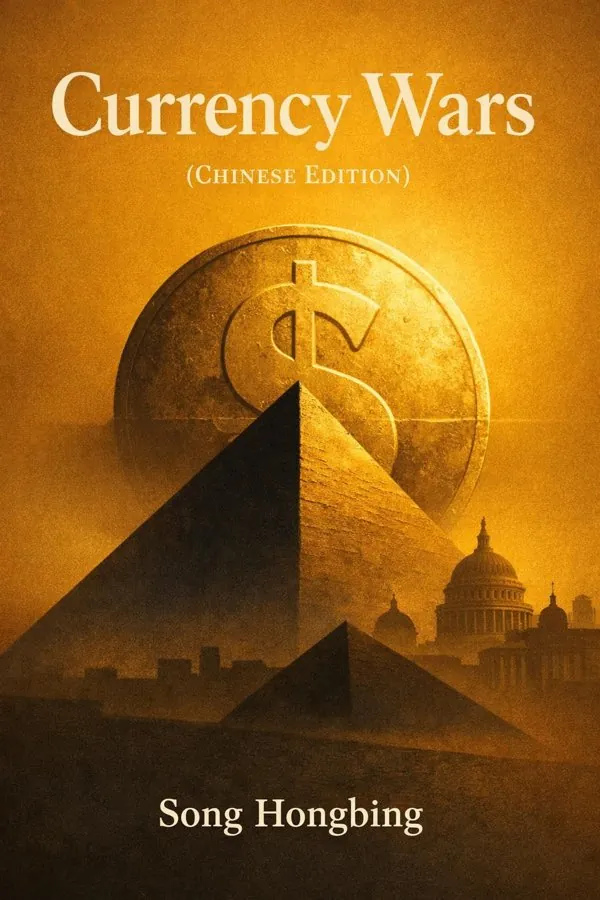
Currency Wars (Chinese Edition): Summary & Key Insights
 10 min5 chaptersAudio available
What Is Currency Wars (Chinese Edition) About?
Currency Wars (Chinese Edition) by Song Hongbing is a economics book spanning 5 pages. Currency Wars is a Chinese economic book by Song Hongbing, first published in 2007 by CITIC Press. It explores the history and mechanisms of the international financial system, focusing on the influence of major financial powers such as the Federal Reserve and the Rothschild family. Through historical events and financial case studies, the author presents his views on monetary sovereignty and national security, aiming to raise awareness of global financial power structures.
This FizzRead summary covers all 5 key chapters of Currency Wars (Chinese Edition) in approximately 10 minutes, distilling the most important ideas, arguments, and takeaways from Song Hongbing's work. Also available as an audio summary and Key Quotes Podcast.
Currency Wars (Chinese Edition)
Currency Wars is a Chinese economic book by Song Hongbing, first published in 2007 by CITIC Press. It explores the history and mechanisms of the international financial system, focusing on the influence of major financial powers such as the Federal Reserve and the Rothschild family. Through historical events and financial case studies, the author presents his views on monetary sovereignty and national security, aiming to raise awareness of global financial power structures.
Who Should Read Currency Wars (Chinese Edition)?
This book is perfect for anyone interested in economics and looking to gain actionable insights in a short read. Whether you're a student, professional, or lifelong learner, the key ideas from Currency Wars (Chinese Edition) by Song Hongbing will help you think differently.
- ✓Readers who enjoy economics and want practical takeaways
- ✓Professionals looking to apply new ideas to their work and life
- ✓Anyone who wants the core insights of Currency Wars (Chinese Edition) in just 10 minutes
Want the full summary?
Get instant access to this book summary and 100K+ more with Fizz Moment.
Get Free SummaryAvailable on App Store • Free to download
Key Chapters
To understand today’s monetary struggle, we must first step back to the origins of central banking. The history of money is a history of control. Early European banking systems arose not from state initiatives but from private ventures spearheaded by merchants and financiers. Over centuries, these institutions proved that whoever controlled issuance of currency could shape the destiny of kings and governments. The Bank of England, established in 1694, became the prototype: a private entity lending to the state, effectively placing public finance under private governance.
This relationship between governments and banks reappears throughout history. During wars and economic expansion, rulers required funds beyond their means. By granting bankers the right to issue money backed by government debt, they created systems that seemingly solved liquidity limitations while quietly transferring long-term power. The banker became indispensable, and the government became increasingly dependent on the mechanisms of credit and interest.
With modern central banking came a profound shift: money ceased to be a symbol of tangible value—such as gold or silver—and became a promise built on confidence. When that confidence is managed by a private elite, the security of nations rests on fragile foundations. Historically, this transition allowed expansion of trade and industry, but it also introduced the possibility of manipulation on an unprecedented scale. The creation of paper money, bonds, and derivative instruments linked national economies into global webs in which crises could ripple from one market to another.
In Europe, this model spread rapidly as states recognized the efficiency of centralized monetary management. Yet efficiency came at the cost of independence. Every major geopolitical conflict—from the Napoleonic wars to the First World War—was financed through debt structures created by these banking systems. Behind military strategies lay the quiet arithmetic of interest and inflation. Thus began what I call the First Currency Wars: the competition for monetary dominance among European powers, where victory was measured not only by land conquered but by currencies secured.
To trace this development is to see that modern economics, for all its sophistication, rests on a form of inherited debt. The central bank, though appearing as a public institution, often operates according to private logic: risk mitigation for creditors and preservation of their control over the flow of money. This structural feature is fundamental to understanding every financial crisis that followed.
No examination of monetary influence can ignore the role of the Rothschild family, whose ascent in European banking set the template for financial dynasties that followed. Starting from modest beginnings in Frankfurt, Mayer Amschel Rothschild laid the cornerstone for a family network that spanned the major capitals of Europe—London, Paris, Vienna, Naples. Rather than merely trading currencies, they mastered information and timing, becoming indispensable intermediaries for monarchs and financing wars that reshaped the continent.
What distinguished the Rothschilds was not just wealth but coordination. At a time when news traveled slowly, they built avenues of communication that outpaced governments themselves. During battles, they were often first to know who had won, adjusting their investments before official reports reached markets. This informational edge allowed them to influence not only public perception but state policy. By leveraging bonds and gold shipments, they could support or weaken governments at will.
The Rothschild approach encapsulated a deeper truth: control of finance translates into political leverage. Through their handling of debt issuance, they insulated themselves from the risks that afflicted ordinary investors. Governments entrusted them with arranging loans, and in return, accepted terms that entrenched the family’s position. The structure of European banking thus evolved into a network of privately controlled nodes whose decisions bore continental consequences.
But we must understand this influence not as conspiracy, but as design. The Rothschilds functioned within a world where money itself conveyed power. Their mastery of transnational operations demonstrated that the boundaries of states were porous when it came to capital. This set the stage for later institutions, including the central banks and international funds that continue to shape global dynamics.
Through this lens, we begin to perceive how financial elites came to define policy indirectly. Their interests lay not in transient profits but in structural permanence—the assurance that the system of debt-backed money would endure. Once banking families and their successors acquired this control, currency itself became the instrument of governance. Thus the economic rivalry between nations evolved into a subtler struggle: those who issue money shaping the destiny of those who merely use it.
+ 3 more chapters — available in the FizzRead app
All Chapters in Currency Wars (Chinese Edition)
About the Author
Song Hongbing is a Chinese author and financial researcher. A graduate of Beijing Normal University, he has worked in finance and information technology. Since the publication of Currency Wars in 2007, he has become known for his studies on international finance and monetary policy, later publishing sequels including Currency Wars 2 and Currency Wars 3.
Get This Summary in Your Preferred Format
Read or listen to the Currency Wars (Chinese Edition) summary by Song Hongbing anytime, anywhere. FizzRead offers multiple formats so you can learn on your terms — all free.
Available formats: App · Audio · PDF · EPUB — All included free with FizzRead
Download Currency Wars (Chinese Edition) PDF and EPUB Summary
Key Quotes from Currency Wars (Chinese Edition)
“To understand today’s monetary struggle, we must first step back to the origins of central banking.”
“No examination of monetary influence can ignore the role of the Rothschild family, whose ascent in European banking set the template for financial dynasties that followed.”
Frequently Asked Questions about Currency Wars (Chinese Edition)
Currency Wars (Chinese Edition) by Song Hongbing is a economics book that explores key ideas across 5 chapters. Currency Wars is a Chinese economic book by Song Hongbing, first published in 2007 by CITIC Press. It explores the history and mechanisms of the international financial system, focusing on the influence of major financial powers such as the Federal Reserve and the Rothschild family. Through historical events and financial case studies, the author presents his views on monetary sovereignty and national security, aiming to raise awareness of global financial power structures.
You Might Also Like

Business Adventures
John Brooks
10 min
Nudge
Richard H. Thaler, Cass R. Sunstein
10 min
The Hitchhiker"s Guide to the Galaxy
Douglas Adams
10 minThe Muqaddimah
Ibn Khaldun
10 minThe Outsiders
William N. Thorndike
10 min
A Little History of Economics
Niall Kishtainy
10 minBrowse by Category
Ready to read Currency Wars (Chinese Edition)?
Get the full summary and 100K+ more books with Fizz Moment.