
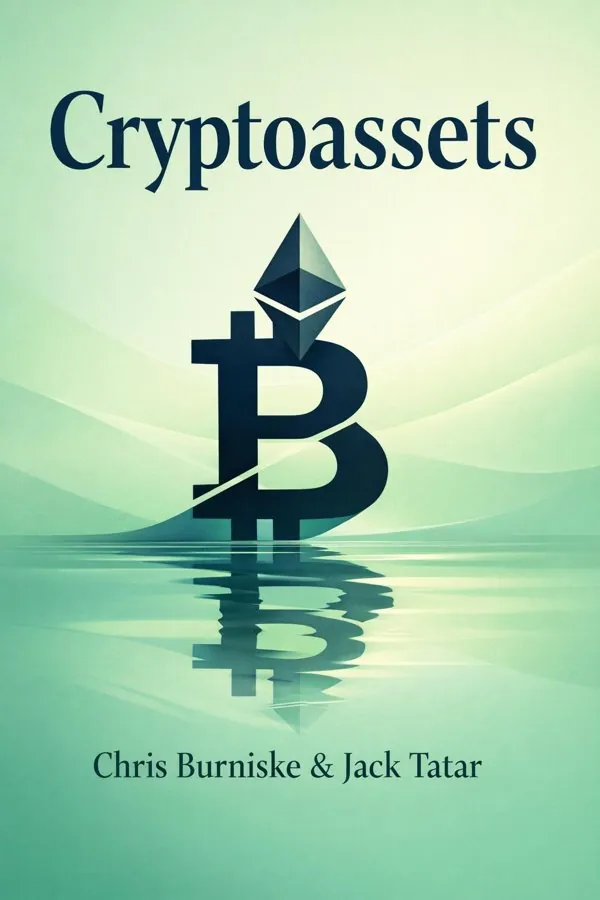
Cryptoassets: The Innovative Investor’s Guide to Bitcoin and Beyond: Summary & Key Insights
 10 min10 chaptersAudio available
Key Takeaways from Cryptoassets: The Innovative Investor’s Guide to Bitcoin and Beyond
The most important shift in the book is this: cryptoassets should not be viewed merely as quirky internet money, but as a new asset class with unique economic properties.
Money has never been static, and Bitcoin makes more sense when you see it as the latest chapter in a long evolution rather than a sudden anomaly.
Trust is one of the hidden costs of modern finance, and blockchain technology is an attempt to redesign how trust is created.
One of the most expensive mistakes in crypto investing is assuming all digital assets are interchangeable.
A cryptoasset becomes valuable when a network becomes useful, and usefulness grows when more participants join and rely on it.
What Is Cryptoassets: The Innovative Investor’s Guide to Bitcoin and Beyond About?
Cryptoassets: The Innovative Investor’s Guide to Bitcoin and Beyond by Chris Burniske & Jack Tatar is a finance book spanning 10 pages. Cryptoassets: The Innovative Investor’s Guide to Bitcoin and Beyond is one of the earliest and most practical frameworks for understanding digital assets as a legitimate investment category rather than a passing tech trend. Chris Burniske and Jack Tatar explain how Bitcoin, Ethereum, and other blockchain-based assets differ from stocks, bonds, commodities, and fiat currencies, while also showing how investors can analyze them with discipline instead of hype. The book matters because crypto often attracts extreme reactions: blind enthusiasm on one side and outright dismissal on the other. Burniske and Tatar offer a middle path grounded in financial reasoning, historical context, and risk awareness. They explore how blockchains create digital scarcity, how tokens derive value from network usage, and how investors can think about valuation, diversification, custody, and regulation. Burniske brings deep institutional knowledge from crypto research and investing, while Tatar contributes a strong background in personal finance and portfolio strategy. Together, they make a complex subject accessible to newcomers and useful to serious investors seeking a clear lens on an emerging asset class.
This FizzRead summary covers all 10 key chapters of Cryptoassets: The Innovative Investor’s Guide to Bitcoin and Beyond in approximately 10 minutes, distilling the most important ideas, arguments, and takeaways from Chris Burniske & Jack Tatar's work. Also available as an audio summary and Key Quotes Podcast.
Cryptoassets: The Innovative Investor’s Guide to Bitcoin and Beyond
Cryptoassets: The Innovative Investor’s Guide to Bitcoin and Beyond is one of the earliest and most practical frameworks for understanding digital assets as a legitimate investment category rather than a passing tech trend. Chris Burniske and Jack Tatar explain how Bitcoin, Ethereum, and other blockchain-based assets differ from stocks, bonds, commodities, and fiat currencies, while also showing how investors can analyze them with discipline instead of hype. The book matters because crypto often attracts extreme reactions: blind enthusiasm on one side and outright dismissal on the other. Burniske and Tatar offer a middle path grounded in financial reasoning, historical context, and risk awareness. They explore how blockchains create digital scarcity, how tokens derive value from network usage, and how investors can think about valuation, diversification, custody, and regulation. Burniske brings deep institutional knowledge from crypto research and investing, while Tatar contributes a strong background in personal finance and portfolio strategy. Together, they make a complex subject accessible to newcomers and useful to serious investors seeking a clear lens on an emerging asset class.
Who Should Read Cryptoassets: The Innovative Investor’s Guide to Bitcoin and Beyond?
This book is perfect for anyone interested in finance and looking to gain actionable insights in a short read. Whether you're a student, professional, or lifelong learner, the key ideas from Cryptoassets: The Innovative Investor’s Guide to Bitcoin and Beyond by Chris Burniske & Jack Tatar will help you think differently.
- ✓Readers who enjoy finance and want practical takeaways
- ✓Professionals looking to apply new ideas to their work and life
- ✓Anyone who wants the core insights of Cryptoassets: The Innovative Investor’s Guide to Bitcoin and Beyond in just 10 minutes
Want the full summary?
Get instant access to this book summary and 100K+ more with Fizz Moment.
Get Free SummaryAvailable on App Store • Free to download
Key Chapters
The most important shift in the book is this: cryptoassets should not be viewed merely as quirky internet money, but as a new asset class with unique economic properties. Traditional financial assets usually represent claims on something else. A stock represents ownership in a company, a bond represents a loan, and fiat currency is backed by government authority. Cryptoassets are different because many of them are native to decentralized networks. Their value comes not from a central issuer, but from the utility, security, scarcity, and adoption of the network itself.
This distinction matters because investors often misprice what they do not understand. If you treat Bitcoin like a stock, you will look for earnings and a management team. If you treat Ethereum like a commodity alone, you may miss its role as programmable infrastructure. Burniske and Tatar argue that cryptoassets combine characteristics of currencies, commodities, and technology platforms, which means they need their own mental models.
A practical example is Bitcoin. It does not generate cash flow in the conventional sense, yet investors still assign value to it because it offers censorship resistance, scarcity, portability, and a global settlement layer. Ethereum, meanwhile, may be better understood through the activity happening on its network: smart contracts, decentralized applications, and token issuance.
The investor takeaway is simple: stop forcing cryptoassets into old categories. Begin by asking what function a digital asset serves inside its network, what problem it solves, and why users would continue to rely on it over time.
Money has never been static, and Bitcoin makes more sense when you see it as the latest chapter in a long evolution rather than a sudden anomaly. Across history, societies have moved from barter to shells, metals, paper notes, bank deposits, and digital balances. Each shift improved portability, divisibility, durability, or trust. The book places Bitcoin within that historical arc, arguing that the search for better money did not stop with credit cards or online banking.
Bitcoin emerged after the global financial crisis, at a moment when trust in banks and governments had weakened. Its design responded to two long-standing monetary problems: how to create scarcity in a digital world and how to transfer value without relying on a central intermediary. Through blockchain technology and proof-of-work consensus, Bitcoin introduced a system where rules are enforced by code and distributed participants rather than a single institution.
This historical perspective helps investors avoid shallow judgments. Bitcoin is not trying to be a prettier version of PayPal. It is an attempt to create a form of money with predictable supply, global accessibility, and resistance to censorship. In countries with unstable currencies or capital controls, this is more than theory. People may use Bitcoin not for speculation but for savings, remittances, or cross-border value transfer.
The practical takeaway is to analyze Bitcoin as a monetary technology. Ask whether its properties improve on existing money for specific use cases, and assess adoption through that lens instead of dismissing it because it looks unfamiliar.
Trust is one of the hidden costs of modern finance, and blockchain technology is an attempt to redesign how trust is created. In the traditional system, banks, payment processors, clearinghouses, and governments act as central authorities that verify records and settle transactions. These intermediaries provide confidence, but they also introduce fees, delays, single points of failure, and political control. Burniske and Tatar explain blockchain as a shared, tamper-resistant ledger that allows a network of participants to agree on transaction history without requiring one central administrator.
The key innovation is not simply storing data in blocks. It is combining cryptography, incentives, and consensus mechanisms so that rewriting history becomes prohibitively difficult. In Bitcoin, miners secure the network by expending computational effort. In other systems, alternative mechanisms may be used, but the core goal remains the same: maintain a trusted record in an untrusted environment.
This architecture has implications far beyond payments. A blockchain can coordinate digital property rights, track the ownership of tokens, support decentralized applications, and create programmable agreements. For investors, this means a cryptoasset is often inseparable from the health of the underlying network. A token tied to a weak or insecure chain may lose value quickly, while one attached to a widely used and resilient protocol may gain durability.
The actionable takeaway is to study the trust model behind any cryptoasset. Before investing, ask who validates transactions, how the network is secured, how decentralized it really is, and what would need to happen for confidence in the ledger to break down.
One of the most expensive mistakes in crypto investing is assuming all digital assets are interchangeable. Burniske and Tatar emphasize classification because value depends on function. Some cryptoassets are primarily currencies, intended to store and transfer value. Others behave more like commodities, powering computation, storage, or bandwidth on decentralized networks. Still others are tokens tied to specific applications, rights, or access within an ecosystem.
This framework matters because an investor needs the right yardstick for the right asset. Bitcoin may be judged partly on monetary adoption, scarcity, and security. Ether may be judged on network activity, developer engagement, transaction demand, and the role of the token in paying for computation. A utility token linked to a decentralized service might depend on whether users actually need that token to access the service and whether demand grows with platform usage.
Consider two hypothetical investments. One token is marketed as a currency but has low liquidity, unclear governance, and no real user base. Another powers a network where developers are building applications and paying fees in the native token. Even if both trade actively, their value drivers are completely different. Without classification, investors end up comparing unrelated metrics and making poor decisions.
The practical takeaway is to begin every analysis with a basic question: what is this asset for? Classify the token before valuing it. If you cannot clearly explain its purpose, users, and economic role in the network, you are not ready to invest.
A cryptoasset becomes valuable when a network becomes useful, and usefulness grows when more participants join and rely on it. This is why Burniske and Tatar place so much emphasis on network effects. Traditional investments often center on cash flows, assets, or earnings. Cryptoassets frequently derive value from usage, liquidity, security, and the strength of the ecosystem around them. In simple terms, if a network solves a meaningful problem and attracts users, developers, capital, and infrastructure, its native asset may appreciate as the network becomes more important.
This helps explain why early-stage valuation in crypto can feel unfamiliar. Many networks begin before they have mature revenues or clear business models. Instead, investors may examine wallet growth, transaction volume, developer activity, daily active users, fee generation, or the amount of value secured by the protocol. The logic is similar to evaluating a communication network: a network with few users has limited value, but one with broad participation becomes far more useful to everyone on it.
A practical example is Ethereum. Its value is not based only on scarcity, but on the demand generated by decentralized applications, token issuance, decentralized finance, and other on-chain activity. If those use cases expand, demand for the underlying asset can rise as well.
The actionable takeaway is to focus less on price chatter and more on real adoption signals. Track whether the network is gaining users, developers, transactions, and meaningful utility, because long-term value follows genuine usage more reliably than market excitement.
Speculation may dominate headlines, but disciplined analysis remains one of the book’s strongest themes. Burniske and Tatar argue that crypto investing should not be reduced to momentum chasing or social media narratives. Even in a fast-moving market, investors can perform a form of fundamental analysis by studying the technology, token economics, governance, competitive landscape, and user behavior of a given asset.
This means asking a set of grounded questions. What problem does the project solve? Why is a blockchain necessary? Who are the developers and how active are they? Is the token actually needed, or is it artificially inserted into the model? How is supply created and distributed? Are incentives aligned between users, validators, developers, and investors? Is there evidence of real engagement, or only promotional noise?
For example, two projects may promise decentralized storage. One has open-source code, clear demand, active developers, growing usage, and transparent token economics. The other has vague marketing, concentrated insider ownership, and little real product adoption. Price alone may not reveal the difference, but fundamental analysis will.
The authors encourage investors to think like venture analysts, technologists, and risk managers at once. Cryptoassets are part financial instrument, part software network, and part social system. Understanding them requires broader diligence than a simple chart review.
The practical takeaway is to build an analysis checklist and use it consistently. Before buying any cryptoasset, review the team, token design, user adoption, governance, competition, and security assumptions so your conviction rests on evidence rather than excitement.
Because cryptoassets sit outside traditional categories, valuing them requires creativity as well as caution. Burniske and Tatar explore metrics such as network value relative to transaction activity and other usage-based indicators as early tools for estimating whether an asset may be overheated or undervalued. These frameworks are imperfect, but they are useful because they push investors to connect price with underlying activity instead of relying purely on story-driven speculation.
The broader lesson is that valuation in crypto is probabilistic. Investors are dealing with young networks, shifting protocols, uncertain regulation, and rapidly changing narratives. A metric can illuminate part of the picture, but no single ratio can capture the full economic reality of an emerging protocol. This is especially true when an asset serves multiple functions at once, such as acting as a store of value, a productive network commodity, and collateral within decentralized applications.
A practical application is comparing an asset’s market value with the amount of economic activity taking place on its network. If usage is rising steadily while valuation remains relatively modest, the network may deserve closer study. If valuation is soaring while activity stagnates, caution is warranted. But investors must also account for context, such as changes in token supply, upgrades, or the long-term potential of a platform.
The actionable takeaway is to use valuation metrics as guides, not gospel. Combine quantitative indicators with qualitative judgment, and always leave room for uncertainty when investing in systems that are still evolving.
In a market as volatile as crypto, survival often matters more than brilliance. Burniske and Tatar repeatedly stress portfolio management because even strong convictions can be undone by poor sizing, concentration, or emotional decision-making. Cryptoassets can deliver exceptional returns, but they can also suffer brutal drawdowns. The investor who treats them as a serious portfolio component rather than a casino bet is far more likely to stay in the game long enough to benefit.
This starts with position sizing. Because of high volatility, crypto may deserve only a limited allocation within a broader portfolio, especially for conservative investors. Diversification also matters, but not in a lazy way. Owning ten highly correlated speculative tokens is not true diversification. A more thoughtful approach might include different categories of exposure, such as a monetary asset, a smart-contract platform, and selectively chosen application-layer bets.
Rebalancing is another practical tool. If one position grows dramatically, trimming it back to target weight can reduce concentration risk and force disciplined profit-taking. Conversely, regularly adding small amounts through dollar-cost averaging may help investors avoid buying only during euphoric peaks.
The psychological dimension is just as important. Investors must prepare for volatility before it arrives. If a 50 percent drop would force a panic sale, the position was likely too large to begin with.
The actionable takeaway is to create written portfolio rules: target allocation, position limits, rebalancing criteria, and risk tolerance. Good process will protect you better than trying to predict every market cycle.
Many investors focus on finding the next winning token while underestimating a simpler truth: if you cannot store an asset safely or navigate its legal context, your thesis may never matter. Burniske and Tatar devote attention to custody, operational risk, and regulation because these practical details are central to successful crypto investing. Unlike traditional brokerage accounts, crypto ownership often places greater responsibility on the investor. Losing private keys, trusting an insecure exchange, or misunderstanding tax and legal obligations can destroy value regardless of market direction.
Custody choices involve trade-offs between convenience and control. Keeping assets on an exchange may be easier, but it exposes the investor to counterparty risk. Self-custody provides greater sovereignty, yet it requires careful handling of private keys, backup procedures, and device security. Institutional investors may prefer professional custodians, while individuals may choose hardware wallets for long-term holdings.
Regulation also influences market structure, liquidity, and legitimacy. Rules around securities classification, taxation, anti-money-laundering compliance, and custody standards can affect which assets gain broader adoption. Regulatory clarity can support institutional participation, while uncertainty may suppress it or create sudden shocks.
A practical example is an investor who buys promising tokens but leaves them on a poorly governed exchange that later fails. The investment idea may have been correct, but execution erased the return.
The actionable takeaway is to treat operations as part of investing. Use secure custody, understand the legal environment in your jurisdiction, and never separate opportunity from the practical realities of ownership.
The deepest argument in the book is not that certain coins will rise in price, but that cryptoassets signal a broader restructuring of how value moves, how networks are owned, and how financial infrastructure is built. Burniske and Tatar encourage readers to look past short-term market manias and ask what becomes possible when money, contracts, and digital property can exist natively on open networks. The result could be a financial system that is more global, programmable, and accessible than the one inherited from the industrial age.
This long-term view helps separate durable trends from temporary speculation. Some projects will fail, some tokens will disappear, and many valuations will prove excessive. Yet the underlying innovation may persist much as the internet survived the dot-com crash. The major opportunity lies in protocols that become foundational infrastructure: systems for settlement, decentralized computation, tokenized ownership, and borderless financial coordination.
For investors, this means balancing skepticism with imagination. It is wise to challenge weak projects, hype cycles, and unsound token models. It is equally unwise to ignore a technology that may reshape payments, savings, fundraising, market structure, and digital identity. The winning mindset is neither evangelical nor dismissive. It is curious, analytical, and patient.
The actionable takeaway is to invest with a decade-long lens. Study which networks are building real infrastructure, attracting committed communities, and solving genuine problems, because lasting value is more likely to emerge from utility and resilience than from short-term excitement.
All Chapters in Cryptoassets: The Innovative Investor’s Guide to Bitcoin and Beyond
About the Authors
Chris Burniske is a leading crypto investor and researcher known for helping frame digital assets as a serious investment category. He previously led blockchain-related work at ARK Invest and later became a partner at Placeholder, a venture capital firm focused on decentralized networks and cryptoassets. His work has influenced how many investors think about token valuation, network effects, and the long-term role of blockchain infrastructure. Jack Tatar is an investor, financial educator, and author with expertise in personal finance, retirement planning, and emerging technologies. He has written extensively on how individuals can approach innovation responsibly from an investment perspective. Together, Burniske and Tatar combine deep crypto knowledge with practical portfolio thinking, making their collaboration especially valuable for readers trying to understand digital assets without losing sight of risk, discipline, and financial context.
Get This Summary in Your Preferred Format
Read or listen to the Cryptoassets: The Innovative Investor’s Guide to Bitcoin and Beyond summary by Chris Burniske & Jack Tatar anytime, anywhere. FizzRead offers multiple formats so you can learn on your terms — all free.
Available formats: App · Audio · PDF · EPUB — All included free with FizzRead
Download Cryptoassets: The Innovative Investor’s Guide to Bitcoin and Beyond PDF and EPUB Summary
Key Quotes from Cryptoassets: The Innovative Investor’s Guide to Bitcoin and Beyond
“The most important shift in the book is this: cryptoassets should not be viewed merely as quirky internet money, but as a new asset class with unique economic properties.”
“Money has never been static, and Bitcoin makes more sense when you see it as the latest chapter in a long evolution rather than a sudden anomaly.”
“Trust is one of the hidden costs of modern finance, and blockchain technology is an attempt to redesign how trust is created.”
“One of the most expensive mistakes in crypto investing is assuming all digital assets are interchangeable.”
“A cryptoasset becomes valuable when a network becomes useful, and usefulness grows when more participants join and rely on it.”
Frequently Asked Questions about Cryptoassets: The Innovative Investor’s Guide to Bitcoin and Beyond
Cryptoassets: The Innovative Investor’s Guide to Bitcoin and Beyond by Chris Burniske & Jack Tatar is a finance book that explores key ideas across 10 chapters. Cryptoassets: The Innovative Investor’s Guide to Bitcoin and Beyond is one of the earliest and most practical frameworks for understanding digital assets as a legitimate investment category rather than a passing tech trend. Chris Burniske and Jack Tatar explain how Bitcoin, Ethereum, and other blockchain-based assets differ from stocks, bonds, commodities, and fiat currencies, while also showing how investors can analyze them with discipline instead of hype. The book matters because crypto often attracts extreme reactions: blind enthusiasm on one side and outright dismissal on the other. Burniske and Tatar offer a middle path grounded in financial reasoning, historical context, and risk awareness. They explore how blockchains create digital scarcity, how tokens derive value from network usage, and how investors can think about valuation, diversification, custody, and regulation. Burniske brings deep institutional knowledge from crypto research and investing, while Tatar contributes a strong background in personal finance and portfolio strategy. Together, they make a complex subject accessible to newcomers and useful to serious investors seeking a clear lens on an emerging asset class.
You Might Also Like





Browse by Category
Ready to read Cryptoassets: The Innovative Investor’s Guide to Bitcoin and Beyond?
Get the full summary and 100K+ more books with Fizz Moment.