
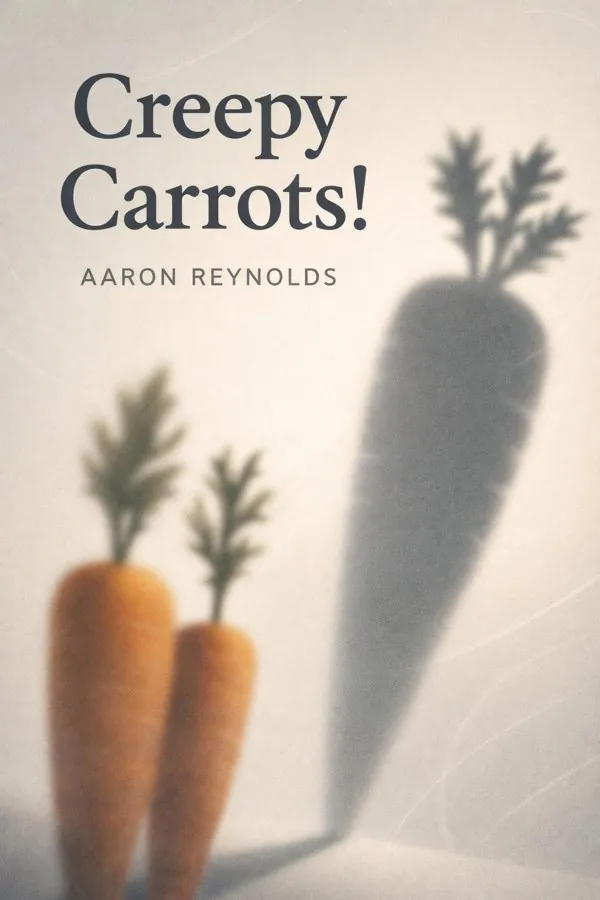
Creepy Carrots!: Summary & Key Insights
 10 min9 chaptersAudio available
Key Takeaways from Creepy Carrots!
A story often reveals character through desire, and Jasper Rabbit’s love of carrots tells us almost everything we need to know before the suspense even begins.
Fear rarely arrives all at once; it often begins as a whisper, and Creepy Carrots!
One of the book’s most insightful themes is that imagination is not only creative; it is amplifying.
People often assume that fear disappears when we use logic, but Jasper Rabbit shows that reasoning and panic can exist side by side.
One reason Jasper remains such an effective protagonist is that he does not stay frozen forever.
What Is Creepy Carrots! About?
Creepy Carrots! by Aaron Reynolds is a bestsellers book spanning 4 pages. Some of the most memorable children’s books take an ordinary desire and turn it into a thrilling adventure, and Creepy Carrots! does exactly that. Written by Aaron Reynolds, this witty picture book follows Jasper Rabbit, a bunny who cannot resist snacking on the carrots from Crackenhopper Field. At first, his obsession seems harmless and even funny. Then the mood shifts: Jasper starts to believe the carrots are following him. What begins as a simple tale about a favorite food becomes a suspenseful, laugh-out-loud story about imagination, anxiety, and the stories we tell ourselves when fear takes hold. What makes the book stand out is its brilliant balance of humor and spookiness. Reynolds understands how children experience fear: often dramatically, vividly, and with complete sincerity. He taps into that emotional truth while keeping the tone playful and accessible. The story also gains enormous power from its cinematic pacing and the contrast between the eerie atmosphere and the absurd idea of threatening vegetables. For parents, teachers, and young readers, Creepy Carrots! offers more than entertainment. It opens a conversation about perception, self-control, consequences, and how our minds can transform ordinary moments into something much bigger.
This FizzRead summary covers all 9 key chapters of Creepy Carrots! in approximately 10 minutes, distilling the most important ideas, arguments, and takeaways from Aaron Reynolds's work. Also available as an audio summary and Key Quotes Podcast.
Creepy Carrots!
Some of the most memorable children’s books take an ordinary desire and turn it into a thrilling adventure, and Creepy Carrots! does exactly that. Written by Aaron Reynolds, this witty picture book follows Jasper Rabbit, a bunny who cannot resist snacking on the carrots from Crackenhopper Field. At first, his obsession seems harmless and even funny. Then the mood shifts: Jasper starts to believe the carrots are following him. What begins as a simple tale about a favorite food becomes a suspenseful, laugh-out-loud story about imagination, anxiety, and the stories we tell ourselves when fear takes hold.
What makes the book stand out is its brilliant balance of humor and spookiness. Reynolds understands how children experience fear: often dramatically, vividly, and with complete sincerity. He taps into that emotional truth while keeping the tone playful and accessible. The story also gains enormous power from its cinematic pacing and the contrast between the eerie atmosphere and the absurd idea of threatening vegetables. For parents, teachers, and young readers, Creepy Carrots! offers more than entertainment. It opens a conversation about perception, self-control, consequences, and how our minds can transform ordinary moments into something much bigger.
Who Should Read Creepy Carrots!?
This book is perfect for anyone interested in bestsellers and looking to gain actionable insights in a short read. Whether you're a student, professional, or lifelong learner, the key ideas from Creepy Carrots! by Aaron Reynolds will help you think differently.
- ✓Readers who enjoy bestsellers and want practical takeaways
- ✓Professionals looking to apply new ideas to their work and life
- ✓Anyone who wants the core insights of Creepy Carrots! in just 10 minutes
Want the full summary?
Get instant access to this book summary and 100K+ more with Fizz Moment.
Get Free SummaryAvailable on App Store • Free to download
Key Chapters
A story often reveals character through desire, and Jasper Rabbit’s love of carrots tells us almost everything we need to know before the suspense even begins. Jasper is not casually fond of carrots; he adores them, especially the ones from Crackenhopper Field. They are crisp, sweet, plentiful, and always available, so he helps himself whenever he likes. This repetitive indulgence creates the foundation for the entire plot. His appetite is funny, familiar, and easy for children to understand. Most readers know what it feels like to want one more cookie, one more game, or one more trip to a favorite place.
The brilliance here is that Jasper’s harmless pleasure slowly becomes excessive. The field is no longer just a source of food; it becomes a place of habit and entitlement. He assumes the carrots will always be there for him. That is an important emotional setup because when things start to feel strange, the disruption lands harder. The comfort of routine has been interrupted.
In real life, this idea applies well beyond carrots. Children and adults both form habits around things they enjoy, from snacks to screen time to attention from others. Those habits can feel so normal that we stop noticing when they become too much. Jasper’s story gently shows how desire can shape behavior and blind us to limits.
A useful way to discuss this with young readers is to ask: what is something you like so much that it is hard to stop? This invites reflection without judgment. Jasper is not evil or foolish; he is simply very attached. That makes him relatable.
Actionable takeaway: Pay attention to the small habits you repeat automatically, because they often become the starting point for much bigger feelings and decisions.
Fear rarely arrives all at once; it often begins as a whisper, and Creepy Carrots! captures that progression beautifully. After one of his many visits to Crackenhopper Field, Jasper starts to notice unsettling signs. He thinks he sees carrots behind him. He senses movement. He catches flashes of orange where there should be none. These moments are not dramatic attacks but subtle disturbances, which makes them more believable and, in many ways, more effective.
This is exactly how anxiety often works. A person notices one odd detail, then another, and suddenly the mind begins building a pattern. The ordinary becomes suspicious. The harmless becomes charged with meaning. For a child, that could be a shadow in the hallway, a sound outside the bedroom, or a coat on a chair that looks strange at night. For adults, it might be an unread message, a change in tone, or a missed call that triggers imagined worst-case scenarios.
The book validates the experience of feeling scared even when the evidence is uncertain. Jasper’s fear feels real to him, and that matters. Rather than mocking fear, the story uses humor to make it manageable. That is one reason the book works so well in classrooms and homes: it acknowledges how powerful imagination can be without making children feel silly for having big reactions.
Readers can apply this idea by learning to pause when they sense a fear spiral beginning. Ask: what do I know for sure, and what am I imagining? That simple distinction helps separate facts from assumptions.
Actionable takeaway: When something ordinary suddenly feels frightening, slow down and name the difference between what you observed and the story your mind added to it.
One of the book’s most insightful themes is that imagination is not only creative; it is amplifying. Jasper does not just notice carrots. He experiences them as a growing presence, almost as if they are organizing around him. The more he thinks about them, the more convincing the threat becomes. This is what makes the story funny and psychologically sharp at the same time. A tiny suspicion, once fed by imagination, can grow into a full emotional reality.
For children, imagination is often celebrated for storytelling, play, and invention, but Creepy Carrots! reminds us that it also has a darker side. The same mind that can turn a cardboard box into a spaceship can turn a rustle in the grass into danger. That does not make imagination bad. It makes it powerful. The book invites adults to respect this power rather than dismiss it.
This idea has practical value in everyday life. A child lying awake at night may not need a lecture about logic as much as reassurance, grounding, and a chance to talk through what feels scary. Adults experience the same pattern in different forms: overthinking a conversation, assuming the worst from limited information, or replaying worries until they feel certain.
A helpful application is to give imagination a job instead of letting it run wild. If a child imagines something scary in the closet, ask them to imagine a funny explanation too. If an adult is catastrophizing, they can deliberately invent three non-threatening explanations for the same event. This restores flexibility to the mind.
Actionable takeaway: When imagination starts making fear bigger, redirect it by creating alternative, less frightening possibilities instead of treating the first scary story as truth.
People often assume that fear disappears when we use logic, but Jasper Rabbit shows that reasoning and panic can exist side by side. As the strange carrot sightings continue, Jasper tries to make sense of them. He reassures himself. He attempts to explain away what he sees. Yet each new moment deepens his unease instead of calming it. This inner conflict is familiar: part of him knows the idea sounds ridiculous, but another part remains convinced that danger is real.
That tension is an important lesson for young readers. Fear is not always conquered by a single rational thought. Sometimes feelings are stronger than explanations, especially when they have been building over time. Jasper reaches a breaking point not because the evidence becomes overwhelming, but because the emotional pressure does. He can no longer live with uncertainty.
This insight matters in parenting and education. When children say they are scared, immediately answering with “there’s nothing to worry about” may not help much. Jasper’s experience suggests a better approach: acknowledge the feeling first, then guide the child toward strategies. The same is true for adults dealing with stress or anxiety. Facts matter, but emotional regulation matters too.
Practical tools might include deep breathing, checking the environment calmly, talking through the fear, or creating a plan. Jasper, in his own dramatic way, moves toward action because passively worrying has become unbearable. His breaking point becomes a turning point.
Actionable takeaway: Do not expect logic alone to erase fear; first recognize the feeling, then pair clear thinking with a concrete step that restores a sense of control.
One reason Jasper remains such an effective protagonist is that he does not stay frozen forever. After becoming convinced that the carrots are following him, he decides to do something about it. He creates a plan to protect himself, building barriers and taking steps that make him feel safer. Whether or not the threat is real, his move from helplessness to action changes the emotional energy of the story.
This reflects an important truth about anxiety: uncertainty often feels worse when we do nothing. Action does not always solve the external problem, but it can reduce the internal sense of chaos. For a child, that action might be using a night-light, checking under the bed once, or developing a bedtime routine. For an adult, it could mean writing down worries, making a phone call, setting a boundary, or organizing information instead of endlessly ruminating.
The key is that action works best when it is specific and proportionate. Jasper’s plan is exaggerated for comic effect, which makes it entertaining, but the underlying principle is serious. When fear becomes consuming, a practical response can help transform vague dread into manageable effort.
At the same time, the book subtly raises a thoughtful question: are we acting to solve a problem, or simply to feel better? Both can matter, but it is useful to know the difference. Jasper’s actions give him relief, and that relief is meaningful even if his assumptions are questionable.
Actionable takeaway: When fear begins to spiral, choose one clear, manageable action you can take right away, because movement often interrupts helplessness more effectively than endless worrying.
Great picture books often deliver a final twist that invites readers to reconsider the entire story, and Creepy Carrots! lands this beautifully. Without spoiling the delight of discovery for first-time readers, the ending reveals that the dynamic between Jasper and the carrots is more complex than it seemed. What looked like a one-sided fear story becomes something else: a tale about boundaries, consequences, and competing points of view.
This twist matters because it teaches a sophisticated lesson in a playful format. Readers realize that Jasper has not been the only one affected by events. His constant carrot-eating has consequences, and the so-called creepy presence may not be random after all. Suddenly, the story expands from “Jasper is scared” to “everyone in this situation has motives.” That shift encourages empathy and perspective-taking.
In a broader sense, this mirrors many real-world misunderstandings. We often assume we are the center of a conflict and interpret events solely through our own emotions. But other people may be reacting to our behavior, protecting their interests, or responding in ways we never considered. Children can learn from this in social settings: if a classmate seems upset, there may be a reason beyond what is immediately visible. Adults can apply it to family tensions, work misunderstandings, and everyday disagreements.
The ending also rewards close reading. It invites laughter, surprise, and a second look at the earlier clues. That makes the book especially strong for rereading, which is one of the highest compliments for a picture book.
Actionable takeaway: Whenever a conflict feels simple, pause and ask what the story might look like from the other side before deciding you fully understand it.
Children’s literature is often at its strongest when it helps readers visit difficult emotions without becoming overwhelmed, and humor is one of the best tools for that job. Creepy Carrots! is spooky enough to create suspense, but funny enough to keep the experience playful. The very idea of being stalked by carrots is absurd, and that absurdity gives readers emotional distance. They can enjoy the thrill without feeling trapped by it.
This balance is part of Aaron Reynolds’s skill as a storyteller. He understands that laughter can lower defenses and make challenging feelings easier to examine. A child who would struggle to discuss anxiety directly may have no trouble talking about Jasper’s fears. Once the conversation begins, adults can gently connect the story to real emotions: Have you ever felt scared by something that seemed silly later? Have you ever imagined something following you or watching you?
Humor also helps normalize vulnerability. Jasper is dramatic, jumpy, and intensely worried, yet readers still like him. That sends a reassuring message: being frightened does not make you weak or ridiculous. It makes you human.
In practical settings, this is why funny spooky books work so well as teaching tools. They are excellent for read-alouds, social-emotional learning, and conversations about managing fears. Instead of presenting fear as a problem to eliminate, the book presents it as an experience to understand.
Actionable takeaway: Use humor as a bridge into difficult conversations, because people of all ages are often more willing to discuss fear once they have laughed at a gentler version of it.
In a picture book, the images are not decoration; they are part of the storytelling, and Creepy Carrots! depends on that partnership. The visual world creates suspense through contrast, framing, shadow, and pacing. Even before readers fully understand Jasper’s fear, they can feel it in the atmosphere. The illustrations transform a simple rabbit-and-carrot premise into something cinematic, almost like a classic suspense film adapted for children.
This is important because young readers often process emotion visually before they can articulate it verbally. A page turn, a looming shadow, or a carefully placed splash of color can communicate tension more quickly than explanation. The book’s moody presentation makes Jasper’s perspective convincing. Readers are invited to enter his emotional world and see normal surroundings as he sees them: uncertain, eerie, and charged.
This visual storytelling has practical educational value too. Adults can use the book to teach children how pictures create meaning. Ask what details make a scene feel creepy. Is it the darkness? The spacing? The facial expression? The angle? These questions help children become more attentive readers and more aware of how art shapes emotion.
The same principle applies beyond books. In media, advertising, and even everyday environments, visual cues strongly affect how safe, urgent, or important something feels. Learning to notice those cues builds critical thinking.
Actionable takeaway: Pay attention to how visuals influence your emotions, because noticing the techniques behind a mood can help you respond more thoughtfully instead of simply absorbing the feeling.
What makes Creepy Carrots! endure is that beneath its compact plot lies a surprisingly rich emotional education. In only a short reading experience, the book explores desire, habit, anxiety, imagination, perspective, consequences, and control. That is one of the special strengths of picture books: they can deliver layered insight with remarkable economy.
For children, the story offers reassurance that fear can feel huge even when its source seems small. It also shows that actions have effects, that other points of view matter, and that taking steps to cope with fear can be empowering. For adults, the book is a reminder that children’s emotional lives are often more nuanced than they appear. What looks exaggerated from the outside may feel completely real from within.
The story is also highly shareable. It works in family reading, classroom discussion, library storytime, and one-on-one conversations. Different ages can take different things from it. Younger readers may enjoy the suspense and surprise. Older children may notice the irony and perspective shift. Adults may appreciate the clever structure and emotional truth.
This layered accessibility is why the book remains widely loved. It entertains immediately, but it also invites discussion after the last page. The best children’s books do not just fill a few minutes; they create a memorable emotional experience and open the door to reflection.
Actionable takeaway: Do not underestimate simple stories; revisit them with fresh questions, because short books often contain lessons deep enough to grow with the reader.
All Chapters in Creepy Carrots!
About the Author
Aaron Reynolds is an American author celebrated for his humorous, imaginative, and highly readable children’s books. He has written a wide range of popular titles, including Creepy Carrots!, Creepy Pair of Underwear!, and the Nerdy Birdy series. Reynolds is especially skilled at combining laugh-out-loud premises with real emotional insight, often exploring feelings such as fear, embarrassment, friendship, and self-consciousness in ways that children instantly recognize. His books are favorites among parents, teachers, and librarians because they work equally well as entertaining read-alouds and as conversation starters. With a talent for playful language, strong pacing, and memorable characters, Reynolds has become one of the most distinctive voices in contemporary children’s literature. His stories consistently prove that funny books can also be smart, meaningful, and deeply relatable.
Get This Summary in Your Preferred Format
Read or listen to the Creepy Carrots! summary by Aaron Reynolds anytime, anywhere. FizzRead offers multiple formats so you can learn on your terms — all free.
Available formats: App · Audio · PDF · EPUB — All included free with FizzRead
Download Creepy Carrots! PDF and EPUB Summary
Key Quotes from Creepy Carrots!
“A story often reveals character through desire, and Jasper Rabbit’s love of carrots tells us almost everything we need to know before the suspense even begins.”
“Fear rarely arrives all at once; it often begins as a whisper, and Creepy Carrots!”
“One of the book’s most insightful themes is that imagination is not only creative; it is amplifying.”
“People often assume that fear disappears when we use logic, but Jasper Rabbit shows that reasoning and panic can exist side by side.”
“One reason Jasper remains such an effective protagonist is that he does not stay frozen forever.”
Frequently Asked Questions about Creepy Carrots!
Creepy Carrots! by Aaron Reynolds is a bestsellers book that explores key ideas across 9 chapters. Some of the most memorable children’s books take an ordinary desire and turn it into a thrilling adventure, and Creepy Carrots! does exactly that. Written by Aaron Reynolds, this witty picture book follows Jasper Rabbit, a bunny who cannot resist snacking on the carrots from Crackenhopper Field. At first, his obsession seems harmless and even funny. Then the mood shifts: Jasper starts to believe the carrots are following him. What begins as a simple tale about a favorite food becomes a suspenseful, laugh-out-loud story about imagination, anxiety, and the stories we tell ourselves when fear takes hold. What makes the book stand out is its brilliant balance of humor and spookiness. Reynolds understands how children experience fear: often dramatically, vividly, and with complete sincerity. He taps into that emotional truth while keeping the tone playful and accessible. The story also gains enormous power from its cinematic pacing and the contrast between the eerie atmosphere and the absurd idea of threatening vegetables. For parents, teachers, and young readers, Creepy Carrots! offers more than entertainment. It opens a conversation about perception, self-control, consequences, and how our minds can transform ordinary moments into something much bigger.
More by Aaron Reynolds

You Might Also Like
The Godfather
Mario Puzo
10 min
The Handmaid's Tale
Margaret Atwood
10 min
The Hunger Games
Suzanne Collins
10 min
The Nightingale
Kristin Hannah
10 min
The Seven Husbands of Evelyn Hugo
Taylor Jenkins Reid
10 min
Backwater Justice
Fern Michaels
10 minBrowse by Category
Ready to read Creepy Carrots!?
Get the full summary and 100K+ more books with Fizz Moment.