
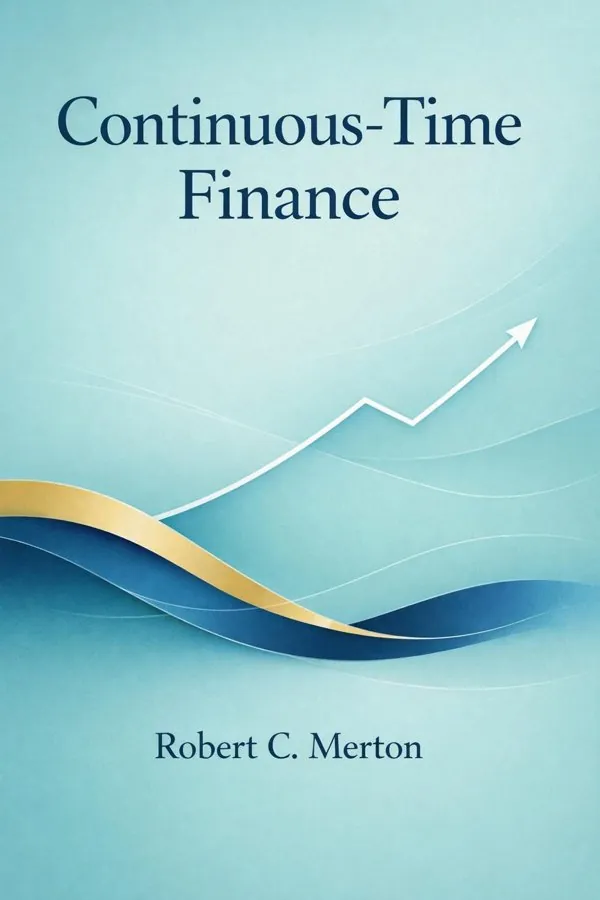
Continuous-Time Finance: Summary & Key Insights
 10 min4 chaptersAudio available
What Is Continuous-Time Finance About?
Continuous-Time Finance by Robert C. Merton is a finance book spanning 4 pages. Continuous-Time Finance es una obra fundamental en la teoría financiera moderna que desarrolla modelos matemáticos para la valoración de activos, gestión de riesgos y decisiones de inversión en tiempo continuo. Merton introduce el uso del cálculo estocástico y las ecuaciones diferenciales para analizar los mercados financieros, extendiendo el trabajo de Black-Scholes y estableciendo las bases de la economía financiera contemporánea.
This FizzRead summary covers all 4 key chapters of Continuous-Time Finance in approximately 10 minutes, distilling the most important ideas, arguments, and takeaways from Robert C. Merton's work. Also available as an audio summary and Key Quotes Podcast.
Continuous-Time Finance
Continuous-Time Finance es una obra fundamental en la teoría financiera moderna que desarrolla modelos matemáticos para la valoración de activos, gestión de riesgos y decisiones de inversión en tiempo continuo. Merton introduce el uso del cálculo estocástico y las ecuaciones diferenciales para analizar los mercados financieros, extendiendo el trabajo de Black-Scholes y estableciendo las bases de la economía financiera contemporánea.
Who Should Read Continuous-Time Finance?
This book is perfect for anyone interested in finance and looking to gain actionable insights in a short read. Whether you're a student, professional, or lifelong learner, the key ideas from Continuous-Time Finance by Robert C. Merton will help you think differently.
- ✓Readers who enjoy finance and want practical takeaways
- ✓Professionals looking to apply new ideas to their work and life
- ✓Anyone who wants the core insights of Continuous-Time Finance in just 10 minutes
Want the full summary?
Get instant access to this book summary and 100K+ more with Fizz Moment.
Get Free SummaryAvailable on App Store • Free to download
Key Chapters
To understand finance in continuous time, we first need mathematical tools that describe motion and uncertainty together. Stochastic processes provide the core language. A stochastic process models how a variable, such as an asset price, evolves over time with both deterministic trends and random shocks. Among these, the Wiener process—or Brownian motion—is central. It represents pure randomness with continuous paths, capturing the unpredictable nature of markets.
Ito calculus is the machinery that lets us manipulate these random processes. Through Ito’s lemma, we can compute how functions of stochastic variables evolve. This principle may seem abstract, but it underlies nearly every model in modern quantitative finance. When we describe an asset price as following a stochastic differential equation, we gain an exact formulation of risk—it becomes measurable and mathematically tractable.
My interest in this approach began from dissatisfaction with discrete models. Those frameworks simplify by treating decisions as if made only at intervals, but real financial dynamics are smooth. Margins, hedges, and risks are adjusted continuously. By embracing continuous-time modeling, we can express the subtle trade-offs that characterize financial behavior across infinitesimal periods.
Mathematical rigor serves a purpose beyond elegance—it provides consistency. Once uncertainty is expressed through stochastic differentials, we can build models of portfolio choice and derivative valuation that are internally coherent. Markets cease to be collections of assumptions and become systems governed by explicit probabilistic laws.
In early finance theory, portfolio selection was dominated by Markowitz’s mean-variance model, which operates in discrete time. Investors choose portfolios to balance expected return and variance of return over a single period. But continuous-time models allow us to extend these ideas into an intertemporal framework. Instead of one choice, we have a stream of decisions adjusting to changing conditions.
In my continuous-time portfolio model, the investor optimizes consumption and investment dynamically. Wealth evolves according to a stochastic differential equation, and at each instant, the investor determines how much to consume and how to allocate wealth among risky and risk-free assets. The mathematical solution uses dynamic programming and Ito calculus, producing policies that adapt continuously to fluctuating market states.
This approach leads naturally to the Intertemporal Capital Asset Pricing Model (ICAPM). While the traditional CAPM describes equilibrium in a static world, the ICAPM connects expected returns to risks that evolve over time. Relevant state variables, such as interest rates or market volatility, affect not only current returns but also investment opportunities in the future. Hence, assets that hedge against adverse changes in these state variables command a premium.
Through this framework, we grasp how risk is multidimensional and how investors value intertemporal hedging potential as much as immediate expected return. Continuous-time reasoning allows us to model this process without artificial segmentation. The finance universe becomes fluid—decisions interact continuously with unfolding uncertainty.
+ 2 more chapters — available in the FizzRead app
All Chapters in Continuous-Time Finance
About the Author
Robert C. Merton es un economista estadounidense, profesor en MIT y Harvard, y ganador del Premio Nobel de Economía en 1997 por su trabajo en la valoración de derivados y la teoría de las finanzas en tiempo continuo. Su investigación ha influido profundamente en la práctica financiera y en el desarrollo de modelos cuantitativos.
Get This Summary in Your Preferred Format
Read or listen to the Continuous-Time Finance summary by Robert C. Merton anytime, anywhere. FizzRead offers multiple formats so you can learn on your terms — all free.
Available formats: App · Audio · PDF · EPUB — All included free with FizzRead
Download Continuous-Time Finance PDF and EPUB Summary
Key Quotes from Continuous-Time Finance
“To understand finance in continuous time, we first need mathematical tools that describe motion and uncertainty together.”
“In early finance theory, portfolio selection was dominated by Markowitz’s mean-variance model, which operates in discrete time.”
Frequently Asked Questions about Continuous-Time Finance
Continuous-Time Finance by Robert C. Merton is a finance book that explores key ideas across 4 chapters. Continuous-Time Finance es una obra fundamental en la teoría financiera moderna que desarrolla modelos matemáticos para la valoración de activos, gestión de riesgos y decisiones de inversión en tiempo continuo. Merton introduce el uso del cálculo estocástico y las ecuaciones diferenciales para analizar los mercados financieros, extendiendo el trabajo de Black-Scholes y estableciendo las bases de la economía financiera contemporánea.
You Might Also Like



Browse by Category
Ready to read Continuous-Time Finance?
Get the full summary and 100K+ more books with Fizz Moment.