
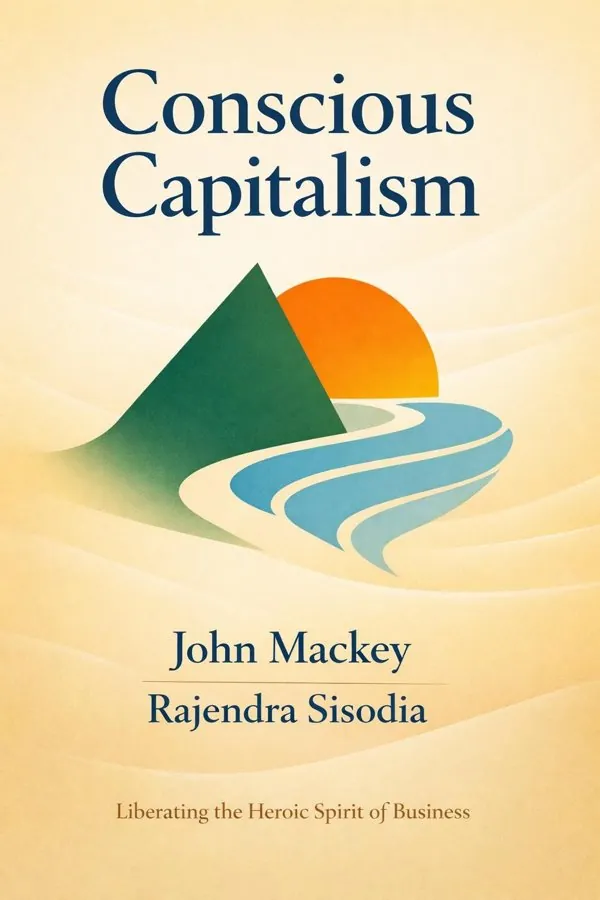
Conscious Capitalism: Liberating the Heroic Spirit of Business: Summary & Key Insights
by John Mackey, Rajendra Sisodia
 10 min11 chaptersAudio available
What Is Conscious Capitalism: Liberating the Heroic Spirit of Business About?
Conscious Capitalism: Liberating the Heroic Spirit of Business by John Mackey, Rajendra Sisodia is a leadership book spanning 11 pages. Conscious Capitalism propone una visión del capitalismo que busca crear valor para todos los grupos de interés —clientes, empleados, proveedores, comunidades y accionistas— a través de un propósito más elevado y una cultura empresarial basada en la confianza y el cuidado. Los autores, John Mackey (cofundador de Whole Foods Market) y Raj Sisodia, argumentan que las empresas pueden ser fuerzas positivas para el bien común sin sacrificar la rentabilidad.
This FizzRead summary covers all 11 key chapters of Conscious Capitalism: Liberating the Heroic Spirit of Business in approximately 10 minutes, distilling the most important ideas, arguments, and takeaways from John Mackey, Rajendra Sisodia's work. Also available as an audio summary and Key Quotes Podcast.
Conscious Capitalism: Liberating the Heroic Spirit of Business
Conscious Capitalism propone una visión del capitalismo que busca crear valor para todos los grupos de interés —clientes, empleados, proveedores, comunidades y accionistas— a través de un propósito más elevado y una cultura empresarial basada en la confianza y el cuidado. Los autores, John Mackey (cofundador de Whole Foods Market) y Raj Sisodia, argumentan que las empresas pueden ser fuerzas positivas para el bien común sin sacrificar la rentabilidad.
Who Should Read Conscious Capitalism: Liberating the Heroic Spirit of Business?
This book is perfect for anyone interested in leadership and looking to gain actionable insights in a short read. Whether you're a student, professional, or lifelong learner, the key ideas from Conscious Capitalism: Liberating the Heroic Spirit of Business by John Mackey, Rajendra Sisodia will help you think differently.
- ✓Readers who enjoy leadership and want practical takeaways
- ✓Professionals looking to apply new ideas to their work and life
- ✓Anyone who wants the core insights of Conscious Capitalism: Liberating the Heroic Spirit of Business in just 10 minutes
Want the full summary?
Get instant access to this book summary and 100K+ more with Fizz Moment.
Get Free SummaryAvailable on App Store • Free to download
Key Chapters
For too long, capitalism has been viewed through a one-dimensional lens. The notion that the only social responsibility of business is to maximize profits became deeply ingrained in the corporate psyche, largely due to influential voices like Milton Friedman and the Chicago School of Economics. That mindset, while driving efficiency and innovation, also introduced an imbalance. It reduced the complex human relationships within business to transactions, eroding trust and creating a culture of short-termism.
We argue that this version of capitalism—one concerned solely with shareholder wealth—is a distortion of what Adam Smith originally envisioned. Smith, who wrote both *The Wealth of Nations* and *The Theory of Moral Sentiments*, understood that commerce must be guided by empathy, virtue, and the invisible hand of mutual benefit. True capitalism, therefore, is not amoral; it is moral by design. It thrives on cooperation, creativity, and the shared pursuit of value.
The global crises we face—economic inequality, environmental degradation, loss of community—underscore the need for an evolved model. Conscious Capitalism seeks to restore the moral foundation of commerce by reorienting business toward a higher purpose and recognizing its inherent interdependence with all stakeholders. When businesses act with consciousness, they ignite innovation and create long-term prosperity that benefits society at large.
This transformation does not mean abandoning profit. Profit remains vital; it is the lifeblood that sustains any organization. But when purpose leads, profit follows naturally. We propose a paradigm shift from profit *maximization* to profit *optimization*—seeking financial success not at the expense of others, but through the creation of meaningful, sustainable value.
Every conscious enterprise begins with an unshakable sense of purpose—a reason for being that transcends financial success. Profit is like oxygen: essential for survival but not the reason we exist. The true vitality of an organization comes from its purpose, its contribution to the world.
At Whole Foods Market, our higher purpose was simple yet profound: to nourish people and the planet. That vision permeated every decision we made, from how we treated our team members to what we put on our shelves. When purpose becomes the organizational North Star, it attracts people who are inspired rather than merely employed, customers who feel kinship rather than calculation, and suppliers who become genuine partners rather than counterparts in negotiation.
A higher purpose gives coherence to a company’s actions and stabilizes it amid turbulence. It answers the essential human question at work: Why does what I do matter? Purpose is not a marketing slogan—it is a philosophical commitment that transforms ordinary business into a moral and emotional journey. And when employees see their work as a reflection of shared values, performance naturally rises. Passion becomes the fuel of innovation.
In a purpose-driven enterprise, success is measured not just by shareholder return but by the positive impact on human lives. When we align purpose with profit, we unlock the profound truth that doing good is good business.
+ 9 more chapters — available in the FizzRead app
All Chapters in Conscious Capitalism: Liberating the Heroic Spirit of Business
About the Authors
John Mackey es cofundador y exdirector ejecutivo de Whole Foods Market, reconocido por su liderazgo en el movimiento de empresas conscientes. Rajendra Sisodia es profesor de marketing en Babson College y cofundador del movimiento Conscious Capitalism, con una amplia trayectoria en investigación sobre liderazgo y gestión empresarial ética.
Get This Summary in Your Preferred Format
Read or listen to the Conscious Capitalism: Liberating the Heroic Spirit of Business summary by John Mackey, Rajendra Sisodia anytime, anywhere. FizzRead offers multiple formats so you can learn on your terms — all free.
Available formats: App · Audio · PDF · EPUB — All included free with FizzRead
Download Conscious Capitalism: Liberating the Heroic Spirit of Business PDF and EPUB Summary
Key Quotes from Conscious Capitalism: Liberating the Heroic Spirit of Business
“For too long, capitalism has been viewed through a one-dimensional lens.”
“Every conscious enterprise begins with an unshakable sense of purpose—a reason for being that transcends financial success.”
Frequently Asked Questions about Conscious Capitalism: Liberating the Heroic Spirit of Business
Conscious Capitalism: Liberating the Heroic Spirit of Business by John Mackey, Rajendra Sisodia is a leadership book that explores key ideas across 11 chapters. Conscious Capitalism propone una visión del capitalismo que busca crear valor para todos los grupos de interés —clientes, empleados, proveedores, comunidades y accionistas— a través de un propósito más elevado y una cultura empresarial basada en la confianza y el cuidado. Los autores, John Mackey (cofundador de Whole Foods Market) y Raj Sisodia, argumentan que las empresas pueden ser fuerzas positivas para el bien común sin sacrificar la rentabilidad.
You Might Also Like

Extreme Ownership
Jocko Willink
10 min
Dare to Lead
Brene Brown
10 min
Leaders Eat Last
Simon Sinek
10 min
The 21 Irrefutable Laws of Leadership
John Maxwell
10 min
Start With Why
Simon Sinek
10 min
How to Lead When You're Not in Charge
Clay Scroggins
10 minBrowse by Category
Ready to read Conscious Capitalism: Liberating the Heroic Spirit of Business?
Get the full summary and 100K+ more books with Fizz Moment.