
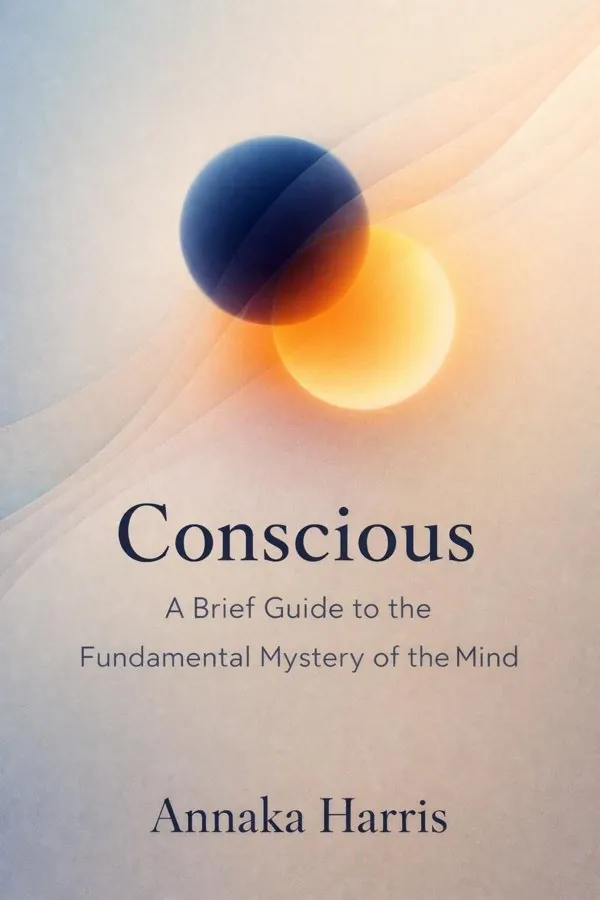
Conscious: A Brief Guide to the Fundamental Mystery of the Mind: Summary & Key Insights
 10 min8 chaptersAudio available
What Is Conscious: A Brief Guide to the Fundamental Mystery of the Mind About?
Conscious: A Brief Guide to the Fundamental Mystery of the Mind by Annaka Harris is a neuroscience book spanning 8 pages. In this concise and accessible exploration, Annaka Harris examines the nature of consciousness—what it is, how it arises, and why it remains one of the most profound mysteries in science and philosophy. Drawing from neuroscience, physics, and philosophy of mind, Harris invites readers to question assumptions about perception, free will, and the self, offering a lucid guide to the enigma of subjective experience.
This FizzRead summary covers all 8 key chapters of Conscious: A Brief Guide to the Fundamental Mystery of the Mind in approximately 10 minutes, distilling the most important ideas, arguments, and takeaways from Annaka Harris's work. Also available as an audio summary and Key Quotes Podcast.
Conscious: A Brief Guide to the Fundamental Mystery of the Mind
In this concise and accessible exploration, Annaka Harris examines the nature of consciousness—what it is, how it arises, and why it remains one of the most profound mysteries in science and philosophy. Drawing from neuroscience, physics, and philosophy of mind, Harris invites readers to question assumptions about perception, free will, and the self, offering a lucid guide to the enigma of subjective experience.
Who Should Read Conscious: A Brief Guide to the Fundamental Mystery of the Mind?
This book is perfect for anyone interested in neuroscience and looking to gain actionable insights in a short read. Whether you're a student, professional, or lifelong learner, the key ideas from Conscious: A Brief Guide to the Fundamental Mystery of the Mind by Annaka Harris will help you think differently.
- ✓Readers who enjoy neuroscience and want practical takeaways
- ✓Professionals looking to apply new ideas to their work and life
- ✓Anyone who wants the core insights of Conscious: A Brief Guide to the Fundamental Mystery of the Mind in just 10 minutes
Want the full summary?
Get instant access to this book summary and 100K+ more with Fizz Moment.
Get Free SummaryAvailable on App Store • Free to download
Key Chapters
Whenever we talk about consciousness, we’re drawn toward definitions — a natural human habit — yet almost every attempt ends in paradox. Neuroscience can describe functions like attention and perception, but when we try to bridge the gap between physical processes and subjective experience, we find an unresolvable tension. The neural correlates of consciousness — patterns in the brain that accompany awareness — can be mapped with great precision, but correlates are not causes. The feeling of seeing red, the taste of coffee, the simple awareness of being oneself in a moment — none can be entirely reduced to neuronal firing.
I’ve come to think of consciousness not as a thing, but as a phenomenon that resists categorization altogether. Other physical systems can be defined by their measurable properties: waves, particles, energy. Consciousness, however, is defined by its immediacy. It is what makes any measurement meaningful, because experience itself is the foundation of knowing. This inversion — that the very tool we use to understand reality cannot itself be fully understood — is the heart of the mystery.
Our brains are masterful creators of experience. Every moment of awareness is shaped by sensory input refined through neural processing, but we rarely sense the mediation happening behind the scenes. Consider vision: photons strike our retinas, electrical signals travel through elaborate pathways, and eventually certain patterns give rise to the experience of color and shape. Yet the color red that you see isn’t out there in the world; it's a construction inside the mind. Neuroscience shows that what we perceive is often a prediction — the brain’s best guess — rather than a simple reflection of reality.
This gap between outside information and inner experience opens the door to deeper philosophical questions. If all perception is mediated by consciousness, then what is awareness itself? Is it simply the brain noticing its own activity, or is there an essential quality that cannot be reduced to physical explanation? I invite you to consider that perhaps awareness isn’t generated but revealed — the brain might be more like a filter or tuner, shaping fundamental consciousness into specific experiences.
+ 6 more chapters — available in the FizzRead app
All Chapters in Conscious: A Brief Guide to the Fundamental Mystery of the Mind
About the Author
Annaka Harris is an American author and editor with a focus on neuroscience, philosophy of mind, and consciousness. She has contributed to several science and philosophy projects and is known for her clear and engaging writing on complex topics.
Get This Summary in Your Preferred Format
Read or listen to the Conscious: A Brief Guide to the Fundamental Mystery of the Mind summary by Annaka Harris anytime, anywhere. FizzRead offers multiple formats so you can learn on your terms — all free.
Available formats: App · Audio · PDF · EPUB — All included free with FizzRead
Download Conscious: A Brief Guide to the Fundamental Mystery of the Mind PDF and EPUB Summary
Key Quotes from Conscious: A Brief Guide to the Fundamental Mystery of the Mind
“Whenever we talk about consciousness, we’re drawn toward definitions — a natural human habit — yet almost every attempt ends in paradox.”
“Our brains are masterful creators of experience.”
Frequently Asked Questions about Conscious: A Brief Guide to the Fundamental Mystery of the Mind
Conscious: A Brief Guide to the Fundamental Mystery of the Mind by Annaka Harris is a neuroscience book that explores key ideas across 8 chapters. In this concise and accessible exploration, Annaka Harris examines the nature of consciousness—what it is, how it arises, and why it remains one of the most profound mysteries in science and philosophy. Drawing from neuroscience, physics, and philosophy of mind, Harris invites readers to question assumptions about perception, free will, and the self, offering a lucid guide to the enigma of subjective experience.
You Might Also Like
Anxious
Joseph LeDoux
10 min
Hallucinations
Oliver Sacks
10 min
The Biological Mind: How Brain, Body, and Environment Collaborate to Make Us Who We Are
Alan Jasanoff
10 min
The Feeling of Life Itself: Why Consciousness Is Widespread but Can't Be Computed
Christof Koch
10 min
The No-Nonsense Meditation Book
Steven Laureys
10 min
A General Theory of Love
Thomas Lewis, Fari Amini, Richard Lannon
10 minBrowse by Category
Ready to read Conscious: A Brief Guide to the Fundamental Mystery of the Mind?
Get the full summary and 100K+ more books with Fizz Moment.