
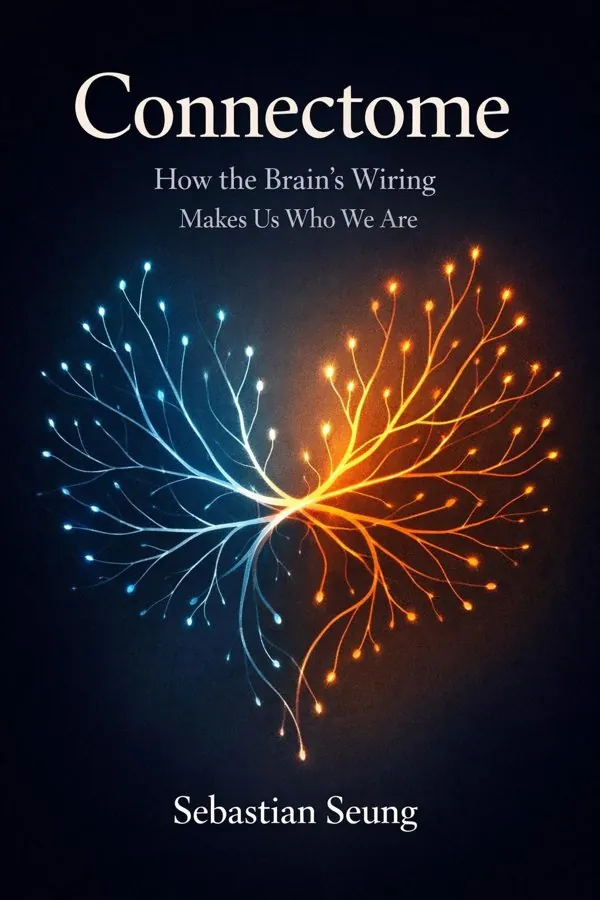
Connectome: How the Brain's Wiring Makes Us Who We Are: Summary & Key Insights
 10 min5 chaptersAudio available
What Is Connectome: How the Brain's Wiring Makes Us Who We Are About?
Connectome: How the Brain's Wiring Makes Us Who We Are by Sebastian Seung is a neuroscience book spanning 5 pages. Connectome explores the emerging field of connectomics, which seeks to map the brain’s intricate network of neural connections. Sebastian Seung argues that our identities, memories, and mental health are encoded not just in our genes but in the unique wiring of our neurons. The book introduces readers to the science behind brain mapping and its implications for understanding personality, mental illness, and the nature of self.
This FizzRead summary covers all 5 key chapters of Connectome: How the Brain's Wiring Makes Us Who We Are in approximately 10 minutes, distilling the most important ideas, arguments, and takeaways from Sebastian Seung's work. Also available as an audio summary and Key Quotes Podcast.
Connectome: How the Brain's Wiring Makes Us Who We Are
Connectome explores the emerging field of connectomics, which seeks to map the brain’s intricate network of neural connections. Sebastian Seung argues that our identities, memories, and mental health are encoded not just in our genes but in the unique wiring of our neurons. The book introduces readers to the science behind brain mapping and its implications for understanding personality, mental illness, and the nature of self.
Who Should Read Connectome: How the Brain's Wiring Makes Us Who We Are?
This book is perfect for anyone interested in neuroscience and looking to gain actionable insights in a short read. Whether you're a student, professional, or lifelong learner, the key ideas from Connectome: How the Brain's Wiring Makes Us Who We Are by Sebastian Seung will help you think differently.
- ✓Readers who enjoy neuroscience and want practical takeaways
- ✓Professionals looking to apply new ideas to their work and life
- ✓Anyone who wants the core insights of Connectome: How the Brain's Wiring Makes Us Who We Are in just 10 minutes
Want the full summary?
Get instant access to this book summary and 100K+ more with Fizz Moment.
Get Free SummaryAvailable on App Store • Free to download
Key Chapters
Early neuroscientists could only dream of capturing the vast intricacy of the brain. When Santiago Ramón y Cajal, more than a century ago, first drew neurons under a microscope, he glimpsed neurons as discrete cells with branching dendrites and axons—a revelation that shattered the older notion of the brain as a continuous web. Yet, even Cajal suspected that understanding the mind would require more than drawing single trees; it demanded reconstructing the entire forest. That dream lay dormant until the dawn of the twenty-first century, when imaging and computing began to converge.
Brains are built from roughly 86 billion neurons, each connected through up to ten thousand synapses. This unimaginably dense network defines every perception, movement, and thought. Mapping it—tracing every link—is the goal of connectomics. A connectome, in essence, is a wiring diagram of the brain. We have names for partial connectomes already, such as the complete map of the roundworm *C. elegans*, which has just 302 neurons. But the human connectome, with its billions of cells, remains our Everest.
I often compare the connectome to the internet or to a city’s power grid. Every neuron is like a node, and each synapse is a connection that carries information. What matters is not just the number of neurons but the pattern of their connections. These patterns define function, just as the topology of a network defines how information flows.
Connectomics emerged when microscopes gained the power to record brain tissue at nanometer resolution and computers became capable of processing terabytes of data. Electron microscopy, automated image alignment, and machine learning now allow us to reconstruct fragments of neural tissue in exquisite detail. But the challenge is immense: a cubic millimeter of cortex contains billions of synapses. Building the tools to map even a modest piece of brain tissue can take years.
Despite those challenges, connectomics is no longer a speculative quest. Partial connectomes have shown us microcircuits of perception or memory, revealing consistent motifs in how information is processed. In these patterns, I see a way to bridge the biological and the computational, the physical and the psychological. Because in every thread of that web lies a story—of how experience has rewired us.
When we first read the human genome, many hoped it would explain everything about what makes us who we are. But genes code for proteins, not for the experiences that shape our lives. They provide the initial layout, the construction guidelines for the brain’s architecture. The fine wiring—the trillions of connections that make each brain distinctive—emerges as neurons grow, compete, and adapt.
Think of childhood development. From birth, our brains bloom with exuberant connectivity. Then, through pruning and reinforcement, experience sculpts what remains. Every word we learn, every face we recognize, every heartbreak rewires synapses. The connectome becomes the cumulative record of living. While the genome is static, the connectome is dynamic. In it, our memories reside physically, as strengthened or weakened synaptic pathways. This view overturns the traditional dichotomy of nature versus nurture. If genes are the script, the connectome is the performance—rewritten anew every day.
When I tell audiences that their memories may be patterns of wiring, many find the prospect unsettling. Does that mean that when a neuron dies, a part of the self is lost? Perhaps. But I see it more as evidence of our adaptability. The brain is not rigidly wired. Synapses constantly change; new connections emerge even in adulthood. Through plasticity, the connectome embodies both stability and growth.
The implications go far beyond philosophy. If we come to understand how wiring encodes personality and thought, we may begin to answer why certain disorders—schizophrenia, autism, depression—manifest when they do. Genetic mutations might set the stage, but it is the resulting miswiring that shapes symptoms. Studying connectivity could thus open new doors to treatment by targeting the structure of thought itself, not merely its chemistry.
+ 3 more chapters — available in the FizzRead app
All Chapters in Connectome: How the Brain's Wiring Makes Us Who We Are
About the Author
Sebastian Seung is a professor of computational neuroscience at Princeton University and a leading researcher in the field of connectomics. Formerly at MIT, he has contributed significantly to the study of neural networks and brain mapping, combining insights from biology, physics, and computer science.
Get This Summary in Your Preferred Format
Read or listen to the Connectome: How the Brain's Wiring Makes Us Who We Are summary by Sebastian Seung anytime, anywhere. FizzRead offers multiple formats so you can learn on your terms — all free.
Available formats: App · Audio · PDF · EPUB — All included free with FizzRead
Download Connectome: How the Brain's Wiring Makes Us Who We Are PDF and EPUB Summary
Key Quotes from Connectome: How the Brain's Wiring Makes Us Who We Are
“Early neuroscientists could only dream of capturing the vast intricacy of the brain.”
“When we first read the human genome, many hoped it would explain everything about what makes us who we are.”
Frequently Asked Questions about Connectome: How the Brain's Wiring Makes Us Who We Are
Connectome: How the Brain's Wiring Makes Us Who We Are by Sebastian Seung is a neuroscience book that explores key ideas across 5 chapters. Connectome explores the emerging field of connectomics, which seeks to map the brain’s intricate network of neural connections. Sebastian Seung argues that our identities, memories, and mental health are encoded not just in our genes but in the unique wiring of our neurons. The book introduces readers to the science behind brain mapping and its implications for understanding personality, mental illness, and the nature of self.
You Might Also Like
Anxious
Joseph LeDoux
10 min
Hallucinations
Oliver Sacks
10 min
The Biological Mind: How Brain, Body, and Environment Collaborate to Make Us Who We Are
Alan Jasanoff
10 min
The Feeling of Life Itself: Why Consciousness Is Widespread but Can't Be Computed
Christof Koch
10 min
The No-Nonsense Meditation Book
Steven Laureys
10 min
A General Theory of Love
Thomas Lewis, Fari Amini, Richard Lannon
10 minBrowse by Category
Ready to read Connectome: How the Brain's Wiring Makes Us Who We Are?
Get the full summary and 100K+ more books with Fizz Moment.