
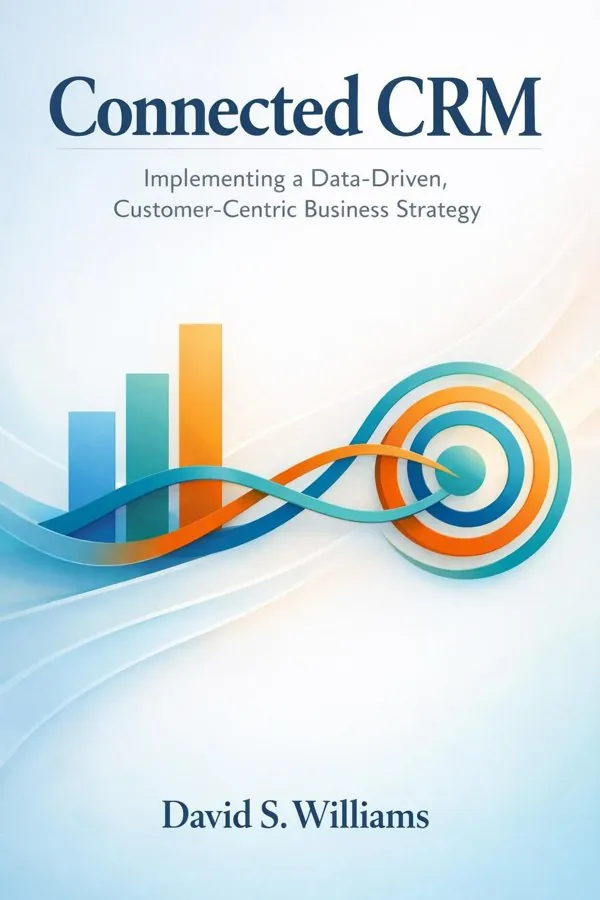
Connected CRM: Implementing a Data-Driven, Customer-Centric Business Strategy: Summary & Key Insights
 10 min5 chaptersAudio available
What Is Connected CRM: Implementing a Data-Driven, Customer-Centric Business Strategy About?
Connected CRM: Implementing a Data-Driven, Customer-Centric Business Strategy by David S. Williams is a marketing book spanning 5 pages. Connected CRM provides a comprehensive framework for building a customer-centric business strategy driven by data and analytics. The book explains how organizations can integrate customer data across channels to create personalized experiences, improve retention, and drive profitability. It combines strategic insights with practical implementation guidance for marketing and business leaders.
This FizzRead summary covers all 5 key chapters of Connected CRM: Implementing a Data-Driven, Customer-Centric Business Strategy in approximately 10 minutes, distilling the most important ideas, arguments, and takeaways from David S. Williams's work. Also available as an audio summary and Key Quotes Podcast.
Connected CRM: Implementing a Data-Driven, Customer-Centric Business Strategy
Connected CRM provides a comprehensive framework for building a customer-centric business strategy driven by data and analytics. The book explains how organizations can integrate customer data across channels to create personalized experiences, improve retention, and drive profitability. It combines strategic insights with practical implementation guidance for marketing and business leaders.
Who Should Read Connected CRM: Implementing a Data-Driven, Customer-Centric Business Strategy?
This book is perfect for anyone interested in marketing and looking to gain actionable insights in a short read. Whether you're a student, professional, or lifelong learner, the key ideas from Connected CRM: Implementing a Data-Driven, Customer-Centric Business Strategy by David S. Williams will help you think differently.
- ✓Readers who enjoy marketing and want practical takeaways
- ✓Professionals looking to apply new ideas to their work and life
- ✓Anyone who wants the core insights of Connected CRM: Implementing a Data-Driven, Customer-Centric Business Strategy in just 10 minutes
Want the full summary?
Get instant access to this book summary and 100K+ more with Fizz Moment.
Get Free SummaryAvailable on App Store • Free to download
Key Chapters
In the early years of customer relationship management, CRM was primarily a data repository—a way to record transactions, track contacts, and support sales teams. Businesses thought they were managing relationships when, in reality, they were managing databases. The assumption was simple: if you collect enough customer data, relationships will naturally thrive. But this was flawed thinking. Data alone doesn’t build trust or loyalty; connection does.
Traditional CRM systems were product-centric and channel-specific. Marketing managed one system; sales managed another; customer service had its own isolated tools. As a result, companies saw fragmented views of the same person. A customer could be treated like a first-time buyer by marketing even after years of loyalty signed up through a service portal. That disconnect produced inefficiencies and frustration for both businesses and consumers.
The emergence of digital technologies—social platforms, mobile apps, online behaviors—fundamentally changed how customers interact with brands. The old linear funnel no longer applied. Consumers move fluidly across touchpoints, and they expect brands to remember them, anticipate their needs, and respond with relevance. This shift required a new approach to CRM—an approach that connects data across silos to create a unified, actionable view of each customer.
Connected CRM is the evolution of this idea. It doesn’t reject traditional CRM; it builds on it. By integrating data from all channels—marketing, e-commerce, service, social—it transforms CRM into a living, learning system. The result is a consistent, personalized, predictive business model that connects brands with people through mutual value.
As I emphasize in the book, this evolution is not primarily technological; it is cultural. It requires organizations to treat CRM not as a tool but as an enterprise-wide discipline grounded in the belief that every decision should begin and end with the customer.
To truly connect with customers, you need to see them completely. But building that unified view is both technically complex and strategically subtle. In *Connected CRM*, I describe the process as the creation of a 'single customer truth'—a consolidated profile that captures demographic data, behaviors, preferences, and interactions across all channels.
This single view is not achieved simply by merging databases. It is established by designing a data architecture that allows for continuous integration, real-time updates, and predictive analytics. The goal is to move from static reports to dynamic insight. You must know not only who your customer is but what they are likely to do next.
Companies that succeed at this start with data governance—clarity about who owns data, how it’s shared, and how it’s validated. They integrate systems so marketing, sales, and service all contribute to and benefit from the same unified profile. The payoff is immense: when a service agent can see a customer’s purchase history and recent campaign engagement, they can personalize the conversation. When marketing understands customer lifecycle value, they can prioritize resources intelligently.
Creating a unified customer view is the backbone of connected CRM. It is the foundation upon which personalization, predictive insight, and loyalty are built. Data becomes a relationship tool, not just a measurement instrument.
+ 3 more chapters — available in the FizzRead app
All Chapters in Connected CRM: Implementing a Data-Driven, Customer-Centric Business Strategy
About the Author
David S. Williams is a marketing strategist and data analytics expert with extensive experience in customer relationship management. He has advised global companies on leveraging data to enhance customer engagement and business performance.
Get This Summary in Your Preferred Format
Read or listen to the Connected CRM: Implementing a Data-Driven, Customer-Centric Business Strategy summary by David S. Williams anytime, anywhere. FizzRead offers multiple formats so you can learn on your terms — all free.
Available formats: App · Audio · PDF · EPUB — All included free with FizzRead
Download Connected CRM: Implementing a Data-Driven, Customer-Centric Business Strategy PDF and EPUB Summary
Key Quotes from Connected CRM: Implementing a Data-Driven, Customer-Centric Business Strategy
“In the early years of customer relationship management, CRM was primarily a data repository—a way to record transactions, track contacts, and support sales teams.”
“To truly connect with customers, you need to see them completely.”
Frequently Asked Questions about Connected CRM: Implementing a Data-Driven, Customer-Centric Business Strategy
Connected CRM: Implementing a Data-Driven, Customer-Centric Business Strategy by David S. Williams is a marketing book that explores key ideas across 5 chapters. Connected CRM provides a comprehensive framework for building a customer-centric business strategy driven by data and analytics. The book explains how organizations can integrate customer data across channels to create personalized experiences, improve retention, and drive profitability. It combines strategic insights with practical implementation guidance for marketing and business leaders.
You Might Also Like
Captivology: The Science of Capturing People's Attention
Ben Parr
10 min
Marketing 5.0: Technology for Humanity
Philip Kotler, Hermawan Kartajaya, Iwan Setiawan
10 min
Marketing Strategy
Paul Fifield
10 min
UnMarketing: Stop Marketing. Start Engaging.
Scott Stratten
10 min
$100M Leads: How to Get Strangers to Want to Buy Your Stuff
Alex Hormozi
10 min
80/20 Sales and Marketing: The Definitive Guide to Working Less and Making More
Perry Marshall
10 minBrowse by Category
Ready to read Connected CRM: Implementing a Data-Driven, Customer-Centric Business Strategy?
Get the full summary and 100K+ more books with Fizz Moment.