
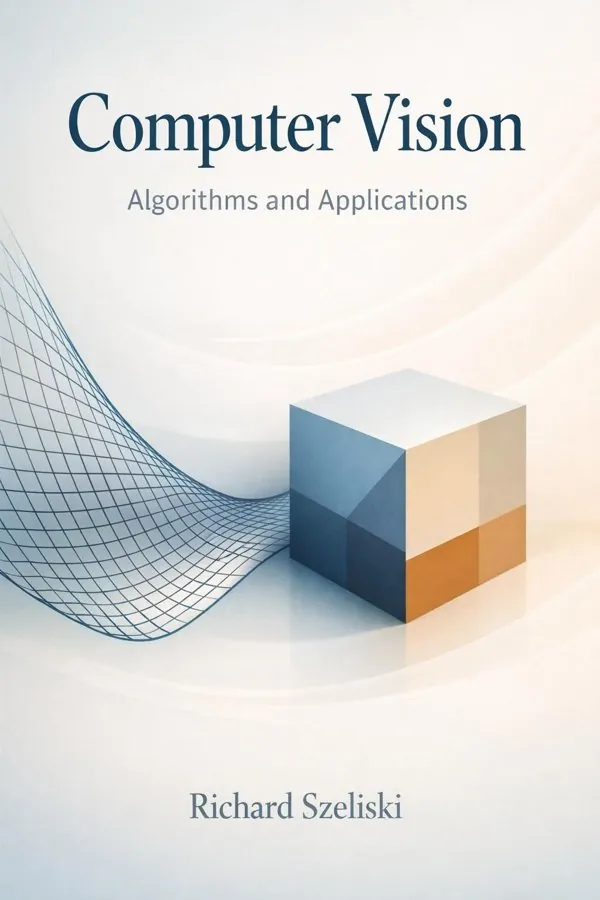
Computer Vision: Algorithms and Applications: Summary & Key Insights
 10 min13 chaptersAudio available
What Is Computer Vision: Algorithms and Applications About?
Computer Vision: Algorithms and Applications by Richard Szeliski is a ai_ml book spanning 13 pages. This comprehensive textbook provides a detailed introduction to computer vision, covering fundamental algorithms and applications. It explores image formation, feature detection, motion estimation, 3D reconstruction, and object recognition, integrating mathematical foundations with practical examples. The book is widely used in academic courses and research for its clear explanations and extensive references.
This FizzRead summary covers all 13 key chapters of Computer Vision: Algorithms and Applications in approximately 10 minutes, distilling the most important ideas, arguments, and takeaways from Richard Szeliski's work. Also available as an audio summary and Key Quotes Podcast.
Computer Vision: Algorithms and Applications
This comprehensive textbook provides a detailed introduction to computer vision, covering fundamental algorithms and applications. It explores image formation, feature detection, motion estimation, 3D reconstruction, and object recognition, integrating mathematical foundations with practical examples. The book is widely used in academic courses and research for its clear explanations and extensive references.
Who Should Read Computer Vision: Algorithms and Applications?
This book is perfect for anyone interested in ai_ml and looking to gain actionable insights in a short read. Whether you're a student, professional, or lifelong learner, the key ideas from Computer Vision: Algorithms and Applications by Richard Szeliski will help you think differently.
- ✓Readers who enjoy ai_ml and want practical takeaways
- ✓Professionals looking to apply new ideas to their work and life
- ✓Anyone who wants the core insights of Computer Vision: Algorithms and Applications in just 10 minutes
Want the full summary?
Get instant access to this book summary and 100K+ more with Fizz Moment.
Get Free SummaryAvailable on App Store • Free to download
Key Chapters
Every understanding of vision begins with how images come into being. In this section, I help you step inside the geometry and physics that govern image creation. A camera doesn’t simply record reality; it transforms light rays into a two-dimensional projection governed by perspective, depth, and the behavior of lenses.
We study pinhole cameras, where each point in the scene corresponds to a line of sight toward the image plane, producing a mathematically ideal projection. Real cameras, with lenses and apertures, modify that projection through focal length and distortion. To model them, we rely on projective geometry and coordinate transformations — essential tools for relating the physical world to its digital encoding.
Radiometry deepens our understanding by quantifying how light intensity translates into pixel values. Surfaces reflect light differently depending on material and orientation, while sensors vary in spectral response and noise characteristics. Understanding radiometric processes lets us simulate or correct images under differing illumination, a key step in color constancy and photometric calibration.
From this foundation, we build camera models that capture both intrinsic parameters (focal length, optical center, distortion) and extrinsic parameters (position and orientation in space). These parameters become the bridge between 3D reality and its digital representation, enabling geometric reasoning for reconstruction and measurement. To capture images accurately, we must calibrate these parameters — a process that lies at the heart of all precise computer vision work.
When you first capture an image, it is simply an array of pixel intensities. To reveal structure, we process it. I discuss filtering — convolution operations that smooth or sharpen, suppress noise, or enhance features. Gaussian filters soften detail, while edge-detection kernels highlight abrupt intensity changes. The mathematics of convolution and Fourier analysis reveal how images can be decomposed into frequency components, making filtering a matter not just of pixels but of harmonic structure.
We then move into multi-scale representation, where image pyramids allow analysis at different resolutions. This principle matters profoundly. By observing patterns from coarse to fine scales, we replicate biological vision’s adaptability and efficiently handle objects of varying size. Image pyramids underpin many features, motion, and recognition algorithms; they facilitate hierarchical reasoning that mirrors the human visual process.
At this stage, I also emphasize the balance between enhancement and preservation. Filtering removes noise but can blur important edges; edge detectors clarify boundaries but amplify false texture. Understanding trade-offs and adjusting algorithms to the task is part of the craft. Through these operations, an image evolves from raw data into structured information, ready for interpretation.
+ 11 more chapters — available in the FizzRead app
All Chapters in Computer Vision: Algorithms and Applications
About the Author
Richard Szeliski is a computer scientist known for his contributions to computer vision and computational photography. He has worked at Microsoft Research and has published extensively in the field, influencing both academic research and practical applications.
Get This Summary in Your Preferred Format
Read or listen to the Computer Vision: Algorithms and Applications summary by Richard Szeliski anytime, anywhere. FizzRead offers multiple formats so you can learn on your terms — all free.
Available formats: App · Audio · PDF · EPUB — All included free with FizzRead
Download Computer Vision: Algorithms and Applications PDF and EPUB Summary
Key Quotes from Computer Vision: Algorithms and Applications
“Every understanding of vision begins with how images come into being.”
“When you first capture an image, it is simply an array of pixel intensities.”
Frequently Asked Questions about Computer Vision: Algorithms and Applications
Computer Vision: Algorithms and Applications by Richard Szeliski is a ai_ml book that explores key ideas across 13 chapters. This comprehensive textbook provides a detailed introduction to computer vision, covering fundamental algorithms and applications. It explores image formation, feature detection, motion estimation, 3D reconstruction, and object recognition, integrating mathematical foundations with practical examples. The book is widely used in academic courses and research for its clear explanations and extensive references.
You Might Also Like
Life 3.0
Max Tegmark
10 min
Superintelligence
Nick Bostrom
10 min
TensorFlow in Action
Thushan Ganegedara
10 min
AI Made Simple: A Beginner’s Guide to Generative AI, ChatGPT, and the Future of Work
Rajeev Kapur
10 min
AI Snake Oil
Arvind Narayanan, Sayash Kapoor
10 min
AI Superpowers: China, Silicon Valley, and the New World Order
Kai-Fu Lee
10 minBrowse by Category
Ready to read Computer Vision: Algorithms and Applications?
Get the full summary and 100K+ more books with Fizz Moment.