
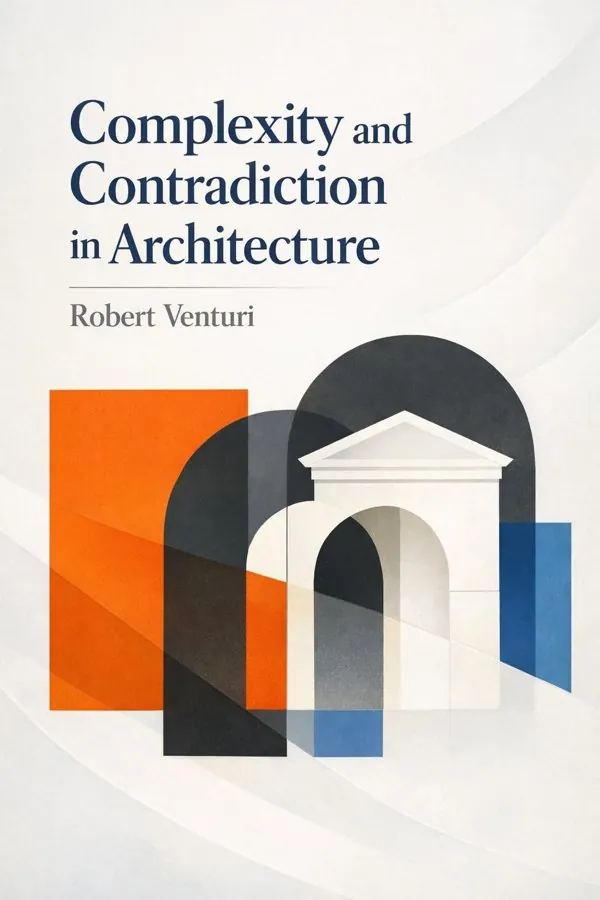
Complexity and Contradiction in Architecture: Summary & Key Insights
 10 min10 chaptersAudio available
What Is Complexity and Contradiction in Architecture About?
Complexity and Contradiction in Architecture by Robert Venturi is a design book spanning 10 pages. Originally published in 1966, this seminal work by architect Robert Venturi challenges the modernist orthodoxy of simplicity and purity in architectural design. Venturi advocates for embracing complexity, contradiction, and historical reference, arguing that architecture should reflect the richness and ambiguity of real life rather than adhere to rigid formalism. The book became a cornerstone of postmodern architectural theory and remains influential in architectural education and practice.
This FizzRead summary covers all 10 key chapters of Complexity and Contradiction in Architecture in approximately 10 minutes, distilling the most important ideas, arguments, and takeaways from Robert Venturi's work. Also available as an audio summary and Key Quotes Podcast.
Complexity and Contradiction in Architecture
Originally published in 1966, this seminal work by architect Robert Venturi challenges the modernist orthodoxy of simplicity and purity in architectural design. Venturi advocates for embracing complexity, contradiction, and historical reference, arguing that architecture should reflect the richness and ambiguity of real life rather than adhere to rigid formalism. The book became a cornerstone of postmodern architectural theory and remains influential in architectural education and practice.
Who Should Read Complexity and Contradiction in Architecture?
This book is perfect for anyone interested in design and looking to gain actionable insights in a short read. Whether you're a student, professional, or lifelong learner, the key ideas from Complexity and Contradiction in Architecture by Robert Venturi will help you think differently.
- ✓Readers who enjoy design and want practical takeaways
- ✓Professionals looking to apply new ideas to their work and life
- ✓Anyone who wants the core insights of Complexity and Contradiction in Architecture in just 10 minutes
Want the full summary?
Get instant access to this book summary and 100K+ more with Fizz Moment.
Get Free SummaryAvailable on App Store • Free to download
Key Chapters
At the heart of this work lies the conviction that complexity and contradiction are not flaws to be purified from architecture, but vital expressions of reality itself. The modernist desire for unity, clarity, and cleanliness—best epitomized by the glass boxes and white planes of the International Style—pretends that the world can be reduced to a rational order. But human experience is never that simple. Life is full of tensions: between public and private, function and form, change and permanence. Architecture, as the setting of life, must reflect these oppositions.
I argue that when we embrace complexity, we accept that contradiction is inherent to meaning. A building may be formally composed yet functionally ambiguous; a façade may conceal as much as it reveals. In these layers of contradiction lies richness—the ability of architecture to speak to multiple audiences, to engage several levels of experience. The modernist pursuit of simplicity rejects this potential. Yet as I show throughout, the greatest works—from the Campidoglio in Rome to Las Vegas’s vernacular clutter—find beauty in the union of opposition.
The key is not chaos but controlled complexity, not random disunity but the thoughtful coexistence of diverse elements. The architect must structure contradictions within an ordered whole, making them resonate rather than cancel each other. In doing so, the building achieves not simplicity but a kind of difficult wholeness, one that mirrors the paradoxes of modern life.
Architectural elements are never merely functional—nor should they be. The modernist impulse reduced walls to structural membranes, columns to weight-bearing devices, and ornament to unnecessary residue. But such reduction ignores the dual nature of every architectural element: it can both serve a physical purpose and communicate symbolic meaning.
A column, for instance, holds up a beam, but it also expresses rhythm, hierarchy, and presence. A façade divides inside from outside, yet it also mediates between them, marking identity and character. When we acknowledge the double function of elements, we allow architecture to regain its expressive power. Michelangelo understood this when he distorted classical orders to convey tension and movement. Modern architects must relearn this lesson—not to abandon function, but to understand that function itself can be enriched through symbolism.
In the complexity of double meanings, architecture speaks more fully. Every door is an invitation and a barrier; every wall is both support and surface of experience. The richness of architecture comes from recognizing and orchestrating these dualities rather than suppressing them in the name of purity.
+ 8 more chapters — available in the FizzRead app
All Chapters in Complexity and Contradiction in Architecture
About the Author
Robert Venturi (1925–2018) was an American architect and theorist, widely regarded as one of the leading figures in postmodern architecture. He co-founded Venturi, Scott Brown and Associates with Denise Scott Brown and contributed to redefining architectural thought through his writings and designs that celebrated historical context, ornament, and complexity.
Get This Summary in Your Preferred Format
Read or listen to the Complexity and Contradiction in Architecture summary by Robert Venturi anytime, anywhere. FizzRead offers multiple formats so you can learn on your terms — all free.
Available formats: App · Audio · PDF · EPUB — All included free with FizzRead
Download Complexity and Contradiction in Architecture PDF and EPUB Summary
Key Quotes from Complexity and Contradiction in Architecture
“At the heart of this work lies the conviction that complexity and contradiction are not flaws to be purified from architecture, but vital expressions of reality itself.”
“Architectural elements are never merely functional—nor should they be.”
Frequently Asked Questions about Complexity and Contradiction in Architecture
Complexity and Contradiction in Architecture by Robert Venturi is a design book that explores key ideas across 10 chapters. Originally published in 1966, this seminal work by architect Robert Venturi challenges the modernist orthodoxy of simplicity and purity in architectural design. Venturi advocates for embracing complexity, contradiction, and historical reference, arguing that architecture should reflect the richness and ambiguity of real life rather than adhere to rigid formalism. The book became a cornerstone of postmodern architectural theory and remains influential in architectural education and practice.
More by Robert Venturi
You Might Also Like

The Design of Everyday Things
Don Norman
10 min
The Better Angels of Our Nature
Steven Pinker
10 min
A Designer's Art
Paul Rand
10 min
Architects' Sketchbooks
Various Editors
10 min
Architectural Graphic Standards
The American Institute of Architects
10 min
Design Is Storytelling
Ellen Lupton
10 minFeatured In
Browse by Category
Ready to read Complexity and Contradiction in Architecture?
Get the full summary and 100K+ more books with Fizz Moment.