
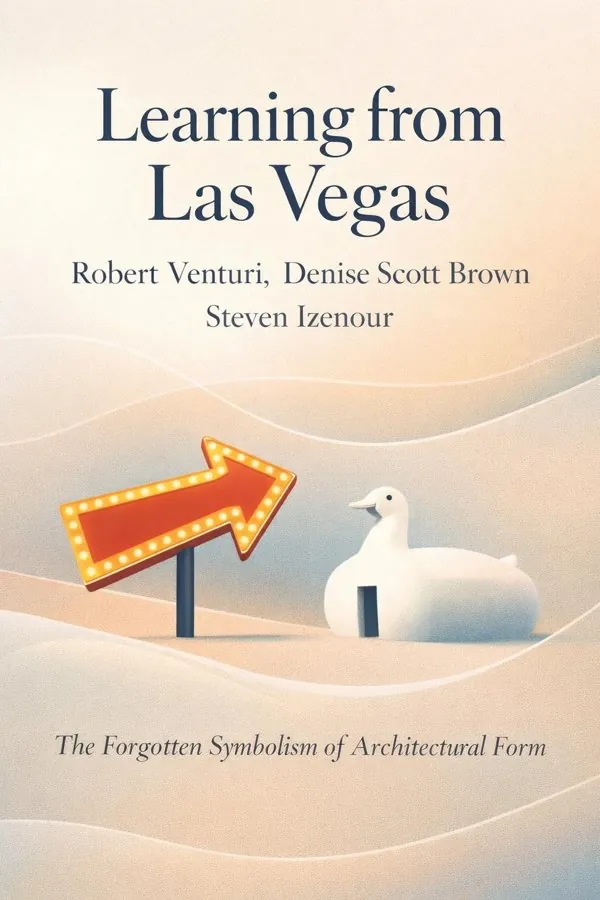
Learning from Las Vegas: The Forgotten Symbolism of Architectural Form: Summary & Key Insights
by Robert Venturi, Denise Scott Brown, Steven Izenour
 10 min8 chaptersAudio available
What Is Learning from Las Vegas: The Forgotten Symbolism of Architectural Form About?
Learning from Las Vegas: The Forgotten Symbolism of Architectural Form by Robert Venturi, Denise Scott Brown, Steven Izenour is a design book spanning 8 pages. Originally published in 1972, this influential architectural theory book challenges modernist ideals by examining the vernacular architecture and commercial landscape of Las Vegas. Venturi, Scott Brown, and Izenour argue for embracing symbolism, ornament, and popular culture in architecture, contrasting the 'Duck' and 'Decorated Shed' as metaphors for architectural communication. The work became a cornerstone of postmodern architectural thought.
This FizzRead summary covers all 8 key chapters of Learning from Las Vegas: The Forgotten Symbolism of Architectural Form in approximately 10 minutes, distilling the most important ideas, arguments, and takeaways from Robert Venturi, Denise Scott Brown, Steven Izenour's work. Also available as an audio summary and Key Quotes Podcast.
Learning from Las Vegas: The Forgotten Symbolism of Architectural Form
Originally published in 1972, this influential architectural theory book challenges modernist ideals by examining the vernacular architecture and commercial landscape of Las Vegas. Venturi, Scott Brown, and Izenour argue for embracing symbolism, ornament, and popular culture in architecture, contrasting the 'Duck' and 'Decorated Shed' as metaphors for architectural communication. The work became a cornerstone of postmodern architectural thought.
Who Should Read Learning from Las Vegas: The Forgotten Symbolism of Architectural Form?
This book is perfect for anyone interested in design and looking to gain actionable insights in a short read. Whether you're a student, professional, or lifelong learner, the key ideas from Learning from Las Vegas: The Forgotten Symbolism of Architectural Form by Robert Venturi, Denise Scott Brown, Steven Izenour will help you think differently.
- ✓Readers who enjoy design and want practical takeaways
- ✓Professionals looking to apply new ideas to their work and life
- ✓Anyone who wants the core insights of Learning from Las Vegas: The Forgotten Symbolism of Architectural Form in just 10 minutes
Want the full summary?
Get instant access to this book summary and 100K+ more with Fizz Moment.
Get Free SummaryAvailable on App Store • Free to download
Key Chapters
Before we turned our gaze toward the glowing facades of the Strip, we knew we had to confront the ideology that had silenced architectural expression. Modernist architecture had been founded on the noble promise of honesty — to express structure and function truthfully, free of ornament and historical reference. The glass box, the white wall, the exposed beam all embodied this ethic of purity. Yet, in its quest for moral clarity, modernism had gradually stripped away the symbols that allowed buildings to communicate meaning.
This purism was a rebellion against the historic overload of ornament, but with time it became its own dogma. Architects began to believe that meaning should be inherent in form alone — that the building’s structure could somehow speak for itself. But the truth we discovered is that architecture, when severed from social and cultural symbolism, loses its ability to connect with people. It becomes autonomous, abstract, and aloof.
In the mid-twentieth century, modernism dominated architectural education and practice. Mies van der Rohe’s dictum “less is more” guided the design of corporate towers and civic monuments alike. But while these buildings were technically and aesthetically refined, their communication was impoverished. They were beautiful, but they were silent. Meanwhile, outside the profession’s ivory tower, ordinary places — roadside motels, fast food restaurants, and billboards — were alive with meaning. They spoke the language of commerce and emotion that modernism refused to acknowledge.
Our critique does not reject modernism entirely; rather, it calls for its expansion. Architecture must rediscover its dual nature — not only as a shelter of function but as a medium of communication. By turning toward Las Vegas, we sought to expose modernism’s blind spot: its failure to grasp that architecture is a symbol system before it is a structural system. To understand meaning in architecture, we had to step outside the museum and into the street.
Our exploration of Las Vegas was not a pilgrimage to kitsch; it was an empirical study of a living urban environment. We treated the Strip as a classroom — one where every billboard, parking lot, and sign offered clues to how people perceive and navigate space. With students from Yale, we conducted photographic and analytical surveys, measuring the scale of buildings, the visibility of signage from moving cars, and the choreography of light and motion. The Strip was a new kind of urban composition, governed not by axial symmetry or classical proportion but by communication.
Driving down Las Vegas Boulevard was a lesson in spatial psychology. Unlike traditional urban centers, the Strip is designed for speed — for perception while in motion. The pedestrian’s intimacy is replaced by the driver’s glance. Signs compete for attention not through subtlety but through visibility, scale, and clarity of message. Architecture here is not sculptural; it is graphic, linguistic, and experiential.
Through our analytic lens, the Strip revealed an unexpected order. What at first appears chaotic is actually a system of clear communication. The signs, separated by great distances, organize space through their visual hierarchy. They define destinations and edges in ways that abstract modernist plazas never could. The Strip’s landscape works precisely because it acknowledges how people truly interact with their environment: through signs, signals, and recognizable symbols.
We documented this environment not to romanticize it but to understand its lessons. The Strip taught us that communication, not form, is architecture’s primary function in popular culture. The city of signs is not the death of architecture; it is the evolution of it. By studying Las Vegas, we were learning how architecture could recover its voice — how to design spaces that speak clearly to the public imagination.
+ 6 more chapters — available in the FizzRead app
All Chapters in Learning from Las Vegas: The Forgotten Symbolism of Architectural Form
About the Authors
Robert Venturi (1925–2018) was an American architect and theorist known for his role in shaping postmodern architecture. Denise Scott Brown (born 1931) is an architect, urban planner, and educator whose collaborative work with Venturi profoundly influenced architectural theory. Steven Izenour (1940–2001) was an architect and urban designer who contributed to the study of urban symbolism and popular architecture.
Get This Summary in Your Preferred Format
Read or listen to the Learning from Las Vegas: The Forgotten Symbolism of Architectural Form summary by Robert Venturi, Denise Scott Brown, Steven Izenour anytime, anywhere. FizzRead offers multiple formats so you can learn on your terms — all free.
Available formats: App · Audio · PDF · EPUB — All included free with FizzRead
Download Learning from Las Vegas: The Forgotten Symbolism of Architectural Form PDF and EPUB Summary
Key Quotes from Learning from Las Vegas: The Forgotten Symbolism of Architectural Form
“Before we turned our gaze toward the glowing facades of the Strip, we knew we had to confront the ideology that had silenced architectural expression.”
“Our exploration of Las Vegas was not a pilgrimage to kitsch; it was an empirical study of a living urban environment.”
Frequently Asked Questions about Learning from Las Vegas: The Forgotten Symbolism of Architectural Form
Learning from Las Vegas: The Forgotten Symbolism of Architectural Form by Robert Venturi, Denise Scott Brown, Steven Izenour is a design book that explores key ideas across 8 chapters. Originally published in 1972, this influential architectural theory book challenges modernist ideals by examining the vernacular architecture and commercial landscape of Las Vegas. Venturi, Scott Brown, and Izenour argue for embracing symbolism, ornament, and popular culture in architecture, contrasting the 'Duck' and 'Decorated Shed' as metaphors for architectural communication. The work became a cornerstone of postmodern architectural thought.
You Might Also Like

The Design of Everyday Things
Don Norman
10 min
The Better Angels of Our Nature
Steven Pinker
10 min
A Designer's Art
Paul Rand
10 min
Architects' Sketchbooks
Various Editors
10 min
Architectural Graphic Standards
The American Institute of Architects
10 min
Design Is Storytelling
Ellen Lupton
10 minBrowse by Category
Ready to read Learning from Las Vegas: The Forgotten Symbolism of Architectural Form?
Get the full summary and 100K+ more books with Fizz Moment.