
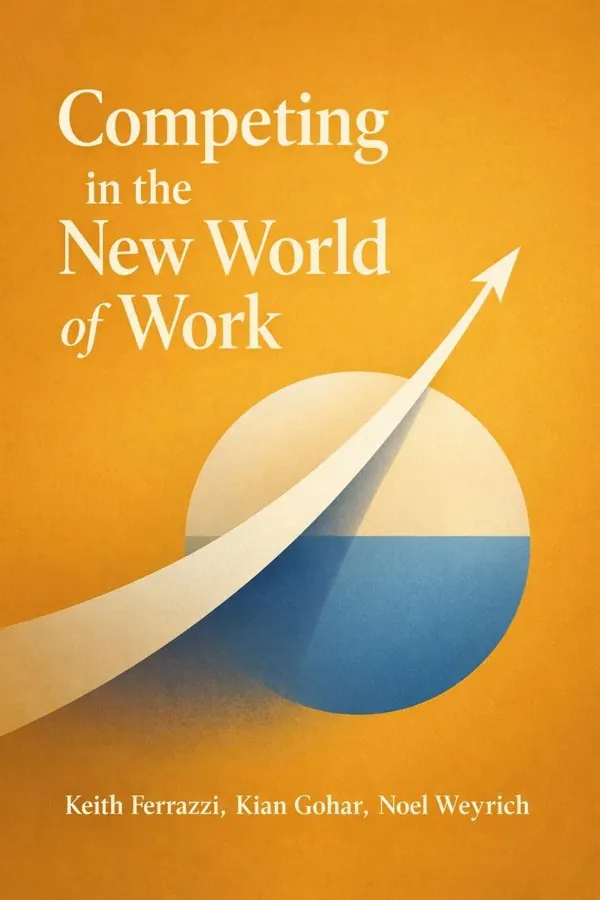
Competing in the New World of Work: How Radical Adaptability Separates the Best from the Rest: Summary & Key Insights
by Keith Ferrazzi, Kian Gohar, Noel Weyrich
 10 min10 chaptersAudio available
Key Takeaways from Competing in the New World of Work: How Radical Adaptability Separates the Best from the Rest
The biggest mistake leaders can make is treating recent disruption as a temporary detour instead of a permanent reset.
Adaptation is often misunderstood as simple flexibility, but the authors argue that true adaptability is a system of capabilities.
In unstable environments, waiting for certainty is often a disguised form of avoidance.
Most organizations do strategic planning as if tomorrow will resemble today with minor adjustments.
Organizations often say they value agility while preserving systems that make fast learning impossible.
What Is Competing in the New World of Work: How Radical Adaptability Separates the Best from the Rest About?
Competing in the New World of Work: How Radical Adaptability Separates the Best from the Rest by Keith Ferrazzi, Kian Gohar, Noel Weyrich is a leadership book spanning 11 pages. Competing in the New World of Work argues that the future of leadership will not be won by the biggest, oldest, or most efficient organizations, but by those that can adapt fastest without losing trust, performance, or humanity. Keith Ferrazzi, Kian Gohar, and Noel Weyrich examine how the pandemic accelerated trends that were already reshaping business: digital collaboration, hybrid teams, employee expectations for flexibility, and the need for constant reinvention. Their central claim is that success now depends on “radical adaptability,” a discipline that helps leaders respond to disruption with courage, foresight, agility, and inclusion. What makes this book especially useful is its blend of research and real-world application. Ferrazzi is widely known for his work on high-performing teams and collaborative leadership, while Gohar brings expertise in futurism and innovation, and Weyrich helps translate these ideas into practical guidance. Together, they offer a framework for rethinking management, teamwork, culture, and innovation in a world where uncertainty is permanent. For leaders trying to build resilient organizations rather than merely survive change, this book provides both a mindset shift and an operating model.
This FizzRead summary covers all 10 key chapters of Competing in the New World of Work: How Radical Adaptability Separates the Best from the Rest in approximately 10 minutes, distilling the most important ideas, arguments, and takeaways from Keith Ferrazzi, Kian Gohar, Noel Weyrich's work. Also available as an audio summary and Key Quotes Podcast.
Competing in the New World of Work: How Radical Adaptability Separates the Best from the Rest
Competing in the New World of Work argues that the future of leadership will not be won by the biggest, oldest, or most efficient organizations, but by those that can adapt fastest without losing trust, performance, or humanity. Keith Ferrazzi, Kian Gohar, and Noel Weyrich examine how the pandemic accelerated trends that were already reshaping business: digital collaboration, hybrid teams, employee expectations for flexibility, and the need for constant reinvention. Their central claim is that success now depends on “radical adaptability,” a discipline that helps leaders respond to disruption with courage, foresight, agility, and inclusion.
What makes this book especially useful is its blend of research and real-world application. Ferrazzi is widely known for his work on high-performing teams and collaborative leadership, while Gohar brings expertise in futurism and innovation, and Weyrich helps translate these ideas into practical guidance. Together, they offer a framework for rethinking management, teamwork, culture, and innovation in a world where uncertainty is permanent. For leaders trying to build resilient organizations rather than merely survive change, this book provides both a mindset shift and an operating model.
Who Should Read Competing in the New World of Work: How Radical Adaptability Separates the Best from the Rest?
This book is perfect for anyone interested in leadership and looking to gain actionable insights in a short read. Whether you're a student, professional, or lifelong learner, the key ideas from Competing in the New World of Work: How Radical Adaptability Separates the Best from the Rest by Keith Ferrazzi, Kian Gohar, Noel Weyrich will help you think differently.
- ✓Readers who enjoy leadership and want practical takeaways
- ✓Professionals looking to apply new ideas to their work and life
- ✓Anyone who wants the core insights of Competing in the New World of Work: How Radical Adaptability Separates the Best from the Rest in just 10 minutes
Want the full summary?
Get instant access to this book summary and 100K+ more with Fizz Moment.
Get Free SummaryAvailable on App Store • Free to download
Key Chapters
The biggest mistake leaders can make is treating recent disruption as a temporary detour instead of a permanent reset. The book begins with the idea that the pandemic did not create a new world of work from scratch; it accelerated changes already underway. Digitization, distributed teams, asynchronous collaboration, employee demands for autonomy, and a stronger focus on well-being were already emerging. Crisis simply compressed years of change into months.
That matters because many organizations still respond with outdated assumptions. They believe productivity depends on physical presence, culture depends on office proximity, and control is the same as leadership. But employees have now seen that work can be organized differently. They expect flexibility, meaningful contribution, and leaders who treat them as adults rather than resources to be monitored.
The authors show that this shift is not only about location. It is about redefining how value is created. Teams now rely on digital tools, cross-functional coordination, and faster decision cycles. Performance comes less from rigid hierarchy and more from clarity, trust, and responsiveness. Companies that cling to old structures risk losing talent and relevance, while those that redesign work around outcomes can move faster and innovate more effectively.
A practical implication is that leaders should audit inherited work norms. Which meetings exist from habit? Which approvals slow execution? Which expectations actually improve results? Instead of asking how to restore the old normal, ask what new operating model best fits current realities. Actionable takeaway: treat work redesign as a strategic priority, not an HR adjustment.
Adaptation is often misunderstood as simple flexibility, but the authors argue that true adaptability is a system of capabilities. Their research identifies four interdependent dimensions: courage, foresight, agility, and inclusion. Together, these qualities separate organizations that react chaotically from those that evolve intelligently.
Courage is the willingness to confront uncertainty, challenge assumptions, and make hard calls before all the data is available. Foresight is the ability to scan the environment, anticipate shifts, and prepare for multiple futures instead of betting on one forecast. Agility is the capacity to move quickly, learn in motion, and reconfigure teams and processes as conditions change. Inclusion ensures that a wide range of voices, experiences, and perspectives are involved, improving both innovation and commitment.
The power of the framework lies in how the four dimensions reinforce one another. Courage without foresight becomes reckless. Foresight without agility becomes analysis paralysis. Agility without inclusion can produce speed but not trust. Inclusion without courage may create conversation without decisions. Radical adaptability emerges only when all four operate together.
In practice, leaders can use this model diagnostically. A company struggling with innovation may not lack ideas; it may lack psychological safety or diverse input. A team slow to execute may not lack talent; it may lack clear authority to act. The framework helps leaders identify where breakdowns occur.
Actionable takeaway: assess your team against the four dimensions and identify the weakest one first, because your lowest capability usually becomes your biggest constraint during change.
In unstable environments, waiting for certainty is often a disguised form of avoidance. The book argues that courageous leadership is not about bold speeches or personal charisma. It is about stepping into ambiguity, naming uncomfortable truths, and making decisions before conditions feel fully safe.
Many leaders hesitate because they fear being wrong, upsetting stakeholders, or disrupting established systems. Yet in periods of rapid change, delay itself becomes a decision. The authors show that courageous leaders are willing to question legacy practices, admit what they do not know, and invite challenge from others. This kind of courage is deeply practical. It allows organizations to experiment earlier, correct faster, and avoid the larger costs of denial.
For example, a leader facing declining engagement in a hybrid team might resist forcing a return to office simply to reassert control. Instead, courage would mean acknowledging that old management methods no longer fit, involving employees in redesigning collaboration norms, and testing new workflows. Similarly, companies confronting digital disruption must often stop protecting familiar revenue models long enough to build future ones.
Courage also includes interpersonal honesty. Teams perform better when leaders can address underperformance, conflict, or strategic confusion directly rather than allowing dysfunction to spread. Candor, handled with care, creates clarity and momentum.
Actionable takeaway: identify one difficult reality your team is avoiding and address it openly this week. Courage begins with naming what everyone senses but no one is saying.
Most organizations do strategic planning as if tomorrow will resemble today with minor adjustments. The authors argue that this mindset is no longer sufficient. In the new world of work, leaders need foresight: the disciplined practice of noticing signals of change early and preparing for multiple plausible futures.
Foresight is not prediction. It does not require perfect accuracy. Instead, it helps organizations reduce surprise and improve readiness. Leaders should scan technological, social, economic, and workforce trends, then ask how these developments could reshape customer behavior, talent expectations, and competitive advantage. This shifts planning from static budgeting to dynamic scenario thinking.
A practical example is workforce design. Rather than assuming a fixed organizational chart, leaders can imagine several future states: more automation, more freelance expertise, more global collaboration, or changing employee expectations around flexibility. From there, they can build capabilities that remain useful across scenarios, such as digital fluency, stronger knowledge sharing, or modular team structures.
Foresight also requires creating channels for weak signals. Frontline employees, customers, younger workers, and external partners often see emerging shifts before senior executives do. Organizations that listen broadly gain earlier insight into what is changing.
The book encourages leaders to move from reactive planning to active sensing. Instead of asking, “What is our plan?” ask, “What assumptions is our plan based on, and what would make those assumptions obsolete?” That question alone can sharpen strategic awareness.
Actionable takeaway: run a quarterly future-readiness session in which your team identifies three emerging trends, three risks to current assumptions, and one capability to strengthen now.
Organizations often say they value agility while preserving systems that make fast learning impossible. The book defines agility not as frantic motion, but as the ability to adjust quickly while staying aligned on purpose. Agile organizations shorten feedback loops, distribute decision-making appropriately, and treat experimentation as part of normal operations.
Traditional structures assume stability: long planning cycles, narrow roles, multiple layers of approval, and rigid performance metrics. In volatile conditions, these systems create drag. By the time a decision moves upward and back down, reality has changed. The authors argue that agility requires redesigning how work happens, not merely asking people to move faster inside old bureaucracies.
Examples include small cross-functional teams empowered to solve specific problems, pilot programs that test ideas before large-scale rollout, and regular retrospectives that convert experience into improvement. In hybrid settings, agility may also mean clarifying which decisions require synchronous discussion and which can happen asynchronously through shared digital tools.
Importantly, agility depends on clarity. Teams cannot adapt well if priorities constantly shift without explanation. Fast-changing environments require an even stronger shared understanding of goals, decision rights, and measures of success. Otherwise, speed becomes confusion.
The authors also suggest that leaders stop treating mistakes as evidence of incompetence. In adaptive organizations, not every experiment succeeds, but every experiment should generate insight. What matters is whether the team learns quickly enough to improve the next move.
Actionable takeaway: choose one major process your team uses and ask how you can cut one approval, shorten one feedback cycle, and run one low-risk experiment within the next month.
When pressure rises, many organizations become less inclusive precisely when they most need broader perspective. The authors argue that inclusion is not merely a moral or cultural ideal; it is a strategic capability. In uncertain environments, better decisions come from hearing more of what is true, especially from people who see risks, opportunities, and blind spots that leaders may miss.
Inclusion strengthens adaptability in several ways. First, diverse perspectives improve problem-solving. A team with different backgrounds, functions, and ways of thinking is more likely to challenge flawed assumptions and generate novel solutions. Second, inclusion increases commitment. People are more willing to support change when they have been heard and respected. Third, inclusion improves sensing. Employees closest to customers, operations, or emerging technologies often spot important signals early.
The book emphasizes that inclusion is not the same as consensus. Leaders still need to decide. But they must create environments where dissent is safe, input is genuinely welcomed, and contributions are evaluated on merit rather than status. In hybrid or remote settings, inclusion also means rethinking meeting design. Who speaks most? Who is overlooked? Are remote participants equal contributors or passive observers?
Simple practices can make a difference: rotating facilitation, inviting written input before meetings, actively surfacing minority views, and rewarding candor. Over time, these habits build psychological safety and stronger team intelligence.
Actionable takeaway: in your next important meeting, explicitly ask for one contrary view, one frontline observation, and one perspective from someone who has spoken least. Inclusion becomes real when participation changes decisions.
The unit of performance in modern organizations is no longer the isolated individual but the team, yet many leaders still manage people as if work were mostly solo and predictable. The authors argue that in the new world of work, teams need to be redesigned for fluidity, accountability, and collaboration across boundaries.
This means moving away from static hierarchies toward more adaptive team structures. Instead of assuming that every challenge fits neatly within a department, leaders should build temporary or semi-permanent cross-functional teams around priorities. These teams can draw expertise from different parts of the organization, solve problems faster, and dissolve or reconfigure as needs change.
The book also introduces a more dynamic view of team leadership. The leader is not merely a supervisor assigning tasks, but an orchestrator of trust, candor, and shared accountability. High-performing teams establish clear commitments, regularly evaluate how they are working, and confront interpersonal issues before they harden into politics.
A practical example is a product launch involving marketing, operations, customer success, and engineering. In a traditional model, each function optimizes its own part and coordination happens late. In a radically adaptable model, the team works as one system from the outset, aligning on outcomes, dependencies, and customer impact.
Hybrid work makes intentional team design even more important. Without clear norms for communication, decision-making, and collaboration, distributed teams can drift into silos.
Actionable takeaway: map one critical business priority and ask whether your current team structure supports it. If not, create a cross-functional team with explicit goals, timelines, and working agreements.
One of Keith Ferrazzi’s signature ideas is co-elevation: the practice of helping one another rise through shared commitment, candor, and mutual accountability. In this book, that idea becomes central to innovation in the new world of work. The authors argue that breakthrough performance comes not from lone heroes but from teams that challenge and elevate each other continuously.
Co-elevation combines generosity with rigor. Team members actively support one another’s success, but they also hold each other to ambitious standards. This creates an environment where feedback is normal, ideas are improved collaboratively, and people are less defensive because accountability is shared. In uncertain times, such cultures adapt faster because they do not waste energy protecting ego or territory.
Innovation especially benefits from this model. New ideas rarely emerge fully formed. They improve through testing, critique, and iteration across different perspectives. A co-elevating team can debate forcefully without becoming fragmented, because members are united by a common mission rather than individual status.
For example, a leadership team facing declining customer loyalty might openly examine failures, invite criticism of existing strategy, and jointly commit to experiments that no one function could manage alone. That process is more demanding than polite harmony, but it produces better learning and stronger ownership.
The authors suggest replacing performative collaboration with active contribution. The question shifts from “Did we work together?” to “Did we make one another better?”
Actionable takeaway: introduce a recurring team practice in which members share one way they can support a colleague and one challenge they need the team’s honest help to solve.
A burned-out workforce cannot sustain excellence, no matter how ambitious the strategy. The book challenges the false tradeoff between high performance and employee well-being. In the new world of work, the authors argue, resilience depends on integrating both. Organizations that ignore human limits may get short bursts of output, but they erode creativity, trust, and long-term execution.
The pandemic exposed how deeply personal and professional lives are interconnected. Employees are not leaving stress, caregiving, health concerns, or emotional fatigue at the door, especially when the door is now digital. Adaptive leaders recognize this reality and design systems that support sustainable contribution. That includes clear priorities, healthier meeting norms, workload transparency, flexibility where possible, and a culture that does not reward constant exhaustion.
This is not about lowering standards. In fact, the authors make the opposite case: well-being is a performance strategy. People make better decisions, collaborate more effectively, and stay engaged longer when they have psychological safety and manageable conditions for focus. Leaders should watch for signs of overload not as a personal weakness in employees, but as data about how work is being designed.
Practical steps include auditing unnecessary demands, defining response-time expectations, encouraging real recovery time, and training managers to discuss workload and energy openly. High-performing cultures become more durable when they respect human capacity.
Actionable takeaway: ask your team which recurring practices create the most unnecessary stress and remove or redesign at least one of them. Sustainable performance starts with intentional subtraction.
The strongest organizations do not reinvent themselves once during crisis; they build reinvention into how they operate. The book’s broader message is that radical adaptability is not a one-time initiative but an enduring cultural capability. The winners in the new world of work are those that keep learning, adjusting, and renewing themselves before disruption forces them to.
This requires more than slogans about innovation. It means institutionalizing reflection, experimentation, and honest feedback. Leaders must reward learning, not just short-term certainty. Teams need regular opportunities to review what is changing externally, what is not working internally, and what new behaviors or structures are needed. Culture, in this sense, becomes a mechanism for evolution.
The authors support this message with research insights and examples showing that high-performing organizations share common habits: they scan for change, invite broad input, make decisions faster, and revisit assumptions frequently. Their competitive edge comes less from any single policy than from the ability to evolve repeatedly.
A practical application is building a cadence of reinvention. Quarterly reviews can examine not only business metrics but also collaboration patterns, customer shifts, capability gaps, and cultural friction. Leaders can ask: What should we stop, start, and redesign? Which assumptions no longer serve us? Where are we overbuilt for a world that no longer exists?
In a volatile era, stability does not come from rigidity. It comes from learning faster than the environment changes.
Actionable takeaway: create a standing reinvention ritual for your team or organization, with time set aside to challenge assumptions, retire outdated practices, and test better ways of working.
All Chapters in Competing in the New World of Work: How Radical Adaptability Separates the Best from the Rest
About the Authors
Keith Ferrazzi is an American entrepreneur, leadership expert, and founder of Ferrazzi Greenlight, a consulting firm focused on team performance, collaboration, and organizational transformation. He is widely known for bestselling books such as Never Eat Alone and Leading Without Authority. Kian Gohar is a futurist, innovation strategist, and speaker whose work explores how emerging trends reshape leadership, work, and competitiveness. He helps organizations think more clearly about the future and prepare for disruption. Noel Weyrich is a writer and editor specializing in business and leadership content, with a talent for turning complex ideas into practical, engaging guidance. Together, the three authors combine expertise in executive leadership, future readiness, and communication to offer a timely framework for succeeding in a fast-changing world of work.
Get This Summary in Your Preferred Format
Read or listen to the Competing in the New World of Work: How Radical Adaptability Separates the Best from the Rest summary by Keith Ferrazzi, Kian Gohar, Noel Weyrich anytime, anywhere. FizzRead offers multiple formats so you can learn on your terms — all free.
Available formats: App · Audio · PDF · EPUB — All included free with FizzRead
Download Competing in the New World of Work: How Radical Adaptability Separates the Best from the Rest PDF and EPUB Summary
Key Quotes from Competing in the New World of Work: How Radical Adaptability Separates the Best from the Rest
“The biggest mistake leaders can make is treating recent disruption as a temporary detour instead of a permanent reset.”
“Adaptation is often misunderstood as simple flexibility, but the authors argue that true adaptability is a system of capabilities.”
“In unstable environments, waiting for certainty is often a disguised form of avoidance.”
“Most organizations do strategic planning as if tomorrow will resemble today with minor adjustments.”
“Organizations often say they value agility while preserving systems that make fast learning impossible.”
Frequently Asked Questions about Competing in the New World of Work: How Radical Adaptability Separates the Best from the Rest
Competing in the New World of Work: How Radical Adaptability Separates the Best from the Rest by Keith Ferrazzi, Kian Gohar, Noel Weyrich is a leadership book that explores key ideas across 10 chapters. Competing in the New World of Work argues that the future of leadership will not be won by the biggest, oldest, or most efficient organizations, but by those that can adapt fastest without losing trust, performance, or humanity. Keith Ferrazzi, Kian Gohar, and Noel Weyrich examine how the pandemic accelerated trends that were already reshaping business: digital collaboration, hybrid teams, employee expectations for flexibility, and the need for constant reinvention. Their central claim is that success now depends on “radical adaptability,” a discipline that helps leaders respond to disruption with courage, foresight, agility, and inclusion. What makes this book especially useful is its blend of research and real-world application. Ferrazzi is widely known for his work on high-performing teams and collaborative leadership, while Gohar brings expertise in futurism and innovation, and Weyrich helps translate these ideas into practical guidance. Together, they offer a framework for rethinking management, teamwork, culture, and innovation in a world where uncertainty is permanent. For leaders trying to build resilient organizations rather than merely survive change, this book provides both a mindset shift and an operating model.
You Might Also Like

Extreme Ownership
Jocko Willink
10 min
Dare to Lead
Brene Brown
10 min
Leaders Eat Last
Simon Sinek
10 min
The 21 Irrefutable Laws of Leadership
John Maxwell
10 min
Start With Why
Simon Sinek
10 min
How to Lead When You're Not in Charge
Clay Scroggins
10 minBrowse by Category
Ready to read Competing in the New World of Work: How Radical Adaptability Separates the Best from the Rest?
Get the full summary and 100K+ more books with Fizz Moment.