
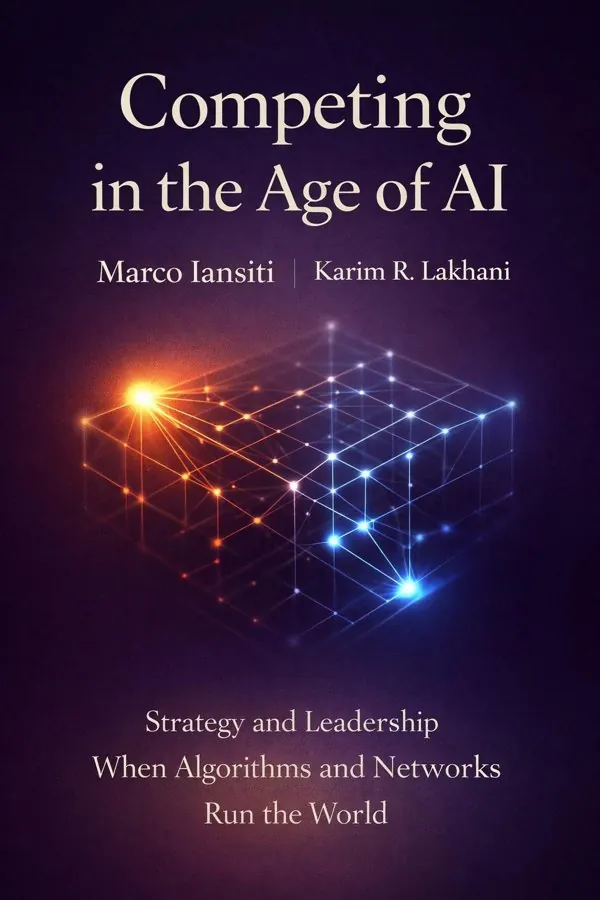
Competing in the Age of AI: Strategy and Leadership When Algorithms and Networks Run the World: Summary & Key Insights
by Marco Iansiti, Karim R. Lakhani
 10 min11 chaptersAudio available
What Is Competing in the Age of AI: Strategy and Leadership When Algorithms and Networks Run the World About?
Competing in the Age of AI: Strategy and Leadership When Algorithms and Networks Run the World by Marco Iansiti, Karim R. Lakhani is a strategy book spanning 11 pages. This book explores how artificial intelligence and digital networks are transforming the foundations of business strategy and leadership. Marco Iansiti and Karim R. Lakhani analyze how data-driven and software-centric models redefine scale, scope, and learning, enabling organizations to compete in unprecedented ways. Drawing on examples from leading firms, they show how AI reshapes operations, innovation, and value creation across industries.
This FizzRead summary covers all 11 key chapters of Competing in the Age of AI: Strategy and Leadership When Algorithms and Networks Run the World in approximately 10 minutes, distilling the most important ideas, arguments, and takeaways from Marco Iansiti, Karim R. Lakhani's work. Also available as an audio summary and Key Quotes Podcast.
Competing in the Age of AI: Strategy and Leadership When Algorithms and Networks Run the World
This book explores how artificial intelligence and digital networks are transforming the foundations of business strategy and leadership. Marco Iansiti and Karim R. Lakhani analyze how data-driven and software-centric models redefine scale, scope, and learning, enabling organizations to compete in unprecedented ways. Drawing on examples from leading firms, they show how AI reshapes operations, innovation, and value creation across industries.
Who Should Read Competing in the Age of AI: Strategy and Leadership When Algorithms and Networks Run the World?
This book is perfect for anyone interested in strategy and looking to gain actionable insights in a short read. Whether you're a student, professional, or lifelong learner, the key ideas from Competing in the Age of AI: Strategy and Leadership When Algorithms and Networks Run the World by Marco Iansiti, Karim R. Lakhani will help you think differently.
- ✓Readers who enjoy strategy and want practical takeaways
- ✓Professionals looking to apply new ideas to their work and life
- ✓Anyone who wants the core insights of Competing in the Age of AI: Strategy and Leadership When Algorithms and Networks Run the World in just 10 minutes
Want the full summary?
Get instant access to this book summary and 100K+ more with Fizz Moment.
Get Free SummaryAvailable on App Store • Free to download
Key Chapters
When we first examined the operations of AI-driven companies, one feature stood out: they run on digital operating models, not physical workflows. In traditional firms, scaling a process requires adding people, equipment, or capital—each new layer introducing friction. In contrast, a digital operating model scales almost effortlessly. Once core processes are digitized, algorithms can execute them continuously, with each data point refining future performance.
In this model, the heart of the firm is an engine that captures data, processes it, and generates predictions or decisions automatically. This cycle—capture, analyze, act, and learn—turns the company into a living system. Every customer interaction feeds into a loop that strengthens the next decision. Whether approving a loan, predicting supply-chain disruptions, or designing a recommendation engine, AI allows firms to respond in real time, not through long managerial chains.
This transformation demands a new kind of discipline. The digital model thrives on integration—on connecting operations with platforms, partners, and ecosystems. Instead of departments, you have modules; instead of workflows, you have APIs. In essence, the digital operating model replaces the traditional firm’s rigid processes with a self-learning organism, capable of evolving with each new dataset. It’s this logic that underpins the AI Factory—an operational core built around machine learning, data infrastructure, and feedback loops that grow in value exponentially over time.
Most businesses still think of themselves in industrial terms: goods flow through supply chains, people make decisions, and performance depends on coordination. AI-driven firms invert this logic. They replace process-based hierarchy with data-centric intelligence. Instead of individuals processing information to make decisions, machine learning systems do so at scale, executing thousands of micro-decisions each second.
Consider the difference between a traditional bank and Ant Financial. The former depends on analysts and credit officers reviewing applications manually, guided by static rules. The latter uses continuous AI-based risk assessment to analyze millions of variables instantly. The cost of serving one more customer is virtually zero, and the quality of decision-making improves as data accumulates.
This transition is not merely efficiency gain; it’s a structural change in how firms create and capture value. Traditional firms are constrained by human capacity and coordination complexity. AI firms are freed from those barriers, learning and scaling with each interaction. As the digital core becomes more sophisticated, the organization becomes flatter, faster, and globally scalable. In this world, strategy revolves around data advantage, not asset ownership. Leadership becomes less about command and more about system design and ethical oversight.
+ 9 more chapters — available in the FizzRead app
All Chapters in Competing in the Age of AI: Strategy and Leadership When Algorithms and Networks Run the World
About the Authors
Marco Iansiti is the David Sarnoff Professor of Business Administration at Harvard Business School, specializing in digital transformation and technology strategy. Karim R. Lakhani is the Charles E. Wilson Professor of Business Administration at Harvard Business School and co-founder of the Laboratory for Innovation Science at Harvard, focusing on AI, crowdsourcing, and digital innovation.
Get This Summary in Your Preferred Format
Read or listen to the Competing in the Age of AI: Strategy and Leadership When Algorithms and Networks Run the World summary by Marco Iansiti, Karim R. Lakhani anytime, anywhere. FizzRead offers multiple formats so you can learn on your terms — all free.
Available formats: App · Audio · PDF · EPUB — All included free with FizzRead
Download Competing in the Age of AI: Strategy and Leadership When Algorithms and Networks Run the World PDF and EPUB Summary
Key Quotes from Competing in the Age of AI: Strategy and Leadership When Algorithms and Networks Run the World
“When we first examined the operations of AI-driven companies, one feature stood out: they run on digital operating models, not physical workflows.”
“Most businesses still think of themselves in industrial terms: goods flow through supply chains, people make decisions, and performance depends on coordination.”
Frequently Asked Questions about Competing in the Age of AI: Strategy and Leadership When Algorithms and Networks Run the World
Competing in the Age of AI: Strategy and Leadership When Algorithms and Networks Run the World by Marco Iansiti, Karim R. Lakhani is a strategy book that explores key ideas across 11 chapters. This book explores how artificial intelligence and digital networks are transforming the foundations of business strategy and leadership. Marco Iansiti and Karim R. Lakhani analyze how data-driven and software-centric models redefine scale, scope, and learning, enabling organizations to compete in unprecedented ways. Drawing on examples from leading firms, they show how AI reshapes operations, innovation, and value creation across industries.
You Might Also Like

Mastery
Robert Greene
10 min
Cut Costs Not Corners: A Practical Guide to Staying Competitive and Improving Profits
Colin Barrow
10 min
Good Strategy/Bad Strategy: The Difference and Why It Matters
Richard P. Rumelt
10 min
On Grand Strategy
John Lewis Gaddis
10 min
The Six Disciplines of Digital Transformation
George Westerman
10 min
7 Powers: The Foundations of Business Strategy
Hamilton Helmer
10 minFeatured In
Browse by Category
Ready to read Competing in the Age of AI: Strategy and Leadership When Algorithms and Networks Run the World?
Get the full summary and 100K+ more books with Fizz Moment.