
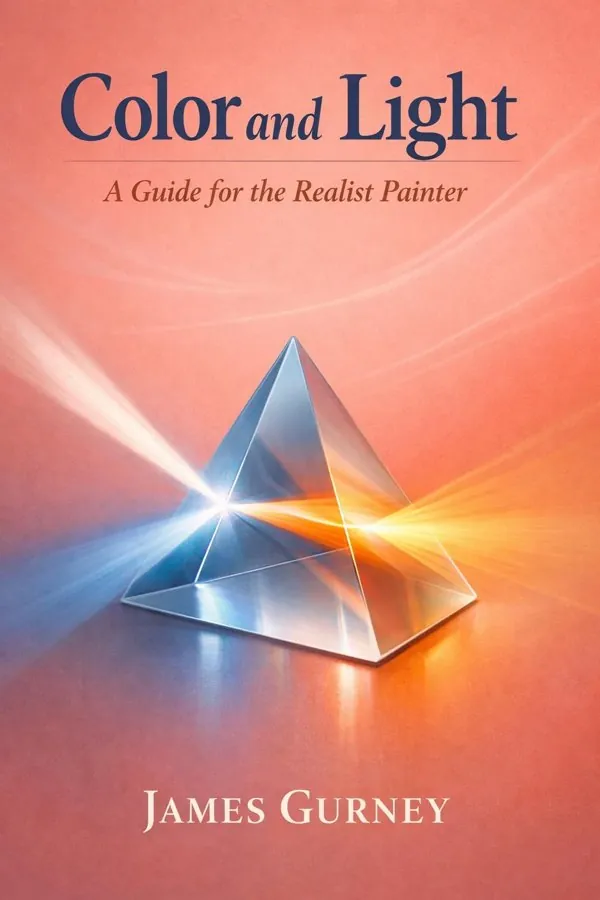
Color and Light: A Guide for the Realist Painter: Summary & Key Insights
by James Gurney
 10 min8 chaptersAudio available
What Is Color and Light: A Guide for the Realist Painter About?
Color and Light: A Guide for the Realist Painter by James Gurney is a design book spanning 8 pages. Color and Light: A Guide for the Realist Painter es un libro de referencia artística que explora los principios del color y la iluminación en la pintura realista. James Gurney, conocido por su serie Dinotopia, ofrece una guía práctica sobre cómo los artistas pueden comprender y aplicar la teoría del color y los efectos de la luz para crear obras convincentes y naturales. El libro combina observaciones científicas, ejemplos pictóricos y consejos técnicos para ayudar a los pintores a mejorar su comprensión visual y su dominio del color.
This FizzRead summary covers all 8 key chapters of Color and Light: A Guide for the Realist Painter in approximately 10 minutes, distilling the most important ideas, arguments, and takeaways from James Gurney's work. Also available as an audio summary and Key Quotes Podcast.
Color and Light: A Guide for the Realist Painter
Color and Light: A Guide for the Realist Painter es un libro de referencia artística que explora los principios del color y la iluminación en la pintura realista. James Gurney, conocido por su serie Dinotopia, ofrece una guía práctica sobre cómo los artistas pueden comprender y aplicar la teoría del color y los efectos de la luz para crear obras convincentes y naturales. El libro combina observaciones científicas, ejemplos pictóricos y consejos técnicos para ayudar a los pintores a mejorar su comprensión visual y su dominio del color.
Who Should Read Color and Light: A Guide for the Realist Painter?
This book is perfect for anyone interested in design and looking to gain actionable insights in a short read. Whether you're a student, professional, or lifelong learner, the key ideas from Color and Light: A Guide for the Realist Painter by James Gurney will help you think differently.
- ✓Readers who enjoy design and want practical takeaways
- ✓Professionals looking to apply new ideas to their work and life
- ✓Anyone who wants the core insights of Color and Light: A Guide for the Realist Painter in just 10 minutes
Want the full summary?
Get instant access to this book summary and 100K+ more with Fizz Moment.
Get Free SummaryAvailable on App Store • Free to download
Key Chapters
To paint light convincingly, we must begin where light itself begins — with physics. Light is both particle and wave, traveling in straight paths until it meets a surface that bends, scatters, or absorbs it. For the artist, however, what matters is not only the scientific definition, but the behavior we observe when illumination strikes different materials. I often tell painters that light reveals the truth of objects. You don’t paint the thing itself; you paint how light interacts with it.
Think about how a beam of sun passes through a window, striking a wooden table. On one portion, the surface gleams with warm gold; on another, the shadow beneath is tinged bluish gray from the skylight. The contrast between those two colors is not merely a difference in brightness — it’s a conversation between two light sources. Once you recognize that dialogue, you start to balance it intentionally in your painting.
Light defines everything: it shapes form, dictates color, creates texture. Without understanding its pathways, realism collapses into guesswork. I emphasize how direct light creates clear-edged shadows, while diffuse light softens transitions; how reflected light illuminates the underside of an object, adding subtle secondary hues; and how atmospheric perspective arises because light loses strength as it travels through air filled with dust and moisture. These principles are scientific, yes, but they become artistic truth the moment you translate them through observation.
Every painter should cultivate the habit of noticing light at all times. Study how morning sunlight differs from evening glow, how lantern light bends around objects, how reflections alter surfaces. In doing so, you’ll realize that painting light isn’t reproduction — it’s translation. You interpret the invisible dance between physics and perception, turning knowledge into beauty.
Color is emotional truth wrapped in optical physics. When you understand hue, value, saturation, and temperature, you learn the language light uses to communicate with the eye. Hue is simply the name of a color like red or green, but each hue carries symbolic and perceptual meaning. Value, the relative lightness or darkness, gives structure to color; it’s what allows form to emerge. Saturation tells you how pure or muted a color is — whether it rings like a trumpet or hums like a cello. And temperature, the warmth or coolness, is the emotional pulse of color harmony.
When I paint, I don’t treat these attributes as isolated variables; they interact constantly. Imagine painting a red apple under a blue sky. The light from the sky will cool the colors in the shadow side of the apple, pushing them towards purple and gray. A warm, direct sunlight might introduce orange tones onto the highlight. The difference between the two is not accidental — it’s what creates presence.
Artists often struggle with color because they attempt to memorize formulas instead of seeing relationships. Understanding how warm light yields cool shadows (and vice versa) frees you from mere imitation. It’s the principle that keeps a painting breathing. To master this, spend time observing natural color variation — on a cloudy day, notice how colors lose their saturation yet gain subtle gradient shifts; at twilight, feel how the palette condenses into harmony.
In practice, I encourage painters to think of color not as pigment squeezed from a tube, but as a living response to light. When you grasp how hue interacts with value, you can manipulate brightness without losing form. When you balance saturation and temperature, you can evoke time of day, emotion, and atmosphere. This is where science meets poetry — color becomes a vessel for storytelling.
+ 6 more chapters — available in the FizzRead app
All Chapters in Color and Light: A Guide for the Realist Painter
About the Author
James Gurney es un pintor e ilustrador estadounidense, célebre por su serie de libros ilustrados Dinotopia. Su trabajo combina la imaginación narrativa con una sólida base en la observación realista. Gurney ha trabajado como ilustrador para National Geographic y ha publicado varios libros sobre técnicas pictóricas, incluyendo Imaginative Realism y Color and Light, que se han convertido en textos esenciales para artistas contemporáneos.
Get This Summary in Your Preferred Format
Read or listen to the Color and Light: A Guide for the Realist Painter summary by James Gurney anytime, anywhere. FizzRead offers multiple formats so you can learn on your terms — all free.
Available formats: App · Audio · PDF · EPUB — All included free with FizzRead
Download Color and Light: A Guide for the Realist Painter PDF and EPUB Summary
Key Quotes from Color and Light: A Guide for the Realist Painter
“To paint light convincingly, we must begin where light itself begins — with physics.”
“Color is emotional truth wrapped in optical physics.”
Frequently Asked Questions about Color and Light: A Guide for the Realist Painter
Color and Light: A Guide for the Realist Painter by James Gurney is a design book that explores key ideas across 8 chapters. Color and Light: A Guide for the Realist Painter es un libro de referencia artística que explora los principios del color y la iluminación en la pintura realista. James Gurney, conocido por su serie Dinotopia, ofrece una guía práctica sobre cómo los artistas pueden comprender y aplicar la teoría del color y los efectos de la luz para crear obras convincentes y naturales. El libro combina observaciones científicas, ejemplos pictóricos y consejos técnicos para ayudar a los pintores a mejorar su comprensión visual y su dominio del color.
More by James Gurney
You Might Also Like

The Design of Everyday Things
Don Norman
10 min
The Better Angels of Our Nature
Steven Pinker
10 min
A Designer's Art
Paul Rand
10 min
Architects' Sketchbooks
Various Editors
10 min
Architectural Graphic Standards
The American Institute of Architects
10 min
Design Is Storytelling
Ellen Lupton
10 minFeatured In
Browse by Category
Ready to read Color and Light: A Guide for the Realist Painter?
Get the full summary and 100K+ more books with Fizz Moment.