
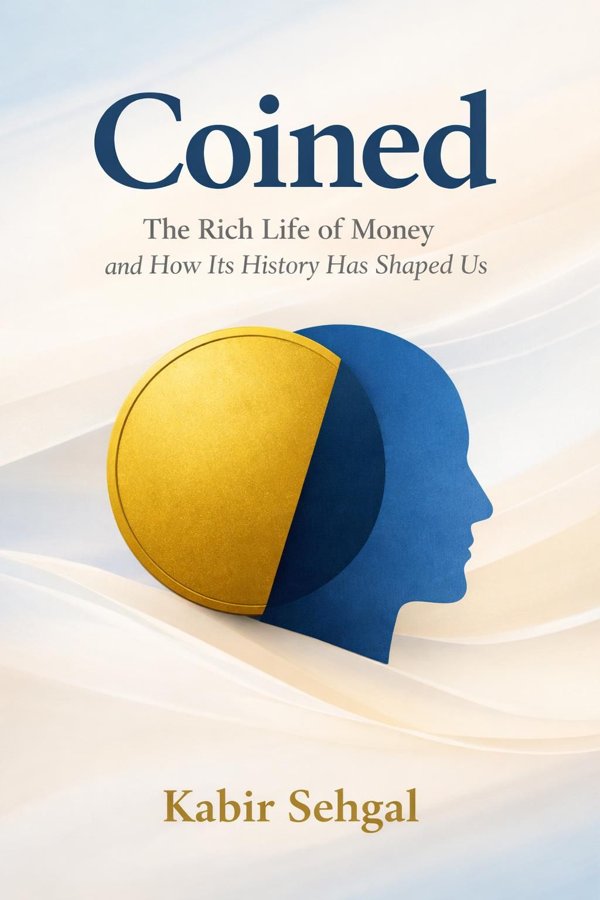
Coined: The Rich Life of Money and How Its History Has Shaped Us: Summary & Key Insights
by Kabir Sehgal
 10 min6 chaptersAudio available
What Is Coined: The Rich Life of Money and How Its History Has Shaped Us About?
Coined: The Rich Life of Money and How Its History Has Shaped Us by Kabir Sehgal is a economics book spanning 6 pages. Coined explores the cultural, psychological, and historical significance of money, tracing its evolution from ancient barter systems to modern digital currencies. Kabir Sehgal examines how money influences human behavior, relationships, and societies, blending economics, anthropology, and neuroscience to reveal how deeply money is intertwined with our identity and values.
This FizzRead summary covers all 6 key chapters of Coined: The Rich Life of Money and How Its History Has Shaped Us in approximately 10 minutes, distilling the most important ideas, arguments, and takeaways from Kabir Sehgal's work. Also available as an audio summary and Key Quotes Podcast.
Coined: The Rich Life of Money and How Its History Has Shaped Us
Coined explores the cultural, psychological, and historical significance of money, tracing its evolution from ancient barter systems to modern digital currencies. Kabir Sehgal examines how money influences human behavior, relationships, and societies, blending economics, anthropology, and neuroscience to reveal how deeply money is intertwined with our identity and values.
Who Should Read Coined: The Rich Life of Money and How Its History Has Shaped Us?
This book is perfect for anyone interested in economics and looking to gain actionable insights in a short read. Whether you're a student, professional, or lifelong learner, the key ideas from Coined: The Rich Life of Money and How Its History Has Shaped Us by Kabir Sehgal will help you think differently.
- ✓Readers who enjoy economics and want practical takeaways
- ✓Professionals looking to apply new ideas to their work and life
- ✓Anyone who wants the core insights of Coined: The Rich Life of Money and How Its History Has Shaped Us in just 10 minutes
Want the full summary?
Get instant access to this book summary and 100K+ more with Fizz Moment.
Get Free SummaryAvailable on App Store • Free to download
Key Chapters
Before coins, before paper notes, before electronic balances and blockchain ledgers, there were people exchanging what they had for what they needed. The story of money begins not with wealth but with trust. Early societies lived by barter—grain for metal, cattle for cloth, salt for labor. Yet barter had limits: how do you trade with someone who needs what you don’t have? That dilemma gave rise to the first hints of abstraction. People began using commodities—objects valued by all—as intermediaries of exchange. Shells, obsidian, even livestock became early currencies.
What fascinates me about these origins is that money wasn’t created by kings or economists; it was born from human cooperation. It was a social contract, a tangible expression of shared belief. Imagine an ancient marketplace. The exchange taking place is not just material; it’s psychological—a silent affirmation that both parties believe in the object’s value. This trust, this faith, is the seed from which our vast economic systems have grown.
Money thus became humanity’s first universal language, transcending tribe and tongue. It turned scarcity into opportunity and trade into civilization. It made cities possible and relationships more complex. Understanding these origins reminds us that value doesn’t reside in gold or paper but in human consent—the invisible agreement that something is worth something. That realization still underpins our modern financial world, even when we no longer touch the currency we spend.
The leap from commodity money to coinage was revolutionary. Around the 7th century BCE, in Lydia—a region of modern-day Turkey—people began to stamp pieces of electrum, a natural gold-silver alloy, with official markings. These coins were beautiful, durable, and crucially, standardized. For the first time, money carried both intrinsic value and official authority.
What this meant for humanity cannot be overstated. Coinage transformed economies into systems of quantifiable trust. It allowed soldiers to be paid, taxes to be collected, and art to be commissioned. It empowered empires like Greece and Rome to expand, forging a union between monetary authority and political power. In Athens, for instance, silver drachmas served not just as payment but as symbols of democracy and civic pride.
I find something poetic in this evolution. The moment we stamped metal with the face of a ruler, we attached identity to value. Money became a message: it told you who ruled, what was sacred, what was real. The coin thus became the earliest social media—a physical tweet, a viral symbol of sovereignty and trust. But with that innovation came control. Monetary systems centralized the means of value, and nations learned that whoever minted coins also minted history. Even today, the echoes of this logic resound—central banks, credit systems, digital tokens—all continue this ancient dance between power and belief.
+ 4 more chapters — available in the FizzRead app
All Chapters in Coined: The Rich Life of Money and How Its History Has Shaped Us
About the Author
Kabir Sehgal is an American author, producer, and former investment banker. He has written several books on economics and culture, and his work often explores the intersection of finance, history, and human behavior. Sehgal is also a Grammy-winning music producer and a thought leader in global economics.
Get This Summary in Your Preferred Format
Read or listen to the Coined: The Rich Life of Money and How Its History Has Shaped Us summary by Kabir Sehgal anytime, anywhere. FizzRead offers multiple formats so you can learn on your terms — all free.
Available formats: App · Audio · PDF · EPUB — All included free with FizzRead
Download Coined: The Rich Life of Money and How Its History Has Shaped Us PDF and EPUB Summary
Key Quotes from Coined: The Rich Life of Money and How Its History Has Shaped Us
“Before coins, before paper notes, before electronic balances and blockchain ledgers, there were people exchanging what they had for what they needed.”
“The leap from commodity money to coinage was revolutionary.”
Frequently Asked Questions about Coined: The Rich Life of Money and How Its History Has Shaped Us
Coined: The Rich Life of Money and How Its History Has Shaped Us by Kabir Sehgal is a economics book that explores key ideas across 6 chapters. Coined explores the cultural, psychological, and historical significance of money, tracing its evolution from ancient barter systems to modern digital currencies. Kabir Sehgal examines how money influences human behavior, relationships, and societies, blending economics, anthropology, and neuroscience to reveal how deeply money is intertwined with our identity and values.
You Might Also Like

Business Adventures
John Brooks
10 min
Nudge
Richard H. Thaler, Cass R. Sunstein
10 min
The Hitchhiker"s Guide to the Galaxy
Douglas Adams
10 minThe Muqaddimah
Ibn Khaldun
10 minThe Outsiders
William N. Thorndike
10 min
A Little History of Economics
Niall Kishtainy
10 minBrowse by Category
Ready to read Coined: The Rich Life of Money and How Its History Has Shaped Us?
Get the full summary and 100K+ more books with Fizz Moment.