
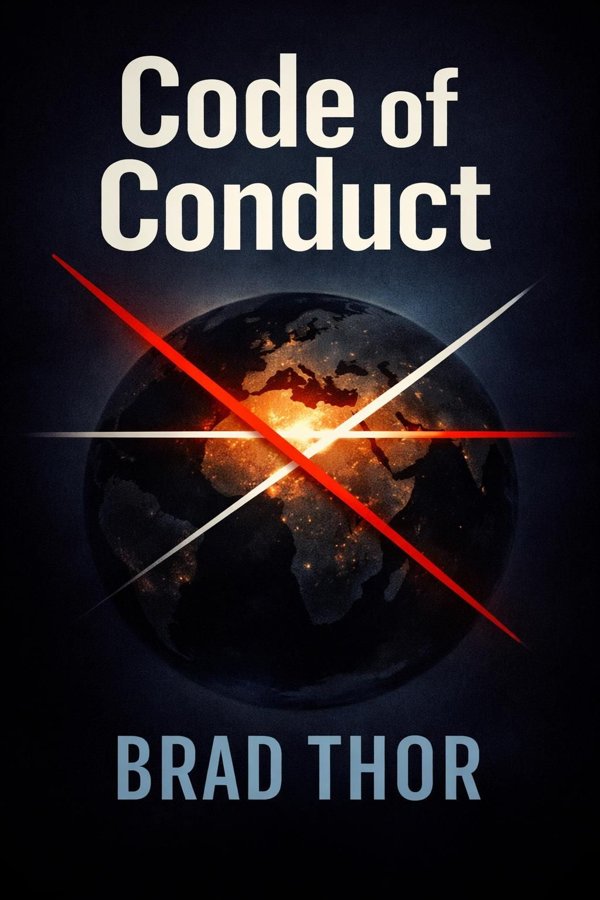
Code of Conduct: Summary & Key Insights
by Brad Thor
 10 min8 chaptersAudio available
Key Takeaways from Code of Conduct
The most dangerous threats often begin as events that look easy to dismiss.
People trust symbols of compassion, and that trust can be weaponized.
The real enemy is often not a person, but a structure.
Urgency changes the way truth is found.
A code of conduct means little until obeying it becomes costly.
What Is Code of Conduct About?
Code of Conduct by Brad Thor is a bestsellers book spanning 4 pages. What makes Code of Conduct more than a fast-moving thriller is the question beating beneath its action: what happens when institutions built to save lives become the perfect cover for mass murder? In this installment of Brad Thor’s Scot Harvath series, a missing medical team in Central Africa triggers an international investigation that quickly expands into a terrifying global conspiracy. Harvath, one of fiction’s most relentless counterterrorism operatives, is forced into a race against time as he uncovers a network operating behind the language of diplomacy, aid, and public health. The deeper he digs, the clearer it becomes that the threat is not just another terrorist attack, but a strategic act designed to reshape world power through engineered chaos. Thor’s authority comes from his long-standing focus on intelligence, national security, and geopolitical conflict, which gives the novel a chilling sense of plausibility. Code of Conduct matters because it blends suspense with a disturbing modern insight: in a connected world, the most devastating weapons may arrive not through open war, but through systems people are trained to trust.
This FizzRead summary covers all 8 key chapters of Code of Conduct in approximately 10 minutes, distilling the most important ideas, arguments, and takeaways from Brad Thor's work. Also available as an audio summary and Key Quotes Podcast.
Code of Conduct
What makes Code of Conduct more than a fast-moving thriller is the question beating beneath its action: what happens when institutions built to save lives become the perfect cover for mass murder? In this installment of Brad Thor’s Scot Harvath series, a missing medical team in Central Africa triggers an international investigation that quickly expands into a terrifying global conspiracy. Harvath, one of fiction’s most relentless counterterrorism operatives, is forced into a race against time as he uncovers a network operating behind the language of diplomacy, aid, and public health. The deeper he digs, the clearer it becomes that the threat is not just another terrorist attack, but a strategic act designed to reshape world power through engineered chaos. Thor’s authority comes from his long-standing focus on intelligence, national security, and geopolitical conflict, which gives the novel a chilling sense of plausibility. Code of Conduct matters because it blends suspense with a disturbing modern insight: in a connected world, the most devastating weapons may arrive not through open war, but through systems people are trained to trust.
Who Should Read Code of Conduct?
This book is perfect for anyone interested in bestsellers and looking to gain actionable insights in a short read. Whether you're a student, professional, or lifelong learner, the key ideas from Code of Conduct by Brad Thor will help you think differently.
- ✓Readers who enjoy bestsellers and want practical takeaways
- ✓Professionals looking to apply new ideas to their work and life
- ✓Anyone who wants the core insights of Code of Conduct in just 10 minutes
Want the full summary?
Get instant access to this book summary and 100K+ more with Fizz Moment.
Get Free SummaryAvailable on App Store • Free to download
Key Chapters
The most dangerous threats often begin as events that look easy to dismiss. In Code of Conduct, the catalyst is the disappearance of an international medical team in Central Africa, an incident that at first seems like one more tragedy in a volatile region. But Brad Thor uses this vanishing act to show how modern crises can hide in plain sight. A missing aid mission, especially in a distant conflict zone, can be written off as a local security failure. Harvath understands that such assumptions are exactly what sophisticated enemies count on.
As the investigation unfolds, the disappearance becomes a doorway into something much larger than kidnapping or regional violence. The absent team represents a pattern: humanitarian work, unstable governments, disease fears, and weak oversight create ideal conditions for bad actors to operate undetected. Thor demonstrates how in a world flooded with information, attention is the scarcest resource. If an event can be framed as routine chaos, it may never receive the scrutiny it deserves.
This idea has practical relevance beyond fiction. In business, politics, and public life, major failures rarely announce themselves dramatically at first. Fraud may begin as a reporting irregularity. A cybersecurity breach may first appear as a minor technical glitch. A reputational crisis may start with one overlooked complaint. The lesson is not paranoia, but disciplined curiosity.
Harvath’s instinct is to ask what everyone else is missing. He looks for motive, pattern, and who benefits from confusion. That habit separates effective operators from passive observers. Actionable takeaway: when a crisis appears isolated, pause before accepting the obvious explanation and ask what larger system, incentive, or hidden agenda might be concealed behind it.
People trust symbols of compassion, and that trust can be weaponized. One of the novel’s most unsettling insights is that humanitarian channels and diplomatic structures can provide extraordinary camouflage for criminal or geopolitical schemes. Thor does not argue that aid organizations are inherently corrupt; instead, he reveals how their legitimacy, mobility, and access can be exploited by those who understand institutional blind spots.
In the story, what should represent healing and international cooperation becomes entangled with secrecy and manipulation. Harvath discovers that the threat does not move through the obvious pathways of conventional terror alone. It travels through spaces where scrutiny is lower because the mission appears noble. This inversion is what gives the plot its power. The enemy understands that suspicion is often directed toward military or extremist actors, not toward medical teams, nonprofit networks, or multinational coordination efforts.
The concept applies broadly in the real world. Financial scams hide behind respected brands. Misinformation spreads through accounts that mimic trusted authorities. Corruption often takes root in organizations whose public image discourages questioning. When institutions become morally untouchable, they can also become operationally vulnerable.
Thor uses Harvath to model a difficult but necessary discipline: respecting good intentions while still verifying facts. Mature judgment does not confuse skepticism with cynicism. You can believe in the value of a system and still recognize that any system can be infiltrated.
Actionable takeaway: do not grant automatic trust based solely on a mission’s moral language; whenever stakes are high, evaluate transparency, incentives, and accountability as carefully as you would in any other high-risk environment.
The real enemy is often not a person, but a structure. One of the turning points in Code of Conduct comes when Harvath and his allies realize they are not dealing with disconnected incidents, but with an organization operating beyond formal chains of command. This hidden entity has embedded itself in international systems, using bureaucracy, deniability, and compartmentalization to stay invisible. Thor’s point is chilling: the most effective conspiracies are not chaotic. They are organized, patient, and protected by complexity.
Harvath’s investigation shows how difficult it is to fight a network that leaves few fingerprints. Unlike a traditional villain who openly claims responsibility, this kind of adversary relies on layers. Different players know only fragments of the plan. Official institutions may unknowingly serve the scheme. By the time a pattern is visible, the machinery is already in motion. This is why Thor’s thriller feels more sophisticated than a simple hunt for a mastermind. It is a battle against systemic concealment.
There is a practical insight here for readers. Many modern problems persist because responsibility is so diffused that no individual appears fully accountable. In corporations, harmful outcomes may result from incentives spread across departments. In politics, bad policy can survive because each actor only owns a small piece. In personal life, recurring dysfunction often comes from hidden systems of habit rather than one dramatic mistake.
Harvath succeeds by tracing relationships instead of chasing headlines. He asks who has access, who gains strategic advantage, and how information is being controlled. That approach reveals the architecture behind appearances. Actionable takeaway: when facing a confusing problem, map the system around it—people, incentives, dependencies, and information flows—because lasting understanding comes from seeing the structure, not just the surface event.
Urgency changes the way truth is found. Once Harvath realizes the scale of the threat in Code of Conduct, the novel transforms into a relentless race to stop an event that could trigger global chaos. What makes this more compelling than a standard countdown plot is Thor’s understanding that speed alone does not solve complex threats. Harvath must move quickly while making sense of incomplete, misleading, and politically sensitive information.
Thor captures a central reality of crisis response: time pressure amplifies both insight and error. Decisions must be made before certainty is available. Harvath cannot wait for perfect clarity because delay itself becomes dangerous. Yet acting too soon on flawed assumptions could help the enemy. This tension drives the book’s suspense and gives Harvath’s skill set real weight. He is not merely brave; he is decisive under ambiguity.
This idea has practical application in leadership, emergency management, and personal decision-making. A company facing a data breach cannot wait weeks to respond, but it also cannot communicate recklessly. A medical team in an outbreak must act on evolving evidence. A family in financial trouble must make choices before every unknown is resolved. The challenge is to distinguish reversible decisions from irreversible ones and to act where delay carries the greatest cost.
Harvath’s method is disciplined action. He prioritizes high-impact leads, relies on trusted operators, and keeps the mission anchored to the larger objective rather than every distracting detail. Thor shows that in real crises, composure matters as much as force.
Actionable takeaway: when facing a high-stakes situation, identify the decision that most reduces immediate risk, act on the best verified information available, and update quickly as new facts emerge.
A code of conduct means little until obeying it becomes costly. The title of the novel points to one of its deepest themes: rules, principles, and loyalties are easy to profess in safety but brutally difficult to maintain under extreme pressure. Harvath operates in a world where legal boundaries, political interests, and survival instincts collide. Thor uses that environment to ask whether moral conduct is a luxury or a necessity when the stakes are existential.
Throughout the story, characters are forced to choose between expediency and principle. Some justify manipulation in the name of security. Others hide behind procedure while danger spreads. Harvath’s value lies not in being morally perfect, but in recognizing that methods matter, even in dark circumstances. He understands that once institutions abandon all ethical restraint, they may defeat one threat only by becoming another.
This theme resonates well outside espionage fiction. In workplaces, leaders reveal themselves during layoffs, scandals, and negotiations. In public life, ethics are tested when power can be gained through fear or deception. In private relationships, integrity is proven when honesty is inconvenient. The point is not rigid idealism. Thor’s novel acknowledges that hard choices are unavoidable. But it insists that abandoning all standards in the name of necessity creates long-term destruction.
Readers can apply this by clarifying in advance which lines they will not cross. Under pressure, people rarely invent values; they fall back on whatever standards they have already practiced. Harvath survives because he combines toughness with an internal compass.
Actionable takeaway: define your nonnegotiable principles before a crisis arrives, because the quality of your decisions under stress will depend less on your intentions in the moment than on the standards you established beforehand.
No elite operative works alone, and no team succeeds without both loyalty and disagreement. One of the strengths of Code of Conduct is how it portrays intelligence work as collaborative rather than purely individual. Harvath depends on analysts, field assets, technical experts, and political contacts. Yet Thor also shows that effective teams are not built on blind agreement. Productive friction—questioning assumptions, testing evidence, challenging plans—makes the mission stronger.
This matters because thrillers often glamorize the lone hero. Thor gives Harvath plenty of capability, but he is most effective when supported by trusted people who bring different perspectives. The team dynamic reflects how serious operations actually function: one person may see the human motive, another the logistical pattern, another the political fallout. Without those combined views, blind spots multiply.
The practical lesson applies to any organization. Strong teams balance confidence with skepticism. If everyone is too deferential, weak ideas survive. If everyone is combative, momentum disappears. The best groups create enough trust that disagreement improves judgment instead of eroding cohesion. In crisis settings especially, leaders need people who will speak honestly, not simply confirm what they want to hear.
Harvath’s interactions reinforce this principle. He values competence, but he also values people who can challenge him without undermining the mission. That tension increases the odds of getting to the truth before it is too late. Thor’s larger message is that intelligence is social: better outcomes come from disciplined collaboration.
Actionable takeaway: build teams where candor is safe and expected, and when stakes are high, actively seek one informed challenge to your plan before committing fully.
Modern danger travels faster than politics can contain it. A major contribution of Code of Conduct is its portrayal of threat as transnational, fluid, and opportunistic. What begins in one region quickly implicates multiple countries, agencies, and power centers. Thor uses this global scale to remind readers that today’s crises do not respect borders. Disease, terrorism, disinformation, cyberattacks, and covert influence all move through interconnected systems.
Harvath’s challenge is not simply tracking an enemy across locations. He must navigate the reality that every nation involved has its own interests, sensitivities, and limits. Even when leaders face the same threat, they may disagree on what matters most: public stability, political survival, strategic advantage, or moral responsibility. This makes coordination slow precisely when speed is essential.
The insight extends beyond geopolitics. Supply chains link distant markets. Online networks spread panic globally within hours. Environmental shocks in one area trigger consequences elsewhere. In professional life, teams separated by geography may still share exposure to the same risk. Interdependence creates opportunity, but also fragility.
Thor’s novel rewards readers who appreciate how local events can be globally significant. Harvath succeeds because he thinks across domains. He does not treat a regional anomaly as merely regional. He sees how health systems, intelligence channels, and international leverage intersect. That systems-level thinking is increasingly necessary in real life as well.
Actionable takeaway: when evaluating a risk, ask not only where it starts but where it can spread—to partners, customers, institutions, or populations—and plan responses at the scale of the network, not just the point of origin.
Stopping a disaster is only the beginning; what follows determines whether the victory lasts. In the later movement of Code of Conduct, Thor turns attention toward consequences. Even if the immediate plot is disrupted, the damage done by fear, secrecy, and institutional compromise does not simply disappear. The aftermath becomes its own battlefield, one defined by trust, accountability, and strategic realignment.
This is one of the novel’s more mature insights. Many thrillers end when the bomb is stopped or the villain falls. Thor understands that major crises leave residue. Alliances shift. Public confidence erodes. Agencies protect themselves. Opportunists rewrite the story to preserve power. Harvath may be able to neutralize the direct threat, but he cannot restore innocence. That emotional and political realism gives the novel weight beyond its action scenes.
The idea is deeply practical. After any crisis—a corporate scandal, personal betrayal, security incident, or public emergency—leaders often focus on immediate containment and then rush to normalcy. But the harder work is rebuilding trust, learning from failure, and preventing recurrence. If lessons are not institutionalized, the same vulnerabilities remain available for exploitation.
Thor implies that resilience is not just the capacity to endure attack. It is the willingness to confront what the attack exposed. Systems improve only when people are honest about weaknesses. Harvath’s world is dangerous precisely because too many institutions prefer image over reform.
Actionable takeaway: after resolving any major problem, conduct a serious review of what made it possible—failures of communication, oversight, culture, or incentives—and make one concrete structural change so the same threat cannot return through the same opening.
All Chapters in Code of Conduct
About the Author
Brad Thor is an American bestselling author known for his high-octane political and espionage thrillers, especially the long-running Scot Harvath series. His fiction focuses on terrorism, intelligence operations, national security, and geopolitical conflict, often blending rapid action with themes drawn from real-world policy and covert strategy. Thor has been widely recognized for bringing a strong sense of plausibility to his novels, helped by his long-standing interest in security issues and his exposure to national security analysis. Over the course of his career, he has built a large international readership and become a major name in modern thriller fiction. Readers turn to Thor for stories that are not only suspenseful and cinematic, but also sharply attuned to the vulnerabilities of the contemporary world.
Get This Summary in Your Preferred Format
Read or listen to the Code of Conduct summary by Brad Thor anytime, anywhere. FizzRead offers multiple formats so you can learn on your terms — all free.
Available formats: App · Audio · PDF · EPUB — All included free with FizzRead
Download Code of Conduct PDF and EPUB Summary
Key Quotes from Code of Conduct
“The most dangerous threats often begin as events that look easy to dismiss.”
“People trust symbols of compassion, and that trust can be weaponized.”
“The real enemy is often not a person, but a structure.”
“Once Harvath realizes the scale of the threat in Code of Conduct, the novel transforms into a relentless race to stop an event that could trigger global chaos.”
“A code of conduct means little until obeying it becomes costly.”
Frequently Asked Questions about Code of Conduct
Code of Conduct by Brad Thor is a bestsellers book that explores key ideas across 8 chapters. What makes Code of Conduct more than a fast-moving thriller is the question beating beneath its action: what happens when institutions built to save lives become the perfect cover for mass murder? In this installment of Brad Thor’s Scot Harvath series, a missing medical team in Central Africa triggers an international investigation that quickly expands into a terrifying global conspiracy. Harvath, one of fiction’s most relentless counterterrorism operatives, is forced into a race against time as he uncovers a network operating behind the language of diplomacy, aid, and public health. The deeper he digs, the clearer it becomes that the threat is not just another terrorist attack, but a strategic act designed to reshape world power through engineered chaos. Thor’s authority comes from his long-standing focus on intelligence, national security, and geopolitical conflict, which gives the novel a chilling sense of plausibility. Code of Conduct matters because it blends suspense with a disturbing modern insight: in a connected world, the most devastating weapons may arrive not through open war, but through systems people are trained to trust.
You Might Also Like

The Godfather
Mario Puzo
10 min
The Handmaid's Tale
Margaret Atwood
10 min
The Hunger Games
Suzanne Collins
10 min
The Nightingale
Kristin Hannah
10 min
The Seven Husbands of Evelyn Hugo
Taylor Jenkins Reid
10 min
Backwater Justice
Fern Michaels
10 minBrowse by Category
Ready to read Code of Conduct?
Get the full summary and 100K+ more books with Fizz Moment.