
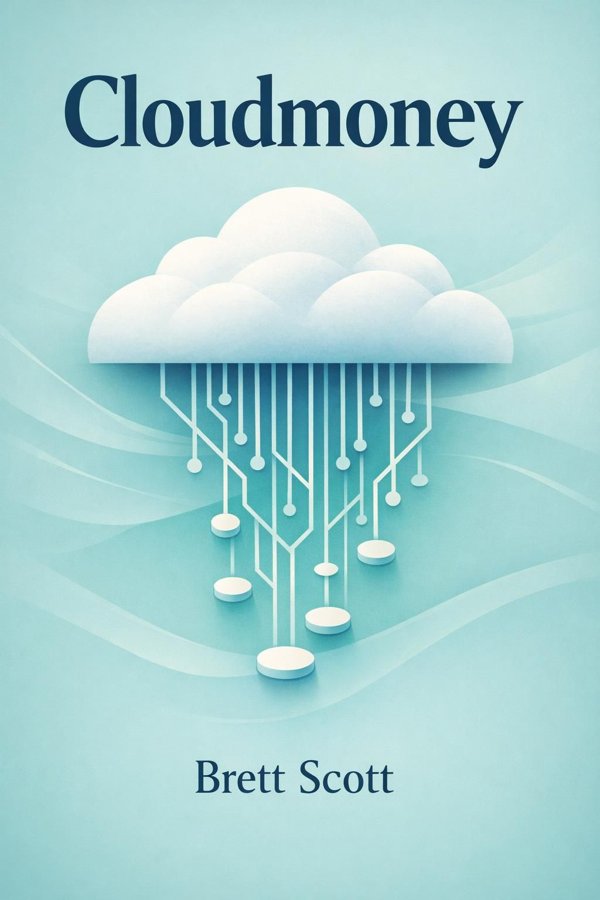
Cloudmoney: Cash, Cards, Crypto and the War for Our Wallets: Summary & Key Insights
by Brett Scott
 10 min9 chaptersAudio available
What Is Cloudmoney: Cash, Cards, Crypto and the War for Our Wallets About?
Cloudmoney: Cash, Cards, Crypto and the War for Our Wallets by Brett Scott is a economics book spanning 9 pages. Cloudmoney is a critical analysis of the global shift toward digital money and the decline of cash. Brett Scott explores how banks, tech corporations, and governments are driving a cashless economy, warning of the implications for privacy, freedom, and financial control. The book blends economic research, monetary history, and financial activism to uncover the forces behind the digitization of money.
This FizzRead summary covers all 9 key chapters of Cloudmoney: Cash, Cards, Crypto and the War for Our Wallets in approximately 10 minutes, distilling the most important ideas, arguments, and takeaways from Brett Scott's work. Also available as an audio summary and Key Quotes Podcast.
Cloudmoney: Cash, Cards, Crypto and the War for Our Wallets
Cloudmoney is a critical analysis of the global shift toward digital money and the decline of cash. Brett Scott explores how banks, tech corporations, and governments are driving a cashless economy, warning of the implications for privacy, freedom, and financial control. The book blends economic research, monetary history, and financial activism to uncover the forces behind the digitization of money.
Who Should Read Cloudmoney: Cash, Cards, Crypto and the War for Our Wallets?
This book is perfect for anyone interested in economics and looking to gain actionable insights in a short read. Whether you're a student, professional, or lifelong learner, the key ideas from Cloudmoney: Cash, Cards, Crypto and the War for Our Wallets by Brett Scott will help you think differently.
- ✓Readers who enjoy economics and want practical takeaways
- ✓Professionals looking to apply new ideas to their work and life
- ✓Anyone who wants the core insights of Cloudmoney: Cash, Cards, Crypto and the War for Our Wallets in just 10 minutes
Want the full summary?
Get instant access to this book summary and 100K+ more with Fizz Moment.
Get Free SummaryAvailable on App Store • Free to download
Key Chapters
Money has always been a technology, a social construction linking trust and exchange. I begin this journey in the world of physical tokens—coins and notes—which served not merely as economic instruments but as tangible manifestations of social connection. Over centuries, the state and banking systems consolidated control over the production and distribution of these tokens, evolving from coinage to paper money backed by institutions.
The twentieth century brought an invisible revolution. Electronic banking, debit and credit cards, and eventually online transactions translated money into code—a dematerialization that reduced friction while introducing new dependencies. Each innovation promised freedom and convenience but tethered us increasingly to centralized networks. The shift from cash to electronic systems transformed money from a bearer object into an entry in a ledger maintained by remote authorities.
The critical point in this evolution came when payment infrastructures—once primarily public—became dominated by private entities. Visa, Mastercard, and later the tech giants built digital highways linking consumers and merchants, extracting tolls all along the way. Money became data, and the institutions storing that data gradually became gatekeepers to the economy itself.
In tracing this progression, I emphasize the continuity in the story: technological advancement often masquerades as liberation while tightening institutional control. The more intangible money becomes, the more tightly it can be monitored. Understanding where we came from—the tangible world of coins and notes—helps us see what’s truly at stake as we drift further into the cloud.
The rush toward a cashless society is not simply a spontaneous outcome of technological progress. It is engineered. Banks, payment companies, and governments actively promote electronic payment systems, dressing the movement up in the language of efficiency and modernization. But beneath the rhetoric lies an agenda driven by profit and control.
In *Cloudmoney*, I expose how financial institutions cast cash as outdated and unsafe—a relic vulnerable to crime and inefficiency—while branding digital payments as sleek, secure, and inevitable. This narrative is convenient: eliminating cash reduces operational costs and expands the reach of data-driven business models. Governments often echo this messaging, conflating cashlessness with national progress, yet the benefits accrue mainly to the system’s architects.
I call this orchestrated process the “war on cash.” It’s waged subtly, through incentives, policies, and cultural branding. ATMs quietly vanish from neighborhoods, small merchants are charged higher fees for cash deposits, and pandemic-era hygiene narratives conveniently reinforce the idea that cash is dirty. These shifts detach people from physical currency, effectively channeling every transaction through digital pipelines owned by powerful intermediaries.
As I show, the cashless agenda isn’t only about economics—it’s about the normalization of surveillance capitalism. Once every payment flows through traceable channels, human behavior becomes a dataset. This digitization erodes financial autonomy, creating a citizenry perpetually visible to institutions. Recognizing these mechanisms is the first step toward resisting them.
+ 7 more chapters — available in the FizzRead app
All Chapters in Cloudmoney: Cash, Cards, Crypto and the War for Our Wallets
About the Author
Brett Scott is a British writer, journalist, and financial activist specializing in financial technology, cryptocurrencies, and alternative economies. He is the author of 'The Heretic's Guide to Global Finance' and has contributed to outlets such as The Guardian and New Scientist.
Get This Summary in Your Preferred Format
Read or listen to the Cloudmoney: Cash, Cards, Crypto and the War for Our Wallets summary by Brett Scott anytime, anywhere. FizzRead offers multiple formats so you can learn on your terms — all free.
Available formats: App · Audio · PDF · EPUB — All included free with FizzRead
Download Cloudmoney: Cash, Cards, Crypto and the War for Our Wallets PDF and EPUB Summary
Key Quotes from Cloudmoney: Cash, Cards, Crypto and the War for Our Wallets
“Money has always been a technology, a social construction linking trust and exchange.”
“The rush toward a cashless society is not simply a spontaneous outcome of technological progress.”
Frequently Asked Questions about Cloudmoney: Cash, Cards, Crypto and the War for Our Wallets
Cloudmoney: Cash, Cards, Crypto and the War for Our Wallets by Brett Scott is a economics book that explores key ideas across 9 chapters. Cloudmoney is a critical analysis of the global shift toward digital money and the decline of cash. Brett Scott explores how banks, tech corporations, and governments are driving a cashless economy, warning of the implications for privacy, freedom, and financial control. The book blends economic research, monetary history, and financial activism to uncover the forces behind the digitization of money.
You Might Also Like

Business Adventures
John Brooks
10 min
Nudge
Richard H. Thaler, Cass R. Sunstein
10 min
The Hitchhiker"s Guide to the Galaxy
Douglas Adams
10 minThe Muqaddimah
Ibn Khaldun
10 minThe Outsiders
William N. Thorndike
10 min
A Little History of Economics
Niall Kishtainy
10 minBrowse by Category
Ready to read Cloudmoney: Cash, Cards, Crypto and the War for Our Wallets?
Get the full summary and 100K+ more books with Fizz Moment.