
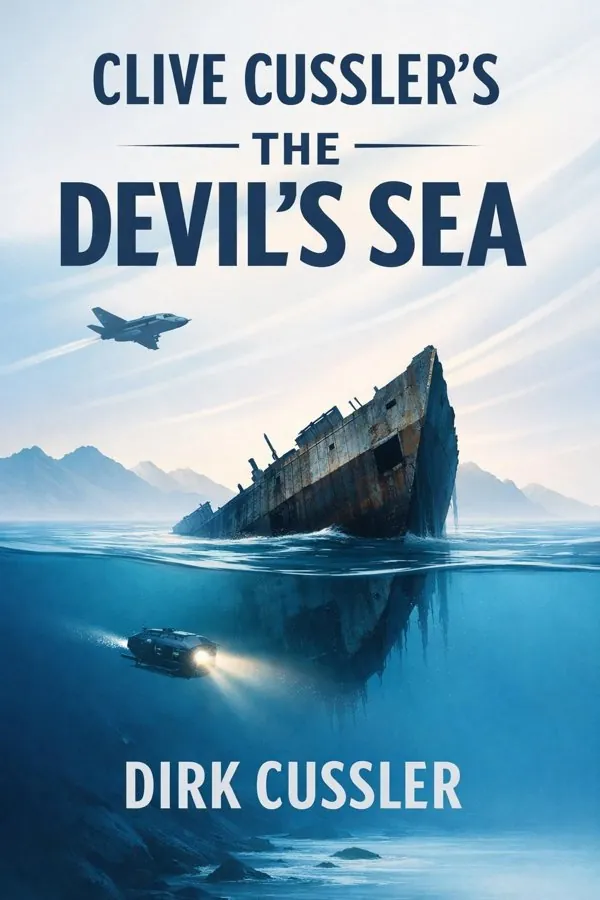
Clive Cussler's The Devil's Sea: Summary & Key Insights
by Dirk Cussler
 10 min8 chaptersAudio available
Key Takeaways from Clive Cussler's The Devil's Sea
Some of the most dangerous truths do not announce themselves loudly; they wait in silence until someone is curious enough to disturb them.
History rarely stays buried when power is involved.
Nations may change flags, alliances, and leaders, but their rivalries often continue under new names.
Thrillers work best when the clock is not just ticking, but accelerating.
The past is not past when its inventions remain functional.
What Is Clive Cussler's The Devil's Sea About?
Clive Cussler's The Devil's Sea by Dirk Cussler is a bestsellers book spanning 5 pages. What if the greatest threat to the modern world were not a future invention, but a forgotten weapon buried in the past? Clive Cussler's The Devil's Sea, written by Dirk Cussler, delivers exactly that kind of high-concept suspense: a globe-spanning thriller in which Dirk Pitt and the NUMA team uncover a deadly secret hidden beneath the Black Sea. What begins as an underwater discovery soon expands into a layered conspiracy involving Cold War science, vanished technology, international power struggles, and a race to stop a catastrophe with worldwide consequences. Like the best Dirk Pitt novels, this book blends maritime adventure, historical mystery, and relentless action. It matters because it turns a familiar thriller premise into something richer: a story about how dangerous ideas survive long after the regimes that created them have fallen. Dirk Cussler writes with the authority of someone deeply steeped in the series' legacy, continuing the fast-paced, detail-rich storytelling made famous by Clive Cussler while adding his own contemporary edge. For readers who enjoy treasure hunts, geopolitical intrigue, and heroes who battle both nature and human ambition, The Devil's Sea offers a gripping descent into peril from first page to last.
This FizzRead summary covers all 8 key chapters of Clive Cussler's The Devil's Sea in approximately 10 minutes, distilling the most important ideas, arguments, and takeaways from Dirk Cussler's work. Also available as an audio summary and Key Quotes Podcast.
Clive Cussler's The Devil's Sea
What if the greatest threat to the modern world were not a future invention, but a forgotten weapon buried in the past? Clive Cussler's The Devil's Sea, written by Dirk Cussler, delivers exactly that kind of high-concept suspense: a globe-spanning thriller in which Dirk Pitt and the NUMA team uncover a deadly secret hidden beneath the Black Sea. What begins as an underwater discovery soon expands into a layered conspiracy involving Cold War science, vanished technology, international power struggles, and a race to stop a catastrophe with worldwide consequences.
Like the best Dirk Pitt novels, this book blends maritime adventure, historical mystery, and relentless action. It matters because it turns a familiar thriller premise into something richer: a story about how dangerous ideas survive long after the regimes that created them have fallen. Dirk Cussler writes with the authority of someone deeply steeped in the series' legacy, continuing the fast-paced, detail-rich storytelling made famous by Clive Cussler while adding his own contemporary edge. For readers who enjoy treasure hunts, geopolitical intrigue, and heroes who battle both nature and human ambition, The Devil's Sea offers a gripping descent into peril from first page to last.
Who Should Read Clive Cussler's The Devil's Sea?
This book is perfect for anyone interested in bestsellers and looking to gain actionable insights in a short read. Whether you're a student, professional, or lifelong learner, the key ideas from Clive Cussler's The Devil's Sea by Dirk Cussler will help you think differently.
- ✓Readers who enjoy bestsellers and want practical takeaways
- ✓Professionals looking to apply new ideas to their work and life
- ✓Anyone who wants the core insights of Clive Cussler's The Devil's Sea in just 10 minutes
Want the full summary?
Get instant access to this book summary and 100K+ more with Fizz Moment.
Get Free SummaryAvailable on App Store • Free to download
Key Chapters
Some of the most dangerous truths do not announce themselves loudly; they wait in silence until someone is curious enough to disturb them. That idea drives the opening of The Devil's Sea, where a mysterious anomaly deep beneath the Black Sea draws Dirk Pitt and the NUMA team into what first appears to be a standard underwater investigation. Yet in classic Cussler fashion, the wreck is not merely a relic. It is a sealed doorway into a hidden chapter of history, one with the power to destabilize the present.
The Black Sea setting matters. Its depths, isolation, and layered history make it the perfect place for a secret to remain buried for decades. NUMA's discovery begins with technology and observation, but it quickly becomes an exercise in interpretation. A wreck is never just metal and cargo; it is a message from another time. As clues accumulate, the team realizes that what lies below was intentionally hidden, suggesting an operation of unusual importance and danger.
This idea has practical resonance beyond fiction. In real life, breakthroughs often begin with anomalies that others ignore: an odd data point, an old memo, an unexplained failure, a forgotten asset. Whether in business, research, or personal decision-making, careful attention to what does not fit the pattern can uncover both risk and opportunity. The novel reminds us that curiosity is not passive; it is an active force that can expose systems others would prefer to leave untouched.
Actionable takeaway: Pay attention to anomalies in your own work or life. The overlooked detail, unexplained inconsistency, or hidden record may contain the most important truth of all.
History rarely stays buried when power is involved. As NUMA digs deeper into the wreck and its origins, The Devil's Sea shifts from oceanic mystery to intelligence-driven investigation. Archival fragments, classified references, and scattered evidence point toward a secret Soviet-era program involving experimental science and weaponized ambition. The wreck is no accident of history; it is part of a larger design, one shaped by the paranoia, competition, and moral compromises of the Cold War.
What makes this thread compelling is how the novel shows old systems living on through neglected records, hidden collaborators, and unfinished projects. The Soviet Union may be gone, but the logic that created dangerous experiments—fear, competition, and the desire for strategic advantage—has not disappeared. Dirk Pitt and his allies must therefore act as both explorers and historians, reconstructing events from fragments before others can weaponize the knowledge they uncover.
This dynamic reflects a practical truth in organizations and institutions: today's crisis often began as yesterday's "temporary" solution. Legacy systems, unresolved decisions, and hidden assumptions can remain dormant for years before creating serious consequences. Businesses inherit debt from old strategies; governments inherit risks from classified operations; families inherit patterns from prior generations. The challenge is not merely discovering the past, but understanding how it still shapes the present.
The novel also underscores the value of multidisciplinary thinking. Fieldwork alone is not enough; neither is research in isolation. The solution emerges through collaboration among divers, analysts, historians, and strategists.
Actionable takeaway: When facing a complicated problem, investigate its origins. Ask what past decision, hidden process, or inherited assumption may still be influencing the situation today.
Nations may change flags, alliances, and leaders, but their rivalries often continue under new names. One of the strongest ideas in The Devil's Sea is that geopolitical tension does not disappear simply because a historical era ends. As Dirk Pitt follows the trail of the wreck's secret, he enters a world where state interests, private agendas, and old loyalties overlap. The danger comes not just from a single villain, but from a web of actors eager to claim or suppress what the wreck reveals.
This elevates the novel beyond a straightforward treasure hunt. The discovery matters because information is power, and power attracts competition. The hidden technology or scientific breakthrough tied to the wreck has implications large enough to affect international stability. As a result, every step NUMA takes is shadowed by surveillance, interference, and political calculation. What should be a scientific investigation becomes a diplomatic and strategic minefield.
In practical terms, the book offers a useful lens on modern complexity. Many problems today operate across multiple domains at once: cybersecurity is also politics; climate policy is also economics; supply chains are also national security. Success depends on recognizing that visible events usually have invisible stakeholders. Someone always benefits, someone feels threatened, and someone is trying to shape the narrative.
For readers in leadership roles, this is especially relevant. A decision that appears technical may carry reputational, financial, or political consequences. Before acting, it helps to map the landscape: who cares, who gains, who loses, and who may resist quietly rather than openly.
Actionable takeaway: Whenever stakes rise, look beyond the obvious conflict. Identify the hidden interests around the problem, because unseen pressures often determine the outcome more than visible ones do.
Thrillers work best when the clock is not just ticking, but accelerating. In The Devil's Sea, the investigation soon becomes an urgent race to prevent catastrophe. Once the scale of the hidden threat comes into focus, Dirk Pitt and the NUMA team are forced out of research mode and into survival mode. Their challenge is no longer simply to understand what was lost beneath the Black Sea, but to stop powerful enemies from using it before the consequences become irreversible.
This shift is one of the novel's central pleasures. Discovery creates suspense, but urgency creates momentum. The team must operate under pressure, with incomplete information, shifting alliances, and physical danger on multiple fronts. This pressure reveals character. Pitt's effectiveness does not come from superhuman certainty, but from calm action amid chaos. He adapts, prioritizes, and keeps moving when delay is the greatest enemy.
There is a practical lesson here for anyone overwhelmed by high-stakes decisions. In moments of crisis, perfect clarity is rarely available. Waiting for complete certainty can be more dangerous than taking informed action. The novel dramatizes a principle used in emergency management, military planning, and business continuity: act on the best credible information you have, reassess constantly, and keep the mission clear.
It also reminds readers that speed without judgment is reckless. NUMA's success depends on disciplined urgency, not panic. They move fast because they know what matters most.
Actionable takeaway: In time-sensitive situations, define the core objective, make the best decision available with current facts, and keep updating your plan as new information emerges.
The past is not past when its inventions remain functional. A defining idea in The Devil's Sea is that Cold War thinking still casts a long shadow over the modern world. The secret buried in the wreck is not just dangerous because of what it can do; it is dangerous because it was created in an era that normalized extreme secrecy, ideological absolutism, and scientific experimentation in the name of national survival.
By linking present-day danger to Cold War ambition, the novel shows how historical periods leave behind more than documents. They leave infrastructures, capabilities, and moral habits. The old superpower rivalry may have ended, but technologies designed for domination do not become harmless simply because they are forgotten. In fact, forgotten technologies may be even more dangerous, because oversight vanishes while capability remains.
This idea applies broadly. Many modern systems—digital platforms, institutional rules, industrial processes—were built for conditions that no longer exist. Yet they continue to shape behavior long after their original purpose is gone. Problems arise when people inherit powerful tools without inheriting the ethical frameworks needed to use them wisely.
In the novel, the final confrontation becomes more than a battle against villains. It is a confrontation with history itself: with the temptation to revive old methods of control through new actors and circumstances. Pitt's mission is therefore both physical and moral. He must stop the weaponization of a legacy that should never have survived.
Actionable takeaway: Examine the systems, tools, and assumptions you rely on. Ask whether they were built for today's reality—or whether you are living with outdated logic that could create modern harm.
Heroism is most believable when it combines courage with competence. One reason The Devil's Sea works so well is that Dirk Pitt is not simply an action figure inserted into danger. He is a problem-solver. He observes patterns, synthesizes information, trusts skilled teammates, and takes decisive risks when necessary. His heroism lies as much in how he thinks as in how he fights.
This matters because adventure fiction can easily reduce protagonists to invincibility. Pitt is different. He succeeds through a blend of maritime expertise, historical intuition, situational awareness, and willingness to improvise. He understands the physical world—ships, currents, mechanics—but he also reads people and motives. That mix allows him to navigate both underwater hazards and human deception.
There is practical value in this model of leadership. Effective problem-solvers rarely rely on one strength alone. They integrate technical knowledge, emotional discipline, and collaborative trust. In a workplace, this might mean pairing analytical rigor with communication skills. In personal life, it might mean balancing instinct with evidence. The novel repeatedly shows that crises are solved not by ego, but by flexible intelligence.
Pitt also demonstrates a useful principle: action and reflection are not opposites. He acts quickly, but his actions are rooted in understanding. That is why readers find him compelling across so many books—he represents the ideal of confident adaptability.
Actionable takeaway: Build your problem-solving range. Strengthen not just one skill, but the combination of observation, judgment, teamwork, and decisive action that lets you respond effectively under pressure.
Even the boldest adventurer cannot defeat a complex threat alone. While Dirk Pitt remains the emotional center of The Devil's Sea, the novel makes a strong case for teamwork through the role of NUMA. Scientists, divers, researchers, engineers, and field operatives each contribute pieces of the puzzle, turning what could have been a solo quest into a coordinated effort against escalating danger.
This is one of the book's most grounded insights. High-stakes problems are usually interdisciplinary. A shipwreck investigation requires sonar analysis, historical research, political awareness, operational planning, and physical bravery. No single person can master every layer. NUMA works because it combines expertise rather than worshipping individual brilliance.
That lesson has obvious applications. In organizations, teams fail when members protect turf instead of sharing information. They succeed when each specialist understands both their own role and the broader mission. The Devil's Sea repeatedly reinforces this by showing how one clue discovered underwater may only become meaningful once another team member connects it to archived data or strategic risk.
The novel also highlights trust. Collaboration under pressure requires confidence that others can do their jobs. Pitt does not micromanage every detail; he relies on capable people. That trust increases speed and resilience.
For readers, this becomes a reminder that asking for help is not weakness but strategy. Complex goals—launching a project, solving a family crisis, changing careers—often become manageable only when viewed as team efforts.
Actionable takeaway: When facing a difficult challenge, identify the expertise you need and assemble support intentionally. Shared intelligence almost always outperforms isolated effort.
Escapist stories often endure because they do more than entertain; they transform abstract fears into dramatic, manageable forms. The Devil's Sea delivers shipwrecks, covert operations, and global peril, but beneath its action lies a set of modern anxieties: mistrust of hidden institutions, fear of weaponized technology, the fragility of international stability, and the sense that old mistakes continue to threaten the future.
This is part of what gives the book energy. Readers are not just following a chase; they are engaging with recognizable concerns through the lens of adventure. The hidden Soviet program echoes real fears about secret research. The scramble for dangerous knowledge reflects concerns about proliferation and technological misuse. The geopolitical maneuvering mirrors today's unstable balance between cooperation and competition.
Fiction can be useful precisely because it creates distance. A novel allows readers to think about large, frightening issues through character, plot, and resolution. Instead of being paralyzed by complexity, we watch a skilled team investigate causes, identify threats, and act. That structure can be reassuring. It suggests that even tangled systems can be understood, and even large dangers can be confronted.
For practical purposes, this is why thrillers remain valuable reading. They sharpen awareness of risk, incentive, and consequence while keeping readers emotionally engaged. They also encourage a habit of asking better questions: Who built this? Who benefits? What is being concealed? What happens if no one intervenes?
Actionable takeaway: Use fiction as a lens, not just an escape. After reading a thriller, identify one real-world issue it reflects and consider what the story helps you understand more clearly.
All Chapters in Clive Cussler's The Devil's Sea
About the Author
Dirk Cussler is an American author best known for continuing the bestselling Dirk Pitt adventure series created by his father, Clive Cussler. As a co-author and later solo contributor to books in the Cussler universe, he has helped preserve the franchise's signature mix of maritime discovery, historical mystery, exotic locations, and high-stakes action. His writing reflects a close familiarity with the world of adventure fiction that defined the original series, while also bringing a more contemporary pace and perspective to new installments. Through novels such as The Devil's Sea, Dirk Cussler has established himself as a capable steward of a beloved literary legacy, appealing both to longtime fans of Clive Cussler and to newer readers discovering Dirk Pitt for the first time.
Get This Summary in Your Preferred Format
Read or listen to the Clive Cussler's The Devil's Sea summary by Dirk Cussler anytime, anywhere. FizzRead offers multiple formats so you can learn on your terms — all free.
Available formats: App · Audio · PDF · EPUB — All included free with FizzRead
Download Clive Cussler's The Devil's Sea PDF and EPUB Summary
Key Quotes from Clive Cussler's The Devil's Sea
“Some of the most dangerous truths do not announce themselves loudly; they wait in silence until someone is curious enough to disturb them.”
“History rarely stays buried when power is involved.”
“Nations may change flags, alliances, and leaders, but their rivalries often continue under new names.”
“Thrillers work best when the clock is not just ticking, but accelerating.”
“The past is not past when its inventions remain functional.”
Frequently Asked Questions about Clive Cussler's The Devil's Sea
Clive Cussler's The Devil's Sea by Dirk Cussler is a bestsellers book that explores key ideas across 8 chapters. What if the greatest threat to the modern world were not a future invention, but a forgotten weapon buried in the past? Clive Cussler's The Devil's Sea, written by Dirk Cussler, delivers exactly that kind of high-concept suspense: a globe-spanning thriller in which Dirk Pitt and the NUMA team uncover a deadly secret hidden beneath the Black Sea. What begins as an underwater discovery soon expands into a layered conspiracy involving Cold War science, vanished technology, international power struggles, and a race to stop a catastrophe with worldwide consequences. Like the best Dirk Pitt novels, this book blends maritime adventure, historical mystery, and relentless action. It matters because it turns a familiar thriller premise into something richer: a story about how dangerous ideas survive long after the regimes that created them have fallen. Dirk Cussler writes with the authority of someone deeply steeped in the series' legacy, continuing the fast-paced, detail-rich storytelling made famous by Clive Cussler while adding his own contemporary edge. For readers who enjoy treasure hunts, geopolitical intrigue, and heroes who battle both nature and human ambition, The Devil's Sea offers a gripping descent into peril from first page to last.
You Might Also Like

The Godfather
Mario Puzo
10 min
The Handmaid's Tale
Margaret Atwood
10 min
The Hunger Games
Suzanne Collins
10 min
The Nightingale
Kristin Hannah
10 min
The Seven Husbands of Evelyn Hugo
Taylor Jenkins Reid
10 min
Backwater Justice
Fern Michaels
10 minBrowse by Category
Ready to read Clive Cussler's The Devil's Sea?
Get the full summary and 100K+ more books with Fizz Moment.