
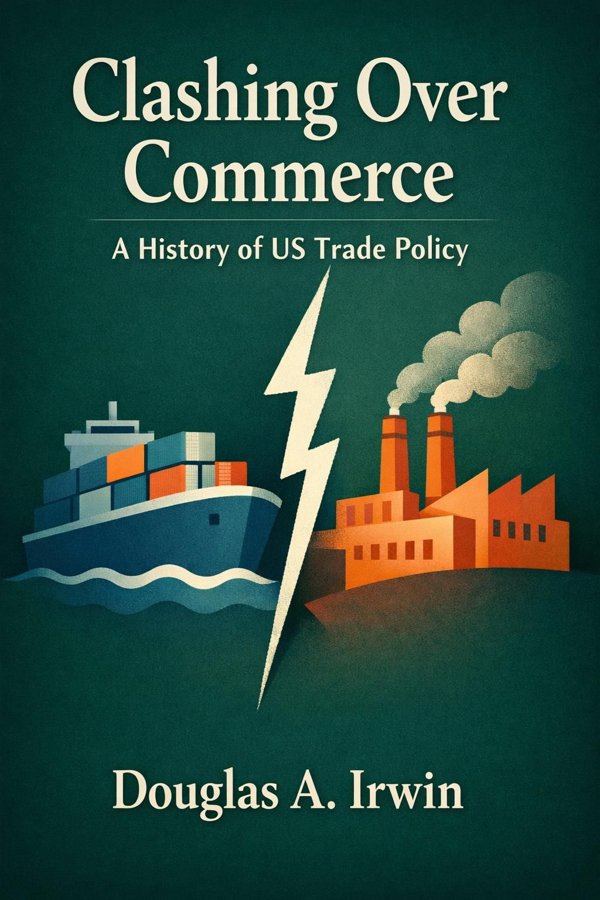
Clashing Over Commerce: A History of US Trade Policy: Summary & Key Insights
 10 min9 chaptersAudio available
What Is Clashing Over Commerce: A History of US Trade Policy About?
Clashing Over Commerce: A History of US Trade Policy by Douglas A. Irwin is a economics book spanning 9 pages. Clashing Over Commerce traces the evolution of U.S. trade policy from the founding of the republic to the present day. Douglas A. Irwin provides a comprehensive historical analysis of how political, economic, and ideological forces have shaped American trade policy. The book explores the recurring debates between protectionism and free trade, showing how these conflicts have influenced the nation’s economic development and global role.
This FizzRead summary covers all 9 key chapters of Clashing Over Commerce: A History of US Trade Policy in approximately 10 minutes, distilling the most important ideas, arguments, and takeaways from Douglas A. Irwin's work. Also available as an audio summary and Key Quotes Podcast.
Clashing Over Commerce: A History of US Trade Policy
Clashing Over Commerce traces the evolution of U.S. trade policy from the founding of the republic to the present day. Douglas A. Irwin provides a comprehensive historical analysis of how political, economic, and ideological forces have shaped American trade policy. The book explores the recurring debates between protectionism and free trade, showing how these conflicts have influenced the nation’s economic development and global role.
Who Should Read Clashing Over Commerce: A History of US Trade Policy?
This book is perfect for anyone interested in economics and looking to gain actionable insights in a short read. Whether you're a student, professional, or lifelong learner, the key ideas from Clashing Over Commerce: A History of US Trade Policy by Douglas A. Irwin will help you think differently.
- ✓Readers who enjoy economics and want practical takeaways
- ✓Professionals looking to apply new ideas to their work and life
- ✓Anyone who wants the core insights of Clashing Over Commerce: A History of US Trade Policy in just 10 minutes
Want the full summary?
Get instant access to this book summary and 100K+ more with Fizz Moment.
Get Free SummaryAvailable on App Store • Free to download
Key Chapters
The origins of U.S. trade policy lie in the birth of the republic itself. When the Constitution granted Congress the power to levy tariffs, it was less an economic decision than a political necessity. The infant government needed revenue, and import duties were its primary source. At the same time, figures like Alexander Hamilton envisioned a broader purpose: using tariffs to foster a domestic manufacturing base and economic independence from Europe. In his *Report on Manufactures* (1791), Hamilton argued that a fledgling country could not rely on laissez-faire. Britain’s industrial dominance left American producers vulnerable, and protection was a tool of national development.
Yet opposition was immediate. Thomas Jefferson and his agrarian allies saw commercial restraint as a betrayal of republican simplicity. The Southern states, reliant on exports of cotton and tobacco, feared that tariffs would raise the cost of manufactured goods and invite retaliation. Thus, from the very beginning, trade policy divided the nation along sectional and ideological lines. What was nominally a revenue policy became a battlefield for competing visions: a commercial, industrial North and an agrarian South.
Through the War of 1812, American leaders learned how dependent their young economy was on foreign trade. The embargoes and blockades of the Napoleonic Wars underscored the need for a more self-sufficient economy. Out of this crucible emerged the conviction that the United States needed to balance openness with protection—an enduring theme that would define its economic politics for the next two centuries.
The end of the War of 1812 gave rise to the first significant protective tariff in American history. The Tariff of 1816 was pitched as a temporary measure, but it opened the door to decades of political conflict. The North sought to protect its emerging industries, the South lamented what it saw as exploitation, and the West vacillated between the two, depending on its agricultural interests.
Protectionism became inseparable from the very substance of American politics. The so-called “Tariff of Abominations” in 1828 provoked the Nullification Crisis, in which South Carolina claimed the right to void federal tariff laws—an early confrontation between state sovereignty and national authority. Behind these constitutional battles lay an economic reality: tariffs benefited Northern manufacturers at the expense of Southern exporters whose cotton was sold in world markets. The industrial revolution deepened this divide. By midcentury, the country was no longer arguing merely about the proper level of duties, but about whose vision of America would prevail.
The political compromise of low tariffs in the 1840s and 1850s reflected the influence of the South and the Democratic Party’s free-trade leanings. Yet the arguments did not vanish; they smoldered, waiting for the economic transformations and wartime urgencies that would reignite protectionism with new force.
+ 7 more chapters — available in the FizzRead app
All Chapters in Clashing Over Commerce: A History of US Trade Policy
About the Author
Douglas A. Irwin is the John French Professor of Economics at Dartmouth College. He is a leading scholar in international trade and economic history, known for his extensive research on trade policy and its historical development in the United States.
Get This Summary in Your Preferred Format
Read or listen to the Clashing Over Commerce: A History of US Trade Policy summary by Douglas A. Irwin anytime, anywhere. FizzRead offers multiple formats so you can learn on your terms — all free.
Available formats: App · Audio · PDF · EPUB — All included free with FizzRead
Download Clashing Over Commerce: A History of US Trade Policy PDF and EPUB Summary
Key Quotes from Clashing Over Commerce: A History of US Trade Policy
“The end of the War of 1812 gave rise to the first significant protective tariff in American history.”
Frequently Asked Questions about Clashing Over Commerce: A History of US Trade Policy
Clashing Over Commerce: A History of US Trade Policy by Douglas A. Irwin is a economics book that explores key ideas across 9 chapters. Clashing Over Commerce traces the evolution of U.S. trade policy from the founding of the republic to the present day. Douglas A. Irwin provides a comprehensive historical analysis of how political, economic, and ideological forces have shaped American trade policy. The book explores the recurring debates between protectionism and free trade, showing how these conflicts have influenced the nation’s economic development and global role.
You Might Also Like

Business Adventures
John Brooks
10 min
Nudge
Richard H. Thaler, Cass R. Sunstein
10 min
The Hitchhiker"s Guide to the Galaxy
Douglas Adams
10 minThe Muqaddimah
Ibn Khaldun
10 minThe Outsiders
William N. Thorndike
10 min
A Little History of Economics
Niall Kishtainy
10 minBrowse by Category
Ready to read Clashing Over Commerce: A History of US Trade Policy?
Get the full summary and 100K+ more books with Fizz Moment.