
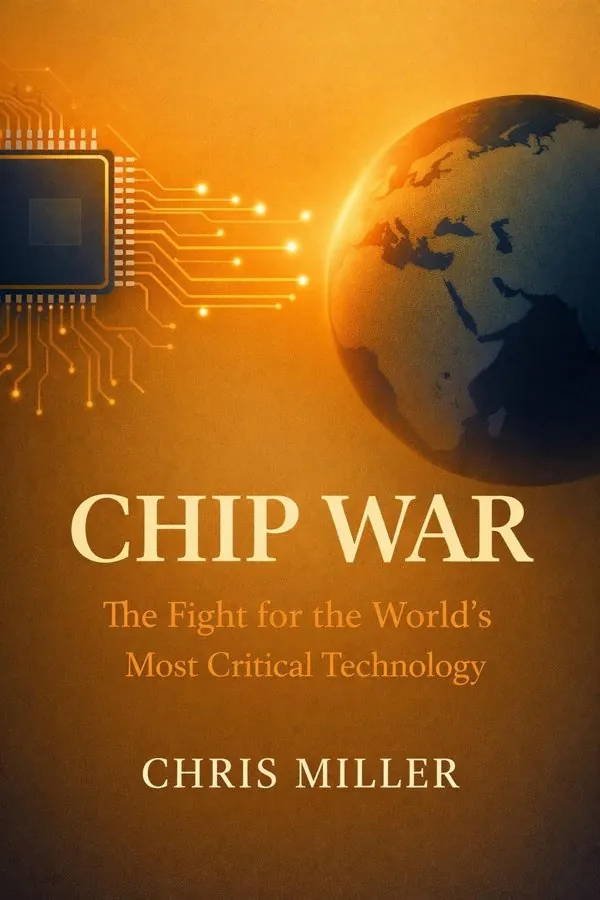
Chip War: The Fight for the World's Most Critical Technology: Summary & Key Insights
by Chris Miller
 10 min10 chaptersAudio available
What Is Chip War: The Fight for the World's Most Critical Technology About?
Chip War: The Fight for the World's Most Critical Technology by Chris Miller is a economics book spanning 10 pages. Chip War is a detailed history of the global semiconductor industry, tracing how microchips became the most critical technology shaping modern economies, militaries, and geopolitics. Chris Miller explores the rise of key players in the United States, East Asia, and Europe, and explains how control over chip manufacturing has become central to the balance of power between nations.
This FizzRead summary covers all 10 key chapters of Chip War: The Fight for the World's Most Critical Technology in approximately 10 minutes, distilling the most important ideas, arguments, and takeaways from Chris Miller's work. Also available as an audio summary and Key Quotes Podcast.
Chip War: The Fight for the World's Most Critical Technology
Chip War is a detailed history of the global semiconductor industry, tracing how microchips became the most critical technology shaping modern economies, militaries, and geopolitics. Chris Miller explores the rise of key players in the United States, East Asia, and Europe, and explains how control over chip manufacturing has become central to the balance of power between nations.
Who Should Read Chip War: The Fight for the World's Most Critical Technology?
This book is perfect for anyone interested in economics and looking to gain actionable insights in a short read. Whether you're a student, professional, or lifelong learner, the key ideas from Chip War: The Fight for the World's Most Critical Technology by Chris Miller will help you think differently.
- ✓Readers who enjoy economics and want practical takeaways
- ✓Professionals looking to apply new ideas to their work and life
- ✓Anyone who wants the core insights of Chip War: The Fight for the World's Most Critical Technology in just 10 minutes
Want the full summary?
Get instant access to this book summary and 100K+ more with Fizz Moment.
Get Free SummaryAvailable on App Store • Free to download
Key Chapters
Our journey begins in the mid-20th century, when physicists at Bell Labs cracked the problem of replacing bulky vacuum tubes with something smaller, faster, and more reliable. In 1947, John Bardeen, William Shockley, and Walter Brattain created the first transistor — a simple device capable of amplifying and switching electrical signals. It was an innovation born from curiosity but destined to redefine civilization. The transistor’s creation marked the moment when electrons could be commanded with microscopic precision, laying the foundation for digital logic.
In those early years, the semiconductor story was a peculiarly American one. Bell Labs represented the pinnacle of postwar scientific optimism, nourished by state funding and corporate vision. Yet the invention alone wasn’t enough. To transform this discovery into a revolution required commercial daring — which arrived in the form of spinoffs like Texas Instruments and Fairchild Semiconductor. Fairchild engineers, inspired by the integrated circuit concept introduced by Jack Kilby and Robert Noyce, found a way to etch multiple transistors onto a single slice of silicon. This was no longer about individual innovations; it was about building an entire industry from sand.
By the 1960s, semiconductors were already the lifeblood of America’s missile guidance systems, satellites, and computers. While the transistor was born in a lab, its destiny was geopolitical. Every Soviet radar and American spacecraft became a theater for chip supremacy, as technological progress fused with national power.
Few phenomena illustrate ingenuity and rebellion like Silicon Valley. The semiconductor industry’s culture of self-made entrepreneurs emerged from Fairchild Semiconductor’s laboratory benches. Known collectively as the ‘traitorous eight,’ these young physicists and engineers abandoned Shockley’s rigid management style to establish their own company. Their defiance marked not only the birth of a firm but the birth of a culture — one defined by freedom, risk, and the pursuit of exponential progress.
At Fairchild, a feedback loop of innovation began. Each breakthrough in chip design or lithographic precision accelerated the next, driving down costs while expanding performance. Out of this environment came Intel, co-founded by Robert Noyce and Gordon Moore. Moore’s 1965 observation — that the number of transistors on a chip would double roughly every two years — evolved into the driving law of the digital age.
From the first commercial microprocessor to the personal computer boom, Silicon Valley transformed how chips were imagined, built, and sold. No longer merely components for military hardware, semiconductors became tools for personal empowerment. The Valley’s business model — light on manufacturing, heavy on design and innovation — would later inspire a global restructuring of tech production, leaving fabrication increasingly offshore. Yet, at its heart, this revolution was powered by a belief: that progress is best achieved when creative minds are free to iterate faster than bureaucracy can constrain them.
+ 8 more chapters — available in the FizzRead app
All Chapters in Chip War: The Fight for the World's Most Critical Technology
About the Author
Chris Miller is an American historian and associate professor at Tufts University’s Fletcher School of Law and Diplomacy. His research focuses on international politics, economics, and technology, particularly the intersection of innovation and global power.
Get This Summary in Your Preferred Format
Read or listen to the Chip War: The Fight for the World's Most Critical Technology summary by Chris Miller anytime, anywhere. FizzRead offers multiple formats so you can learn on your terms — all free.
Available formats: App · Audio · PDF · EPUB — All included free with FizzRead
Download Chip War: The Fight for the World's Most Critical Technology PDF and EPUB Summary
Key Quotes from Chip War: The Fight for the World's Most Critical Technology
“Our journey begins in the mid-20th century, when physicists at Bell Labs cracked the problem of replacing bulky vacuum tubes with something smaller, faster, and more reliable.”
“Few phenomena illustrate ingenuity and rebellion like Silicon Valley.”
Frequently Asked Questions about Chip War: The Fight for the World's Most Critical Technology
Chip War: The Fight for the World's Most Critical Technology by Chris Miller is a economics book that explores key ideas across 10 chapters. Chip War is a detailed history of the global semiconductor industry, tracing how microchips became the most critical technology shaping modern economies, militaries, and geopolitics. Chris Miller explores the rise of key players in the United States, East Asia, and Europe, and explains how control over chip manufacturing has become central to the balance of power between nations.
You Might Also Like
Business Adventures
John Brooks
10 min
Nudge
Richard H. Thaler, Cass R. Sunstein
10 min
The Hitchhiker"s Guide to the Galaxy
Douglas Adams
10 minThe Muqaddimah
Ibn Khaldun
10 minThe Outsiders
William N. Thorndike
10 min
A Little History of Economics
Niall Kishtainy
10 minBrowse by Category
Ready to read Chip War: The Fight for the World's Most Critical Technology?
Get the full summary and 100K+ more books with Fizz Moment.