
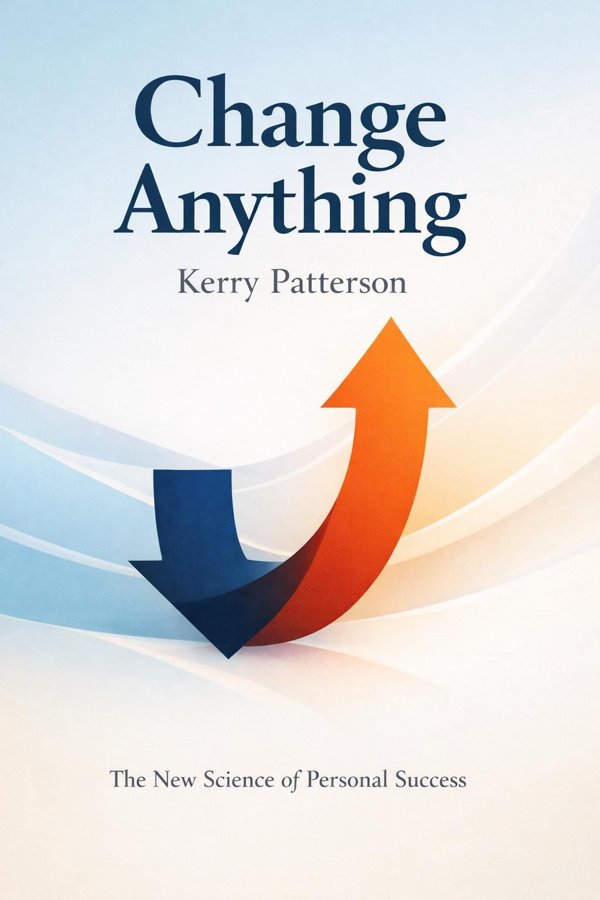
Change Anything: The New Science of Personal Success: Summary & Key Insights
 10 min9 chaptersAudio available
Key Takeaways from Change Anything: The New Science of Personal Success
The biggest mistake people make in change efforts is trying to fix everything at once.
People often fail at change not because they are weak, but because they are solving the wrong problem.
Most change attempts fail because they rely on a single tool—usually personal willpower.
Willpower is unreliable when a bad habit feels rewarding in the moment.
People often assume they fail because they do not want change badly enough.
What Is Change Anything: The New Science of Personal Success About?
Change Anything: The New Science of Personal Success by Kerry Patterson is a habits book spanning 8 pages. Why do so many people sincerely want to change, yet keep repeating the same behaviors? In Change Anything, Kerry Patterson and his coauthors argue that lasting transformation rarely fails because of weak character or low motivation. It fails because most people rely on a narrow, incomplete model of change. They try harder, make resolutions, and blame themselves when willpower collapses—without addressing the many forces that shape behavior every day. This book offers a more powerful approach, combining insights from psychology, behavioral science, organizational research, and real-world case studies to show how meaningful change actually happens. The authors explain that success depends on identifying a few high-leverage behaviors and then redesigning the personal, social, and environmental influences that support or sabotage them. Kerry Patterson brings strong authority to this topic through his work on communication, influence, and performance improvement, including bestselling books such as Crucial Conversations and Influencer. Change Anything matters because it replaces vague self-help advice with a practical system. Whether you want to improve your health, relationships, habits, or professional performance, it provides a structured roadmap for change that lasts.
This FizzRead summary covers all 9 key chapters of Change Anything: The New Science of Personal Success in approximately 10 minutes, distilling the most important ideas, arguments, and takeaways from Kerry Patterson's work. Also available as an audio summary and Key Quotes Podcast.
Change Anything: The New Science of Personal Success
Why do so many people sincerely want to change, yet keep repeating the same behaviors? In Change Anything, Kerry Patterson and his coauthors argue that lasting transformation rarely fails because of weak character or low motivation. It fails because most people rely on a narrow, incomplete model of change. They try harder, make resolutions, and blame themselves when willpower collapses—without addressing the many forces that shape behavior every day. This book offers a more powerful approach, combining insights from psychology, behavioral science, organizational research, and real-world case studies to show how meaningful change actually happens. The authors explain that success depends on identifying a few high-leverage behaviors and then redesigning the personal, social, and environmental influences that support or sabotage them. Kerry Patterson brings strong authority to this topic through his work on communication, influence, and performance improvement, including bestselling books such as Crucial Conversations and Influencer. Change Anything matters because it replaces vague self-help advice with a practical system. Whether you want to improve your health, relationships, habits, or professional performance, it provides a structured roadmap for change that lasts.
Who Should Read Change Anything: The New Science of Personal Success?
This book is perfect for anyone interested in habits and looking to gain actionable insights in a short read. Whether you're a student, professional, or lifelong learner, the key ideas from Change Anything: The New Science of Personal Success by Kerry Patterson will help you think differently.
- ✓Readers who enjoy habits and want practical takeaways
- ✓Professionals looking to apply new ideas to their work and life
- ✓Anyone who wants the core insights of Change Anything: The New Science of Personal Success in just 10 minutes
Want the full summary?
Get instant access to this book summary and 100K+ more with Fizz Moment.
Get Free SummaryAvailable on App Store • Free to download
Key Chapters
The biggest mistake people make in change efforts is trying to fix everything at once. We often describe our goals in broad, emotional terms: get healthy, be more productive, become a better parent, stop procrastinating. But these are outcomes, not behaviors. The authors argue that meaningful change begins when you identify a small number of crucial behaviors—the specific actions that, if performed consistently, make success far more likely.
This idea is powerful because most results are driven by a few high-impact habits. A struggling student may not need to "work harder" in general; the crucial behaviors might be attending every class, reviewing notes within twenty-four hours, and studying with a focused partner. Someone trying to lose weight may not need a complete lifestyle overhaul; key behaviors might include tracking meals, removing sugary drinks, and walking thirty minutes daily. By narrowing attention, you reduce overwhelm and increase clarity.
The authors emphasize that crucial behaviors are both observable and repeatable. "Be more disciplined" is too vague. "Prepare tomorrow’s top three priorities before leaving work" is concrete. That precision makes measurement possible, and measurement makes progress visible. It also helps you intervene at the right level: behavior, not intention.
The practical lesson is to stop asking, "How do I transform my whole life?" and start asking, "What are the two or three actions that would make the biggest difference if I did them consistently?" Once identified, these behaviors become the foundation for every other change strategy in the book.
Actionable takeaway: Define your goal in one sentence, then list three specific behaviors that most directly produce that result. Focus your change effort on those behaviors first.
People often fail at change not because they are weak, but because they are solving the wrong problem. We are quick to explain setbacks with simplistic labels: lazy, unmotivated, inconsistent, bad with money, not a morning person. The book challenges this habit and insists on proper diagnosis before intervention. If you misunderstand why a behavior persists, your solution will almost certainly miss the mark.
For example, someone who keeps skipping workouts may think the issue is lack of discipline. But a closer diagnosis might reveal several hidden barriers: exercise feels painful and unrewarding, their social circle normalizes inactivity, their gym is inconvenient, and evenings are already overloaded. In that case, motivational speeches alone will not help. The problem is broader and more structural than it first appears.
The authors encourage readers to become investigators of their own behavior. Instead of judging yourself, study patterns. When does the unwanted behavior happen? What precedes it? What reward does it provide? Who reinforces it? What obstacles make the better behavior difficult? This shift from self-criticism to curiosity is essential. It turns failure into information.
Proper diagnosis also prevents wasted effort. A manager may assume poor team performance comes from lack of accountability when the real issue is missing skills or conflicting incentives. A parent may think a teenager is defiant when the problem is social pressure and unclear expectations. The right diagnosis leads to the right leverage point.
Actionable takeaway: For one recurring behavior you want to change, write down what triggers it, what reward it gives, what makes the better alternative hard, and who or what reinforces the current pattern.
Most change attempts fail because they rely on a single tool—usually personal willpower. Change Anything argues that lasting transformation requires a broader strategy built around six sources of influence. These sources are organized across three levels: personal, social, and structural, with each level containing both motivation and ability. Together, they form a complete map of what drives behavior.
Personal motivation asks whether you actually want to perform the behavior. Personal ability asks whether you can do it reliably. Social motivation considers whether people around you encourage or discourage it. Social ability examines whether others help you succeed through support, coaching, or collaboration. Structural motivation involves rewards, incentives, and consequences built into your environment. Structural ability concerns tools, systems, cues, and physical conditions that make the behavior easier or harder.
This framework matters because behavior is rarely caused by one factor alone. Take smoking cessation. A person may genuinely want to quit, but struggle because nicotine withdrawal lowers ability, friends still smoke, routines trigger cravings, and cigarettes remain easily available. A stronger intervention would include motivation, skill-building, supportive peers, and environmental redesign.
The brilliance of the model is that it expands your options. If one lever is weak, you can strengthen another. When desire fades, social accountability may carry you through. When effort is too high, a structural change can reduce friction. The authors show that the more sources you activate, the greater the chance of success.
Actionable takeaway: Evaluate your change goal through all six sources of influence and identify the two weakest areas. Improve those first rather than relying only on motivation.
Willpower is unreliable when a bad habit feels rewarding in the moment. One of the book’s key insights is that people do what is pleasurable, meaningful, or emotionally compelling right now—not what they merely agree is good in theory. That is why lectures about long-term benefits often fail. If the immediate experience of a behavior is unpleasant, inconvenient, or boring, motivation will erode quickly.
To change behavior, the authors recommend finding ways to make the desired action emotionally engaging and personally meaningful. This may involve connecting it to identity, values, or vivid consequences. A person may stick with exercise more consistently when it becomes tied not to abstract fitness goals, but to being energetic enough to play with their children. Saving money becomes easier when linked to freedom, security, or a dream that feels real. The goal is to shift from distant logic to felt importance.
The book also suggests replacing destructive rewards with healthier ones. If unhealthy eating offers comfort after a stressful day, then simply removing junk food creates a motivational gap. You need an alternative source of relief, pleasure, or reward. Likewise, celebrating small wins can help the new behavior become more satisfying.
Personal motivation improves when the good behavior stops feeling like punishment and starts feeling like progress. This is not manipulation; it is alignment. You are designing your emotional world so that your immediate experience supports your long-term goals.
Actionable takeaway: Ask yourself what emotional reward your current habit provides, then create a healthier behavior that delivers a similar reward while also moving you toward your goal.
People often assume they fail because they do not want change badly enough. But sometimes the real problem is that the desired behavior is simply too hard. According to the authors, personal ability is just as important as motivation. Even highly committed people abandon goals when the required action is confusing, exhausting, inconvenient, or beyond their current skill level.
That is why successful change often begins by making behaviors easier. Instead of planning to write for two hours every morning, start by writing for fifteen minutes at a fixed time. Instead of overhauling your diet overnight, learn three simple meals you can prepare consistently. Instead of trying to become calmer in conflict through sheer effort, practice one communication technique such as pausing before responding or asking one clarifying question.
Skill gaps matter too. People cannot perform behaviors they have never truly learned. A manager may want to give better feedback but lack the language and confidence to do it well. A person may want to manage finances better but not understand budgeting. In such cases, training, practice, and rehearsal are far more useful than self-blame.
The authors repeatedly show that reducing complexity increases follow-through. Friction kills habits; simplicity sustains them. If the desired behavior requires too many steps, too much energy, or too much uncertainty, even good intentions will collapse under daily pressure. Make the path clear, small, and repeatable.
Actionable takeaway: Take one habit you want to build and reduce it to the easiest possible version. Remove extra steps, lower the time requirement, and identify one skill you may need to practice to make success easier.
Behavior is contagious. We like to imagine our habits are private choices, but the people around us shape what feels normal, acceptable, and possible. Change Anything highlights two social forces: social motivation and social ability. Social motivation comes from encouragement, approval, accountability, and shared norms. Social ability comes from help, coaching, reminders, and teamwork.
This matters because habits rarely exist in isolation. If your friends normalize overspending, unhealthy eating, gossip, or chronic lateness, your environment constantly pulls you backward. On the other hand, if you are surrounded by people who practice the behavior you want, change becomes easier because the desired action is reinforced rather than resisted.
The authors encourage building deliberate support systems. That might mean exercising with a partner, joining a writing group, asking a friend to check in on your progress, or involving your family in a shared health goal. In workplaces, it could mean creating peer mentoring, public commitments, or team routines that reinforce performance. People are more likely to persist when they know someone notices, supports, and expects progress.
Social ability is especially important during moments of weakness. A friend who talks you through a craving, a coach who helps you troubleshoot obstacles, or a colleague who shares a useful system can dramatically increase your chances of success. The right person can provide both accountability and skill transfer.
Actionable takeaway: Identify one person who can support your goal and ask for a specific role: accountability partner, coach, encourager, or teammate. Do not settle for vague support—define exactly how they will help.
If a habit is constantly triggered by your surroundings, changing your mind without changing your environment is often a losing battle. The book argues that structural forces—rewards, cues, systems, tools, and physical arrangements—have enormous influence over behavior. We tend to underestimate them because they feel ordinary, but they quietly shape what we do every day.
Structural motivation involves incentives and consequences. People respond to what gets rewarded, recognized, or penalized. In organizations, employees may be told to collaborate, but if promotions only reward individual achievement, the structure undermines the message. In personal life, a savings goal is harder to maintain if spending offers immediate pleasure and no visible consequence. Smart change efforts align rewards with desired actions.
Structural ability concerns the environment itself. If your phone sits beside your bed, mindless scrolling becomes easy. If healthy food is washed, visible, and accessible, better eating becomes easier. If your calendar is cluttered, important habits get squeezed out. Small design changes can produce outsized effects because they reduce reliance on moment-to-moment self-control.
The authors show that successful changers engineer context. They use reminders, checklists, visual cues, pre-commitments, automation, and barriers that make bad habits harder. This approach is practical and humble: instead of assuming perfect discipline, it accepts human limitations and designs around them.
Actionable takeaway: Change one part of your environment today so the desired behavior becomes easier and the unwanted behavior becomes harder. Add a cue, remove a trigger, automate a step, or create a small consequence for noncompliance.
Understanding change is not the same as practicing it. One of the most useful lessons in Change Anything is that insight must be translated into a concrete execution plan. Many people leave a book, seminar, or inspirational moment feeling energized, only to relapse because they never defined when, where, and how the new behavior would happen.
The authors emphasize action planning, tracking, and adjustment. Once you identify crucial behaviors and the sources influencing them, you need a system. That system might include written commitments, scheduled routines, progress measures, and planned responses to predictable obstacles. Without structure, intentions remain fragile. With structure, they become repeatable.
For example, someone who wants to improve sleep should not merely resolve to "get better rest." A stronger plan would specify: no screens after 10 p.m., lights out by 10:30, phone charging outside the bedroom, and a daily log of bedtime and wake time. If social pressure causes late nights, that factor must be addressed. If fatigue leads to evening snacking, that trigger must be planned for. Change becomes sustainable when it is operationalized.
The book also encourages experimentation. If a strategy fails, do not abandon the goal—revise the method. Progress is rarely linear. Long-term success comes from learning what works under real conditions and building resilience after setbacks.
Actionable takeaway: Convert one goal into a one-week behavior plan with a schedule, a tracking method, and a prewritten response to the obstacle most likely to derail you.
Lasting change is not about a perfect streak; it is about recovering quickly when you slip. A common reason people abandon progress is the all-or-nothing mindset. One missed workout becomes proof that the plan is failing. One overspending episode becomes an excuse to give up on budgeting for the month. The book challenges this pattern by showing that relapse is not the opposite of change—it is part of the process of change.
Sustaining improvement requires vigilance, renewal, and adaptation. Behaviors that become easier over time can still weaken when stress rises, routines shift, or social environments change. That is why the authors recommend building maintenance strategies, not just launch strategies. You need ways to notice early warning signs, refresh motivation, and re-engage support systems before small lapses become old patterns.
Celebrating progress matters here as well. When people see evidence of growth, they are more likely to protect it. Reviewing wins, measuring improvements, and reconnecting with the reason for change can reinforce identity: "I am becoming the kind of person who does this consistently." That identity shift is often more durable than temporary enthusiasm.
The book ultimately treats change as a living system rather than a one-time decision. As life evolves, your methods may need to evolve too. The goal is not rigid perfection, but durable capability—the ability to keep moving back toward the behaviors that matter.
Actionable takeaway: Create a relapse plan before you need it. Decide what you will do after a slip, who you will contact, and what small action will get you back on track within twenty-four hours.
All Chapters in Change Anything: The New Science of Personal Success
About the Author
Kerry Patterson is an American author, researcher, and speaker known for his work on communication, influence, and behavior change. He is a coauthor of several bestselling books, including Crucial Conversations, Crucial Accountability, Influencer, and Change Anything. His writing focuses on helping individuals, teams, and organizations solve difficult problems by understanding the forces that shape human behavior. Patterson’s work is widely used in leadership development, workplace training, and personal improvement because it combines research-based insights with clear, practical tools. Across his books, he has built a reputation for turning complex ideas from psychology and organizational science into methods people can apply in everyday life. In Change Anything, he extends that expertise to personal success, showing how lasting transformation becomes possible when change is approached systematically rather than emotionally.
Get This Summary in Your Preferred Format
Read or listen to the Change Anything: The New Science of Personal Success summary by Kerry Patterson anytime, anywhere. FizzRead offers multiple formats so you can learn on your terms — all free.
Available formats: App · Audio · PDF · EPUB — All included free with FizzRead
Download Change Anything: The New Science of Personal Success PDF and EPUB Summary
Key Quotes from Change Anything: The New Science of Personal Success
“The biggest mistake people make in change efforts is trying to fix everything at once.”
“People often fail at change not because they are weak, but because they are solving the wrong problem.”
“Most change attempts fail because they rely on a single tool—usually personal willpower.”
“Willpower is unreliable when a bad habit feels rewarding in the moment.”
“People often assume they fail because they do not want change badly enough.”
Frequently Asked Questions about Change Anything: The New Science of Personal Success
Change Anything: The New Science of Personal Success by Kerry Patterson is a habits book that explores key ideas across 9 chapters. Why do so many people sincerely want to change, yet keep repeating the same behaviors? In Change Anything, Kerry Patterson and his coauthors argue that lasting transformation rarely fails because of weak character or low motivation. It fails because most people rely on a narrow, incomplete model of change. They try harder, make resolutions, and blame themselves when willpower collapses—without addressing the many forces that shape behavior every day. This book offers a more powerful approach, combining insights from psychology, behavioral science, organizational research, and real-world case studies to show how meaningful change actually happens. The authors explain that success depends on identifying a few high-leverage behaviors and then redesigning the personal, social, and environmental influences that support or sabotage them. Kerry Patterson brings strong authority to this topic through his work on communication, influence, and performance improvement, including bestselling books such as Crucial Conversations and Influencer. Change Anything matters because it replaces vague self-help advice with a practical system. Whether you want to improve your health, relationships, habits, or professional performance, it provides a structured roadmap for change that lasts.
More by Kerry Patterson
Crucial Conversations: Tools for Talking When Stakes Are High
Kerry Patterson, Joseph Grenny, Ron McMillan, Al Switzler
10 min
Influencer: The Power to Change Anything
Kerry Patterson
10 min
Crucial Accountability: Tools for Resolving Violated Expectations, Broken Commitments, and Bad Behavior
Kerry Patterson, Joseph Grenny, Ron McMillan, Al Switzler
10 minYou Might Also Like

Atomic Habits: An Easy & Proven Way to Build Good Habits and Break Bad Ones
James Clear
10 min
A Complaint Free World: How to Stop Complaining and Start Enjoying the Life You Always Wanted
Will Bowen
10 minBadass Habits: Cultivate the Awareness, Boundaries, and Daily Upgrades You Need to Make Them Stick
Jen Sincero
10 min
Better Than Before: Mastering The Habits Of Our Everyday Lives
Gretchen Rubin
10 min
Discipline Equals Freedom: Field Manual
Jocko Willink
10 min
Dopamine Detox: A Short Guide to Remove Distractions and Get Your Brain to Do Hard Things
Thibaut Meurisse
10 minBrowse by Category
Ready to read Change Anything: The New Science of Personal Success?
Get the full summary and 100K+ more books with Fizz Moment.