
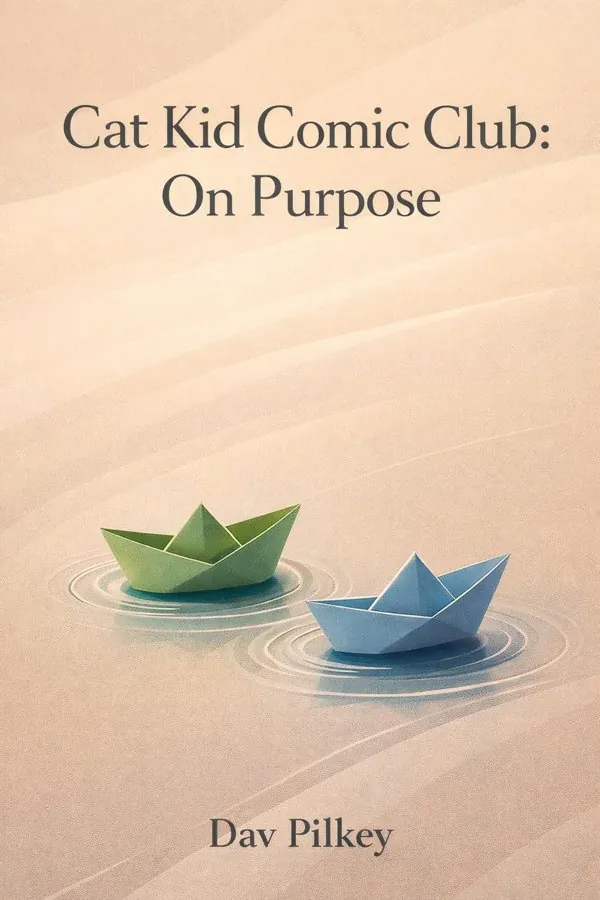
Cat Kid Comic Club: On Purpose: Summary & Key Insights
by Dav Pilkey
 10 min8 chaptersAudio available
Key Takeaways from Cat Kid Comic Club: On Purpose
Purpose often begins not with certainty, but with a question: why am I doing this?
The moment creativity stops feeling easy is often the moment real growth begins.
A creative group becomes powerful not when everyone thinks alike, but when each person contributes something distinct.
Creativity becomes more joyful when it is shared.
Many people imagine purpose as a fixed destination, but Pilkey presents it as something more fluid: a sense of meaning that grows through action.
What Is Cat Kid Comic Club: On Purpose About?
Cat Kid Comic Club: On Purpose by Dav Pilkey is a bestsellers book spanning 4 pages. What if purpose is not a grand answer waiting to be discovered, but a feeling that grows while you make, share, and care? In Cat Kid Comic Club: On Purpose, Dav Pilkey returns to the playful world of Li’l Petey, Molly, and the baby frogs, using comics, jokes, and gentle chaos to explore a surprisingly meaningful question: why do we create at all? This third installment in the Cat Kid Comic Club series combines silliness with emotional intelligence, showing young readers that purpose can emerge through imagination, persistence, and connection with others. As the comic club reunites, the frogs face familiar creative struggles: insecurity, comparison, frustration, and the fear that their ideas may not be good enough. But Pilkey turns those challenges into opportunities for growth. Through visual humor, energetic storytelling, and a deep respect for children’s inner lives, he shows that every voice matters and that creativity becomes richer when people work together. Best known for Captain Underpants and Dog Man, Pilkey has long championed empathy, resilience, and unconventional thinking. Here, he does it again—offering children and families an uplifting reminder that creating with purpose often begins simply by showing up and trying.
This FizzRead summary covers all 8 key chapters of Cat Kid Comic Club: On Purpose in approximately 10 minutes, distilling the most important ideas, arguments, and takeaways from Dav Pilkey's work. Also available as an audio summary and Key Quotes Podcast.
Cat Kid Comic Club: On Purpose
What if purpose is not a grand answer waiting to be discovered, but a feeling that grows while you make, share, and care? In Cat Kid Comic Club: On Purpose, Dav Pilkey returns to the playful world of Li’l Petey, Molly, and the baby frogs, using comics, jokes, and gentle chaos to explore a surprisingly meaningful question: why do we create at all? This third installment in the Cat Kid Comic Club series combines silliness with emotional intelligence, showing young readers that purpose can emerge through imagination, persistence, and connection with others.
As the comic club reunites, the frogs face familiar creative struggles: insecurity, comparison, frustration, and the fear that their ideas may not be good enough. But Pilkey turns those challenges into opportunities for growth. Through visual humor, energetic storytelling, and a deep respect for children’s inner lives, he shows that every voice matters and that creativity becomes richer when people work together. Best known for Captain Underpants and Dog Man, Pilkey has long championed empathy, resilience, and unconventional thinking. Here, he does it again—offering children and families an uplifting reminder that creating with purpose often begins simply by showing up and trying.
Who Should Read Cat Kid Comic Club: On Purpose?
This book is perfect for anyone interested in bestsellers and looking to gain actionable insights in a short read. Whether you're a student, professional, or lifelong learner, the key ideas from Cat Kid Comic Club: On Purpose by Dav Pilkey will help you think differently.
- ✓Readers who enjoy bestsellers and want practical takeaways
- ✓Professionals looking to apply new ideas to their work and life
- ✓Anyone who wants the core insights of Cat Kid Comic Club: On Purpose in just 10 minutes
Want the full summary?
Get instant access to this book summary and 100K+ more with Fizz Moment.
Get Free SummaryAvailable on App Store • Free to download
Key Chapters
Purpose often begins not with certainty, but with a question: why am I doing this? That question sits at the heart of the comic club’s reunion. When Li’l Petey brings the baby frogs back together, the energy feels joyful and familiar, yet there is also a new seriousness beneath the fun. The group is no longer simply making comics to pass the time. They are beginning to wonder what their stories mean, what they want to say, and how creativity connects to identity.
This matters because children, like adults, want to feel that their efforts have meaning. Pilkey presents this search in a way that is light enough for young readers but emotionally honest enough to resonate with anyone who has ever made something and wondered whether it mattered. The frogs each approach the club with their own expectations. Some want to impress others. Some want to be funny. Some want to prove they are talented. In that mix, the club becomes a miniature version of any creative community: full of hope, insecurity, and possibility.
The reunion reminds readers that purpose does not appear all at once. It develops through participation. The act of gathering, brainstorming, and trying again helps each member discover what they care about. In schools, homes, or creative groups, this can look like children writing stories together, sharing drawings, or talking about what they love making most. Instead of asking, “What is my purpose?” a more useful question may be, “What feels meaningful when I do it?”
A practical way to apply this idea is to create regular space for expression without demanding perfection. A family comic night, classroom storytelling circle, or simple sketchbook routine can help purpose grow naturally. Actionable takeaway: start with the habit of creating together, and let meaning emerge through the process rather than waiting for clarity before you begin.
The moment creativity stops feeling easy is often the moment real growth begins. In On Purpose, the frogs encounter the messy side of making art: ideas stall, jokes fall flat, and confidence disappears. Some feel their comics are not good enough. Others compare themselves to friends who seem more naturally talented. Rather than treating these feelings as failure, Pilkey shows them as normal stages in the creative process.
This is one of the book’s most valuable lessons. Many children assume that if creating feels hard, they must not be good at it. Adults often believe the same thing. But frustration is not proof that creativity has ended; it is often evidence that someone cares and is stretching beyond what feels comfortable. The frogs’ struggles make the story relatable because they mirror what happens when anyone writes, draws, solves problems, or learns a new skill.
Pilkey uses humor to soften the sting of self-doubt, but he never dismisses it. The emotional truth remains clear: creating requires courage. That courage is not the absence of fear. It is the willingness to continue despite uncertainty. In practical terms, this can mean letting a child keep an imperfect drawing, encouraging multiple drafts of a story, or praising persistence rather than just talent. It can also mean normalizing statements like, “This part is hard right now,” instead of “I’m bad at this.”
A useful strategy is to break creative work into small steps. If finishing a comic feels overwhelming, start with one character, one panel, or one joke. Progress builds momentum, and momentum rebuilds confidence. Teachers and parents can support this by celebrating effort, experimentation, and revision.
Actionable takeaway: when frustration shows up, name it as part of the process and keep going in smaller steps instead of quitting at the first sign of difficulty.
A creative group becomes powerful not when everyone thinks alike, but when each person contributes something distinct. One of the richest ideas in Cat Kid Comic Club: On Purpose is that the frogs’ differences are not obstacles to overcome; they are the very source of the club’s energy. Their styles, personalities, humor, and emotional perspectives vary widely, and those differences make the club more imaginative and more alive.
Pilkey quietly teaches a lesson about diversity through artistic expression. Some frogs are bold, some shy, some absurdly funny, some sincere, and some more reflective. No single way of making comics is treated as the “correct” one. This matters because many children quickly absorb the idea that they should copy whatever gets the most praise. Pilkey pushes in the opposite direction. He suggests that originality grows when individuals trust their own instincts.
This insight applies far beyond comics. In classrooms, a group project improves when students bring different strengths: one may be a great illustrator, another a strong organizer, another full of unusual ideas. In families, siblings often express themselves in different ways—through drawing, music, storytelling, movement, or humor. Encouraging those differences helps children build confidence instead of competition.
The frogs’ variety also teaches empathy. When readers see multiple creative voices side by side, they learn that someone else’s style does not threaten their own. There is room for many ways of being smart, funny, thoughtful, and artistic. A practical exercise is to ask children what makes their work feel like theirs. Is it the characters they invent? The type of jokes they tell? The colors they choose? Naming those patterns helps identity take shape.
Actionable takeaway: notice and celebrate what is unique in your voice or your child’s voice, because creativity becomes more meaningful when individuality is treated as a strength rather than a problem.
Creativity becomes more joyful when it is shared. While personal expression matters deeply in On Purpose, Pilkey also highlights the unique magic of collaboration. The comic club is not just a collection of individual artists working side by side. It is a community in which ideas bounce, evolve, and improve through interaction. The frogs inspire one another, challenge one another, and at times frustrate one another—but together they create something larger than any one of them could make alone.
This collaborative spirit teaches children an important truth: making art is not only about self-expression; it is also about relationship. Listening, giving feedback, encouraging peers, and building on someone else’s concept are all creative acts. In a culture that often celebrates individual brilliance, Pilkey reminds readers that shared creation can be just as meaningful.
The book also shows that collaboration is not always smooth. Different opinions can lead to tension. People may want control or feel protective of their ideas. Yet these moments are not signs that collaboration has failed. They are invitations to practice respect, compromise, and trust. A classroom comic anthology, for example, may require students to coordinate themes, exchange suggestions, and accept that not every idea will be used exactly as imagined. Those are valuable life skills, not distractions from creativity.
Parents and educators can apply this lesson by designing low-pressure collaborative projects: group storyboards, co-written comics, shared mural pages, or rotating storytelling games. The goal is not merely to produce polished work, but to help children experience the satisfaction of building with others.
When children learn that their ideas can support someone else’s vision, they gain both confidence and humility. They discover that contribution matters as much as recognition. Actionable takeaway: try one creative activity with a partner or group, and focus on listening and building together instead of trying to control the entire result.
Many people imagine purpose as a fixed destination, but Pilkey presents it as something more fluid: a sense of meaning that grows through action. In the world of the comic club, purpose is not delivered as a grand speech or a single revelation. It emerges slowly as the frogs write, draw, laugh, stumble, and share their work with one another. Their purpose is tied not only to what they create, but to how creating makes them feel connected and alive.
This is a powerful lesson for young readers because it replaces pressure with possibility. A child does not need to know their lifelong mission to begin making meaningful things. They only need curiosity, effort, and a willingness to participate. The act of creation itself becomes a way of discovering values. A child who keeps making funny comics may be drawn to joy. One who tells caring stories may be expressing empathy. One who experiments wildly may be exploring freedom and invention.
Adults can benefit from this message too. People often freeze when they think purpose must be impressive, productive, or permanent. Pilkey’s approach is gentler and wiser. Purpose can be found in a small daily practice, in offering delight to others, or in making something that reflects who you are right now.
A practical application is to ask reflective questions after a creative activity: What part did you enjoy most? What felt meaningful? Did your work make someone laugh, think, or feel understood? These questions move attention away from performance and toward meaning.
Purpose becomes clearer when people notice what keeps drawing them back. Actionable takeaway: instead of searching for one perfect purpose, pay attention to the creative activities that repeatedly give you energy, connection, and a sense of contribution.
Laughter is not a distraction from serious emotions; it is often a bridge through them. One of Dav Pilkey’s signature strengths is his ability to use humor to hold complex feelings without making them overwhelming. In On Purpose, the jokes, visual gags, and absurd comic situations do more than entertain. They create emotional safety, allowing readers to approach topics like insecurity, disappointment, and self-discovery with openness rather than fear.
This matters especially for children, who often understand difficult feelings more easily when they are presented in playful form. A silly comic can help a child process embarrassment. A ridiculous character reaction can make frustration feel manageable. Pilkey respects this emotional reality. He never abandons seriousness, but he packages it in delight.
Humor also encourages resilience. When mistakes are funny instead of shameful, children are more willing to take risks. A comic panel that does not work can become part of the joke. A failed idea can turn into a better one. This reframing teaches an invaluable skill: setbacks do not have to define the experience. They can become material.
Parents and teachers can apply this by making room for playful responses to frustration. If a child is stuck on a story, invite them to make the “worst possible ending” for fun and then revise it. If a drawing goes wrong, turn the mistake into a new creature or unexpected scene. Humor lowers pressure and reopens imagination.
There is also a social benefit. Shared laughter strengthens belonging, which in turn supports creativity. When children feel safe with others, they are more likely to share vulnerable ideas. Actionable takeaway: use humor as a creative tool during stressful moments, because a playful perspective can reduce fear and help fresh ideas return.
Talent grows best in an atmosphere of emotional safety. Beneath the jokes and comic-book energy of On Purpose lies a gentle but firm message: creativity flourishes when people are kind to one another. The frogs are not simply learning how to make better comics. They are learning how to support one another through vulnerability, disappointment, and trial and error.
This is crucial because creative work exposes part of the self. When a child shares a drawing or story, they are not only presenting a product; they are revealing imagination, taste, and feeling. Harsh criticism can shut that process down quickly. Encouragement, by contrast, helps children risk more, revise more, and grow more. Pilkey understands this deeply, and the club’s interactions model a version of creativity grounded in care.
Kindness does not mean pretending everything is perfect. It means offering honesty in a way that protects dignity and encourages improvement. Instead of saying, “That’s bad,” a supportive response might be, “I like this character—what if you added one more funny scene?” That shift matters. It preserves motivation while still inviting development.
In everyday life, adults can cultivate this by focusing feedback on specifics, praising effort and originality, and teaching children how to respond respectfully to others’ work. Group norms such as “be helpful, be honest, be kind” can transform a classroom or home art session.
When kindness becomes part of the process, creativity stops feeling like a test and starts feeling like an adventure. Children learn that they can be imperfect and still worthy of being heard. Actionable takeaway: create a feedback culture that is specific, encouraging, and respectful so that creative risks feel safe enough to take.
One of the most refreshing truths in Cat Kid Comic Club: On Purpose is that children are not treated as miniature adults-in-training, but as real creators right now. Pilkey gives the baby frogs genuine artistic agency. Their ideas may be silly, chaotic, or uneven, but they are presented with respect. This subtle choice sends a powerful message: children’s creativity is not trivial. It is meaningful, intelligent, and worthy of attention.
That message matters because young people are often praised superficially without being truly taken seriously. Adults may say “good job” while ignoring the actual content of a child’s work. Pilkey does the opposite. He allows the frogs to have distinct voices, perspectives, and struggles. Their art is part of who they are, not just an activity to keep them busy.
When children feel respected as creators, they become more invested in their own growth. They start to think critically about their work, not because they are pressured to perform, but because they understand that what they make has value. This can be nurtured in practical ways: asking children about their choices, displaying their work thoughtfully, inviting them to explain their stories, and revisiting earlier creations to notice development over time.
This idea also broadens how adults think about literacy and learning. A handmade comic may express emotional insight, sequencing, humor, design thinking, and narrative skill all at once. Taking such work seriously means recognizing multiple forms of intelligence.
Respect does not require expensive materials or formal training. It requires attention. When adults listen carefully to what children make, children learn to listen more carefully to themselves. Actionable takeaway: treat a child’s creative work as meaningful communication by asking thoughtful questions and responding with genuine interest, not automatic praise.
All Chapters in Cat Kid Comic Club: On Purpose
About the Author
Dav Pilkey is an American author and illustrator whose work has shaped modern children’s literature through humor, heart, and visual storytelling. He is best known for the wildly popular Captain Underpants, Dog Man, and Cat Kid Comic Club series, all of which combine comic energy with themes of friendship, empathy, and resilience. Pilkey’s books often celebrate children who think differently, struggle in traditional settings, or express themselves through imagination. His playful style, inventive formats, and emotional sincerity have earned him a devoted global readership among kids, parents, and teachers alike. Beyond the laughs, Pilkey’s stories encourage creativity, kindness, and perseverance. His ability to treat young readers with respect while keeping them entertained has made him one of the most influential and beloved children’s authors of his generation.
Get This Summary in Your Preferred Format
Read or listen to the Cat Kid Comic Club: On Purpose summary by Dav Pilkey anytime, anywhere. FizzRead offers multiple formats so you can learn on your terms — all free.
Available formats: App · Audio · PDF · EPUB — All included free with FizzRead
Download Cat Kid Comic Club: On Purpose PDF and EPUB Summary
Key Quotes from Cat Kid Comic Club: On Purpose
“Purpose often begins not with certainty, but with a question: why am I doing this?”
“The moment creativity stops feeling easy is often the moment real growth begins.”
“A creative group becomes powerful not when everyone thinks alike, but when each person contributes something distinct.”
“Creativity becomes more joyful when it is shared.”
“Many people imagine purpose as a fixed destination, but Pilkey presents it as something more fluid: a sense of meaning that grows through action.”
Frequently Asked Questions about Cat Kid Comic Club: On Purpose
Cat Kid Comic Club: On Purpose by Dav Pilkey is a bestsellers book that explores key ideas across 8 chapters. What if purpose is not a grand answer waiting to be discovered, but a feeling that grows while you make, share, and care? In Cat Kid Comic Club: On Purpose, Dav Pilkey returns to the playful world of Li’l Petey, Molly, and the baby frogs, using comics, jokes, and gentle chaos to explore a surprisingly meaningful question: why do we create at all? This third installment in the Cat Kid Comic Club series combines silliness with emotional intelligence, showing young readers that purpose can emerge through imagination, persistence, and connection with others. As the comic club reunites, the frogs face familiar creative struggles: insecurity, comparison, frustration, and the fear that their ideas may not be good enough. But Pilkey turns those challenges into opportunities for growth. Through visual humor, energetic storytelling, and a deep respect for children’s inner lives, he shows that every voice matters and that creativity becomes richer when people work together. Best known for Captain Underpants and Dog Man, Pilkey has long championed empathy, resilience, and unconventional thinking. Here, he does it again—offering children and families an uplifting reminder that creating with purpose often begins simply by showing up and trying.
More by Dav Pilkey



You Might Also Like

The Godfather
Mario Puzo
10 min
The Handmaid's Tale
Margaret Atwood
10 min
The Hunger Games
Suzanne Collins
10 min
The Nightingale
Kristin Hannah
10 min
The Seven Husbands of Evelyn Hugo
Taylor Jenkins Reid
10 min
Backwater Justice
Fern Michaels
10 minBrowse by Category
Ready to read Cat Kid Comic Club: On Purpose?
Get the full summary and 100K+ more books with Fizz Moment.