
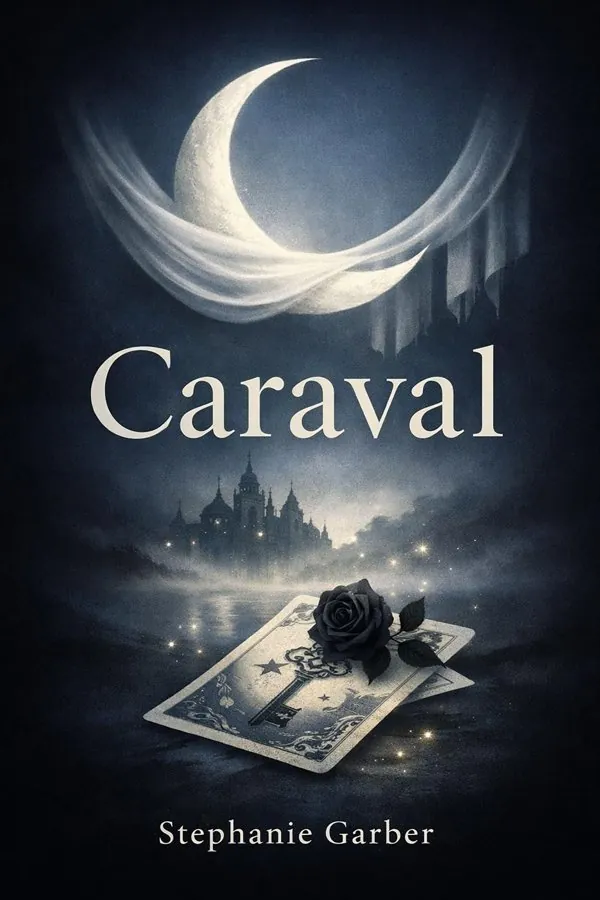
Caraval: Summary & Key Insights
 10 min8 chaptersAudio available
Key Takeaways from Caraval
Sometimes the smallest act of hope becomes the doorway to an entirely different life.
Wonder becomes dangerous the moment you mistake spectacle for safety.
The hardest choices emerge when your heart and your instincts tell different stories.
In many fantasy stories, romance appears to be the central prize, but Caraval quietly insists that the deepest bond may be between sisters.
A world built on illusion reveals how often people confuse presentation with reality.
What Is Caraval About?
Caraval by Stephanie Garber is a bestsellers book spanning 3 pages. What if the greatest escape from your life also forced you to confront the deepest fears you have spent years trying to survive? Stephanie Garber’s Caraval is a bestselling young adult fantasy novel that follows Scarlett Dragna, a sheltered young woman who has long dreamed of attending Caraval, a legendary performance where the audience becomes part of the game. When she finally receives an invitation, what begins as a chance to flee her cruel father turns into a dazzling and dangerous journey through a world built on illusion, desire, and carefully hidden truths. As Scarlett searches for her missing sister Tella, she must decide whom to trust when every clue feels like a trick and every feeling could be manipulated. Caraval matters because it transforms familiar themes—sisterhood, freedom, first love, and self-discovery—into a richly atmospheric story that asks how people find truth in systems designed to deceive them. Garber, known for her immersive fantasy worlds and emotionally charged storytelling, establishes her authority here through vivid sensory writing, intricate plotting, and a talent for making magic feel intimate, seductive, and unsettling all at once.
This FizzRead summary covers all 8 key chapters of Caraval in approximately 10 minutes, distilling the most important ideas, arguments, and takeaways from Stephanie Garber's work. Also available as an audio summary and Key Quotes Podcast.
Caraval
What if the greatest escape from your life also forced you to confront the deepest fears you have spent years trying to survive? Stephanie Garber’s Caraval is a bestselling young adult fantasy novel that follows Scarlett Dragna, a sheltered young woman who has long dreamed of attending Caraval, a legendary performance where the audience becomes part of the game. When she finally receives an invitation, what begins as a chance to flee her cruel father turns into a dazzling and dangerous journey through a world built on illusion, desire, and carefully hidden truths. As Scarlett searches for her missing sister Tella, she must decide whom to trust when every clue feels like a trick and every feeling could be manipulated. Caraval matters because it transforms familiar themes—sisterhood, freedom, first love, and self-discovery—into a richly atmospheric story that asks how people find truth in systems designed to deceive them. Garber, known for her immersive fantasy worlds and emotionally charged storytelling, establishes her authority here through vivid sensory writing, intricate plotting, and a talent for making magic feel intimate, seductive, and unsettling all at once.
Who Should Read Caraval?
This book is perfect for anyone interested in bestsellers and looking to gain actionable insights in a short read. Whether you're a student, professional, or lifelong learner, the key ideas from Caraval by Stephanie Garber will help you think differently.
- ✓Readers who enjoy bestsellers and want practical takeaways
- ✓Professionals looking to apply new ideas to their work and life
- ✓Anyone who wants the core insights of Caraval in just 10 minutes
Want the full summary?
Get instant access to this book summary and 100K+ more with Fizz Moment.
Get Free SummaryAvailable on App Store • Free to download
Key Chapters
Sometimes the smallest act of hope becomes the doorway to an entirely different life. For years, Scarlett Dragna writes letters to Legend, the mysterious master of Caraval, even though she has no reason to believe he will ever answer. Living under the control of a violent father, she clings to the fantasy of Caraval as proof that another world might exist beyond fear, obedience, and survival. The invitation she finally receives is not just a ticket to a magical event; it is a symbol of possibility. It interrupts the future that has already been chosen for her, including an arranged marriage she views as a practical escape rather than a dream.
This idea matters because Caraval begins with a question many readers recognize: how do you keep hope alive when your circumstances seem fixed? Scarlett’s letters represent private resistance. She may appear passive on the surface, but her persistence reveals a quiet refusal to let her father define her entire reality. In everyday life, people often make similar symbolic moves—applying for a job they think they will not get, reaching out to a mentor, enrolling in a class, or planning a move long before they feel ready. These actions do not instantly solve anything, but they create openings.
Garber uses the invitation to show that transformation rarely starts when we feel confident. It begins when longing becomes stronger than fear. Scarlett does not enter Caraval as a fearless heroine; she enters as someone uncertain, anxious, and deeply conditioned by control. That makes her journey more believable and more emotionally resonant.
Actionable takeaway: keep making your “letters to Legend”—small, hopeful actions that prepare you for change before you fully believe change is possible.
Wonder becomes dangerous the moment you mistake spectacle for safety. When Scarlett arrives on Caraval’s island, she steps into a place where reality behaves like theater: dresses change, messages appear in unexpected places, time seems unstable, and every encounter may be a clue, a temptation, or a trap. The official game centers on finding Tella, who has vanished soon after they arrive. Yet the deeper challenge for Scarlett is learning how to act in an environment where the ordinary rules of trust no longer apply.
This section of the novel explores one of its most compelling ideas: enchantment is not neutral. Caraval is beautiful, but it is also destabilizing. It dazzles Scarlett into uncertainty, and that uncertainty forces growth. She can no longer survive by following instructions or staying invisible. To move forward, she must make decisions with incomplete information. She must talk to strangers, evaluate motives, and take emotional risks. In other words, courage in Caraval does not look like fearlessness; it looks like continuing despite confusion.
That idea has practical relevance beyond fantasy. Many real-life transitions—starting college, changing careers, leaving controlling relationships, moving to a new city—feel like entering a world whose rules you do not yet understand. The instinct is to wait until everything becomes clear. Caraval suggests that clarity often comes after movement, not before it.
Garber also reminds readers that beauty can distract from danger. Not every glamorous opportunity is trustworthy, and not every charismatic person has good intentions. Scarlett’s challenge is to remain open to wonder without surrendering judgment.
Actionable takeaway: when you enter an unfamiliar season of life, let curiosity pull you forward, but pair it with careful observation and the courage to act before certainty arrives.
The hardest choices emerge when your heart and your instincts tell different stories. As Scarlett moves deeper into the game, Caraval becomes more than a search for Tella. It turns into a test of love, loyalty, and the boundaries between performance and truth. Her connection with Julian, a sailor who helps bring her to the island, complicates everything. Their growing intimacy feels real, yet Caraval is built on illusion, and Scarlett has been warned repeatedly not to trust what she sees or feels. Meanwhile, her devotion to Tella drives nearly every decision she makes, even when she does not fully understand her sister’s motives.
This key idea captures the emotional center of the novel: love is both a vulnerability and a source of strength. Scarlett must decide whether protecting someone always means controlling outcomes, whether sacrifice is noble when it erases your own needs, and whether trust is possible in a world designed to manipulate desire. Caraval pushes these questions to extremes, but they mirror real relationships. People often confuse love with rescue, duty, or self-denial. Scarlett’s journey suggests that mature love requires discernment. It is not simply giving everything away; it is choosing with awareness.
The novel also shows how easily emotional intensity can blur judgment. A dramatic environment can magnify attraction and fear, making every feeling seem urgent and absolute. In life, high-stakes situations—family crises, fast-moving romances, emotionally charged workplaces—can create similar distortions. It becomes essential to ask not just what you feel, but what is actually being asked of you.
Actionable takeaway: when emotion runs high, pause to separate genuine love from pressure, performance, or panic before making a sacrifice you cannot easily undo.
In many fantasy stories, romance appears to be the central prize, but Caraval quietly insists that the deepest bond may be between sisters. Scarlett and Donatella, known as Tella, are very different. Scarlett is cautious, rule-bound, and shaped by fear; Tella is impulsive, bold, and willing to gamble everything for freedom. Their differences create friction, but they also reveal the complexity of love inside families formed under trauma. Scarlett often believes she is the protector, the responsible one keeping them alive. Tella, however, is not simply reckless. She has her own methods of resistance and her own secrets.
This relationship matters because it gives the novel emotional weight beyond its twists and magical setting. The game of Caraval becomes meaningful not just because it is mysterious, but because Scarlett’s choices are anchored in her commitment to her sister. Readers see how love inside families can become tangled with guilt, obligation, resentment, and idealization. Scarlett thinks she knows what Tella needs, yet part of her growth involves recognizing that love does not equal full understanding.
In practical terms, this dynamic speaks to anyone who has played a fixed role in a family: the peacemaker, the caretaker, the rebel, the responsible one. Those roles can become prisons. Caraval suggests that growth requires allowing loved ones to be more complicated than the labels you have assigned them. It also asks whether protection can become a form of control when driven by fear.
Garber’s portrayal of sisterhood gives the story its staying power. The tension between dependence and independence, devotion and frustration, feels emotionally true even in a magical world.
Actionable takeaway: revisit the roles you and your loved ones play in your family, and ask whether those roles still reflect who you are—or only who you had to be to survive.
A world built on illusion reveals how often people confuse presentation with reality. One of Caraval’s most memorable strengths is its constant blurring of what is staged and what is authentic. Characters perform versions of themselves. Settings shift. Warnings contradict desires. Even pain and tenderness are thrown into doubt. The result is more than suspense; it becomes a meditation on perception. Scarlett wants reliable answers, but Caraval forces her to confront a destabilizing truth: people rarely encounter reality unfiltered. They interpret it through fear, hope, memory, and longing.
This idea extends well beyond the novel’s fantasy setting. Modern life is full of curated performances—social media identities, polished public images, strategic self-presentation at work, even family myths repeated so often they become accepted truth. Caraval dramatizes this phenomenon through magic. If a room can transform in an instant and a person can appear to be several things at once, then the reader is invited to examine how fragile certainty really is.
Garber does not suggest that truth is impossible to find. Instead, she shows that truth often requires more than seeing. It requires pattern recognition, emotional discipline, and the willingness to revise your assumptions. Scarlett grows when she learns not to accept the first explanation that satisfies her fear. She begins asking better questions: Who benefits from this version of events? What am I being encouraged to feel? What have I failed to notice because I wanted something to be true?
These are useful questions in daily life as well, especially in emotionally charged situations where appearances are persuasive.
Actionable takeaway: when a situation feels confusing, do not ask only, “What am I seeing?” Ask, “What story am I being invited to believe, and why?”
Leaving a harmful situation is not the same as becoming free. At the start of Caraval, Scarlett believes marriage to a count she has never met might offer safety from her father’s abuse. Her dream is modest: not joy, not adventure, but stability. This is one of the novel’s sharpest insights. People shaped by control often reduce freedom to the absence of immediate danger. They do not yet have the luxury of imagining a fuller life. Caraval disrupts that limited vision by forcing Scarlett to consider that survival and freedom are not identical.
Throughout the story, Scarlett confronts how deeply her father’s cruelty has trained her thinking. She hesitates, doubts herself, expects punishment, and assumes she must choose the least terrible option rather than a genuinely meaningful one. Her emotional habits do not disappear just because she reaches a magical island. This is realistic and important. External escape may happen quickly; internal escape is slower.
Readers can apply this idea to many forms of transition. Someone may leave a toxic job yet still think in ways shaped by scarcity and fear. A person may end a controlling relationship yet continue to seek approval or avoid risk. Freedom is not complete until the imagination expands. You have to learn not just how to get out, but how to live differently after getting out.
Garber captures this through Scarlett’s gradual movement from compliance toward agency. She does not become reckless. Instead, she begins to make choices based on values and intuition rather than fear alone. That shift is the real liberation.
Actionable takeaway: if you have escaped something limiting, ask yourself whether your current decisions are still being governed by old fear—or by the life you actually want to build.
Trust becomes most valuable when certainty is impossible. Scarlett’s journey is shaped by the problem of whom to believe. Julian is charming and helpful, but evasive. Legend is magnetic but hidden behind rumor and theater. Tella is beloved but secretive. Nearly everyone Scarlett meets seems to know more than they admit. In such an environment, trust cannot be based on comfort alone. It must be tested through patterns, consequences, and intuition sharpened by experience.
Caraval handles this especially well because it avoids simplistic lessons. The answer is not “trust no one.” Total suspicion would leave Scarlett paralyzed and alone. Nor is the lesson “follow your heart” without question, because desire itself can be manipulated. Instead, the novel presents discernment as a middle path. Scarlett learns to notice inconsistencies, evaluate actions rather than promises, and accept that trust often involves risk rather than guarantees.
This applies in practical ways to friendships, romance, and professional life. People frequently overvalue first impressions or emotional intensity. A charismatic person may inspire confidence before they have earned it; a guarded person may seem suspicious simply because they are not performing openness. Discernment asks more useful questions: Does this person’s behavior align with their words? Do I feel pressured to decide quickly? Am I overlooking red flags because I want a particular outcome?
The novel also suggests that learning to trust others is connected to learning to trust yourself. Scarlett has spent years in an environment that undermined her judgment. Reclaiming inner authority is part of her growth.
Actionable takeaway: when deciding whom to trust, look for consistency over charm, evidence over urgency, and remember that healthy trust grows through observation—not fantasy.
A person changes most dramatically when she stops seeing herself only through the limits others imposed on her. Scarlett starts the novel as someone defined by caution. She believes she is the sensible sister, the dutiful daughter, the one who survives by obeying rules and preventing disaster. Caraval exposes the inadequacy of that identity. To move through the game, she must improvise, confront danger, question authority, and accept that she possesses strength she has never fully named.
What makes this transformation satisfying is that it is not a sudden personality reversal. Scarlett does not become fearless overnight. Her growth happens through repeated choices: stepping forward despite anxiety, reevaluating assumptions, and acting before she feels completely prepared. Garber portrays courage as a practice rather than a trait. This makes Scarlett’s arc relatable. Many readers know what it is like to think, “I am just not that kind of person.” Caraval argues that identity is often far more flexible than fear suggests.
The novel also emphasizes that self-belief does not mean perfect confidence. Scarlett still misjudges situations and wrestles with doubt. But she gradually learns that uncertainty does not disqualify her from action. That lesson matters in everyday life. People delay important decisions because they think confidence must come first. In reality, confidence often develops after evidence accumulates that you can survive difficult things.
By the end, Scarlett sees herself less as a passive participant in someone else’s game and more as an active force within her own story. That shift is the foundation of genuine transformation.
Actionable takeaway: stop waiting to feel like a different person before acting boldly; take one brave step now, and let action reshape how you see yourself.
All Chapters in Caraval
About the Author
Stephanie Garber is an American author celebrated for her bestselling young adult fantasy novels, especially the Caraval series. Raised in California, she developed an early love for storytelling and later studied creative writing, eventually teaching it as well. Her fiction is known for its lush imagery, emotionally charged romance, and worlds where magic, performance, and deception intertwine. Garber has earned a devoted international readership by crafting stories that feel immersive and cinematic while remaining deeply focused on character emotion. With Caraval, she established herself as a standout voice in contemporary YA fantasy, blending fairy-tale atmosphere with suspense and psychological tension. Her work continues to attract readers who enjoy enchanting settings, layered mysteries, and heroines forced to navigate desire, danger, and self-discovery.
Get This Summary in Your Preferred Format
Read or listen to the Caraval summary by Stephanie Garber anytime, anywhere. FizzRead offers multiple formats so you can learn on your terms — all free.
Available formats: App · Audio · PDF · EPUB — All included free with FizzRead
Download Caraval PDF and EPUB Summary
Key Quotes from Caraval
“Sometimes the smallest act of hope becomes the doorway to an entirely different life.”
“Wonder becomes dangerous the moment you mistake spectacle for safety.”
“The hardest choices emerge when your heart and your instincts tell different stories.”
“In many fantasy stories, romance appears to be the central prize, but Caraval quietly insists that the deepest bond may be between sisters.”
“A world built on illusion reveals how often people confuse presentation with reality.”
Frequently Asked Questions about Caraval
Caraval by Stephanie Garber is a bestsellers book that explores key ideas across 8 chapters. What if the greatest escape from your life also forced you to confront the deepest fears you have spent years trying to survive? Stephanie Garber’s Caraval is a bestselling young adult fantasy novel that follows Scarlett Dragna, a sheltered young woman who has long dreamed of attending Caraval, a legendary performance where the audience becomes part of the game. When she finally receives an invitation, what begins as a chance to flee her cruel father turns into a dazzling and dangerous journey through a world built on illusion, desire, and carefully hidden truths. As Scarlett searches for her missing sister Tella, she must decide whom to trust when every clue feels like a trick and every feeling could be manipulated. Caraval matters because it transforms familiar themes—sisterhood, freedom, first love, and self-discovery—into a richly atmospheric story that asks how people find truth in systems designed to deceive them. Garber, known for her immersive fantasy worlds and emotionally charged storytelling, establishes her authority here through vivid sensory writing, intricate plotting, and a talent for making magic feel intimate, seductive, and unsettling all at once.
More by Stephanie Garber

You Might Also Like

The Godfather
Mario Puzo
10 min
The Handmaid's Tale
Margaret Atwood
10 min
The Hunger Games
Suzanne Collins
10 min
The Nightingale
Kristin Hannah
10 min
The Seven Husbands of Evelyn Hugo
Taylor Jenkins Reid
10 min
Backwater Justice
Fern Michaels
10 minBrowse by Category
Ready to read Caraval?
Get the full summary and 100K+ more books with Fizz Moment.