
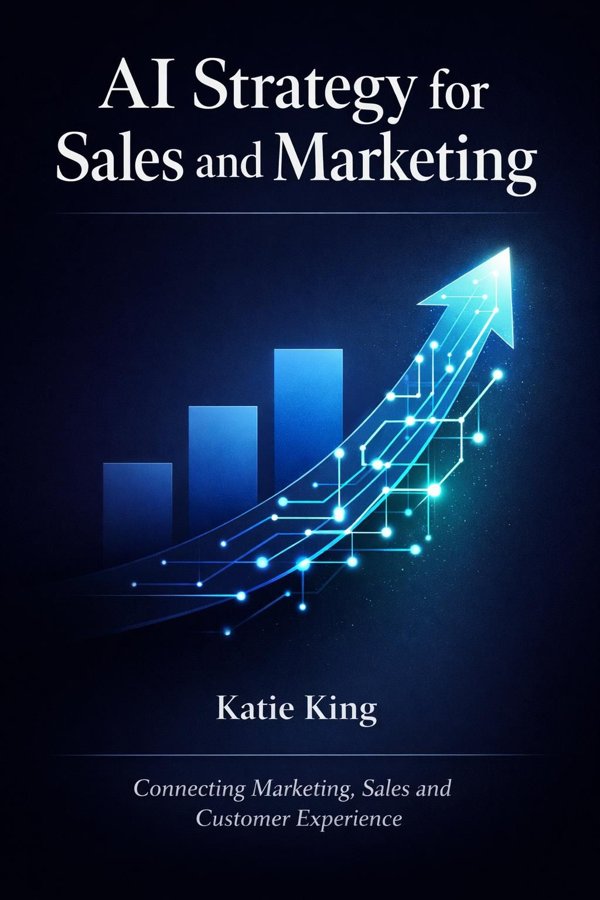
AI Strategy for Sales and Marketing: Connecting Marketing, Sales and Customer Experience: Summary & Key Insights
by Katie King
 10 min9 chaptersAudio available
Key Takeaways from AI Strategy for Sales and Marketing: Connecting Marketing, Sales and Customer Experience
The biggest mistake companies make with AI is assuming it begins with software, when in reality it begins with strategy.
Customers do not compare your company only to competitors; they compare every experience to the most relevant and seamless one they have ever had.
Efficiency alone is not the promise of AI-driven automation; the real promise is better marketing at scale.
Great salespeople have always relied on timing, relevance, and relationship quality; AI helps improve all three.
In markets where products can be copied and prices can be matched, customer experience becomes the most defensible differentiator.
What Is AI Strategy for Sales and Marketing: Connecting Marketing, Sales and Customer Experience About?
AI Strategy for Sales and Marketing: Connecting Marketing, Sales and Customer Experience by Katie King is a marketing book spanning 5 pages. Artificial intelligence is no longer a futuristic concept reserved for tech giants. It is rapidly becoming a core business capability, reshaping how organizations attract prospects, convert leads, serve customers, and build long-term loyalty. In AI Strategy for Sales and Marketing, Katie King offers a practical guide for leaders who want to move beyond hype and use AI in ways that create measurable commercial value. The book connects three areas that are too often managed separately—marketing, sales, and customer experience—and shows how AI can unify them around smarter decisions and more relevant engagement. What makes this book especially useful is its grounded, business-first perspective. Rather than presenting AI as a purely technical topic, King explains it through real organizational challenges: fragmented data, inconsistent customer journeys, weak collaboration between teams, and pressure to do more with less. She combines strategic frameworks with accessible examples, helping readers understand where AI fits, what it can realistically improve, and how to adopt it responsibly. As a respected consultant, speaker, and advisor on AI and digital transformation, Katie King brings both credibility and pragmatism, making this book a valuable resource for modern commercial leaders.
This FizzRead summary covers all 9 key chapters of AI Strategy for Sales and Marketing: Connecting Marketing, Sales and Customer Experience in approximately 10 minutes, distilling the most important ideas, arguments, and takeaways from Katie King's work. Also available as an audio summary and Key Quotes Podcast.
AI Strategy for Sales and Marketing: Connecting Marketing, Sales and Customer Experience
Artificial intelligence is no longer a futuristic concept reserved for tech giants. It is rapidly becoming a core business capability, reshaping how organizations attract prospects, convert leads, serve customers, and build long-term loyalty. In AI Strategy for Sales and Marketing, Katie King offers a practical guide for leaders who want to move beyond hype and use AI in ways that create measurable commercial value. The book connects three areas that are too often managed separately—marketing, sales, and customer experience—and shows how AI can unify them around smarter decisions and more relevant engagement.
What makes this book especially useful is its grounded, business-first perspective. Rather than presenting AI as a purely technical topic, King explains it through real organizational challenges: fragmented data, inconsistent customer journeys, weak collaboration between teams, and pressure to do more with less. She combines strategic frameworks with accessible examples, helping readers understand where AI fits, what it can realistically improve, and how to adopt it responsibly. As a respected consultant, speaker, and advisor on AI and digital transformation, Katie King brings both credibility and pragmatism, making this book a valuable resource for modern commercial leaders.
Who Should Read AI Strategy for Sales and Marketing: Connecting Marketing, Sales and Customer Experience?
This book is perfect for anyone interested in marketing and looking to gain actionable insights in a short read. Whether you're a student, professional, or lifelong learner, the key ideas from AI Strategy for Sales and Marketing: Connecting Marketing, Sales and Customer Experience by Katie King will help you think differently.
- ✓Readers who enjoy marketing and want practical takeaways
- ✓Professionals looking to apply new ideas to their work and life
- ✓Anyone who wants the core insights of AI Strategy for Sales and Marketing: Connecting Marketing, Sales and Customer Experience in just 10 minutes
Want the full summary?
Get instant access to this book summary and 100K+ more with Fizz Moment.
Get Free SummaryAvailable on App Store • Free to download
Key Chapters
The biggest mistake companies make with AI is assuming it begins with software, when in reality it begins with strategy. Katie King starts by clarifying what artificial intelligence actually means in a business context: systems that can analyze data, detect patterns, automate decisions, and support or enhance human judgment at scale. She also strips away common misconceptions. AI is not magic, not a replacement for leadership, and not a one-size-fits-all solution. It is a capability that becomes valuable only when tied to specific business objectives.
This matters because sales and marketing teams are operating in an environment of rising customer expectations, growing data volumes, and relentless competitive pressure. Traditional methods based on intuition alone are no longer enough. AI offers a way to make faster decisions, personalize outreach, identify likely buyers, optimize spend, and improve customer service. But King argues that organizations should not adopt AI simply because competitors are doing it. They need to understand the commercial problem first: low conversion rates, poor retention, inconsistent service, or inefficient campaigns.
She frames AI as part of a broader transformation imperative. The companies that thrive will be those that treat AI as an engine for business reinvention, not just process improvement. For example, a B2B firm might use AI to score leads based on behavioral data, while a retailer might use it to predict churn and trigger retention offers. In both cases, the value comes from aligning technology to outcomes.
Actionable takeaway: start your AI journey by identifying one high-value commercial problem, then assess how better data, automation, or predictive insight could improve it before choosing any tool.
Customers do not compare your company only to competitors; they compare every experience to the most relevant and seamless one they have ever had. That is why personalization has become a strategic necessity rather than a marketing luxury. King explains how AI makes personalization more precise, scalable, and commercially effective by turning customer data into predictions about intent, preference, timing, and behavior.
Predictive analytics allows organizations to move from reactive communication to anticipatory engagement. Instead of sending the same message to everyone, companies can determine which customers are likely to buy, which are at risk of leaving, and which product or message is most likely to resonate. This transforms the customer experience. An online retailer can recommend products based on browsing history, previous purchases, and similar-customer behavior. A software company can identify product usage patterns that signal upsell potential. A bank can detect life-event triggers and offer timely services.
King emphasizes that good personalization depends on more than algorithms. It requires clean data, clear customer segments, and a thoughtful content strategy. Poor data quality leads to irrelevant recommendations. Over-personalization can also feel invasive if customers do not trust how their information is being used. The goal is not to overwhelm people with hyper-targeted messaging, but to make each interaction more useful and convenient.
The strongest organizations combine AI predictions with human judgment. A sales team can use predictive signals to prioritize accounts, while marketers tailor campaigns for specific audience clusters rather than rely on generic outreach.
Actionable takeaway: choose one stage of the customer journey—acquisition, conversion, retention, or upsell—and use predictive data to make that touchpoint more relevant, timely, and helpful.
Efficiency alone is not the promise of AI-driven automation; the real promise is better marketing at scale. King shows how AI can help organizations move beyond repetitive manual execution and create a more intelligent marketing engine—one that continuously learns from data and improves performance over time. This is especially valuable in environments where teams are expected to manage more channels, more content, and more customer expectations with limited resources.
Automation can support campaign scheduling, audience selection, content distribution, performance optimization, and lead nurturing. For example, AI can determine the best time to send emails, allocate media budget across channels, test multiple message variations, and trigger follow-up workflows based on user behavior. Rather than relying solely on static rules, intelligent systems adjust as new data comes in. This makes marketing operations faster, more consistent, and more responsive.
But King is careful to distinguish smart automation from blind automation. Automating a weak strategy only amplifies poor results. If messaging is unclear, segmentation is flawed, or the customer journey is confusing, automation will simply make bad marketing happen more efficiently. That is why strategy, content quality, and customer understanding must come first.
Another critical point is the role of marketers themselves. AI does not eliminate the need for creativity; it frees teams from repetitive tasks so they can focus on planning, storytelling, experimentation, and cross-functional coordination. A lean team, for instance, can use AI tools to repurpose content for different audiences while dedicating more time to campaign concepts and brand positioning.
Actionable takeaway: audit your marketing workflow, identify repetitive tasks that consume disproportionate time, and automate those first so your team can focus on strategic and creative work.
Great salespeople have always relied on timing, relevance, and relationship quality; AI helps improve all three. In the book, King explores how artificial intelligence can enhance sales performance across the pipeline, from identifying promising prospects to supporting conversations, forecasting revenue, and improving close rates. The point is not to replace human selling, but to give sales teams sharper insight and better focus.
One of the clearest benefits is lead prioritization. Sales teams often waste time on low-quality prospects because they lack a reliable way to assess intent. AI can analyze digital behavior, historical wins, firmographic data, and engagement patterns to score leads more accurately. This helps representatives spend more time where they are most likely to succeed. Similarly, AI-powered CRM systems can surface next-best actions, flag stalled opportunities, and forecast likely deal outcomes.
King also discusses conversational tools such as chatbots and virtual assistants. These can qualify inbound inquiries, answer basic questions, schedule meetings, and ensure that leads are not lost outside business hours. Used well, they improve responsiveness and free human sellers to focus on more complex, higher-value interactions. In B2B environments, AI can support account-based selling by identifying buying committee behavior across multiple contacts and channels.
Still, technology cannot compensate for poor sales discipline. AI works best when embedded in a clear process, supported by quality data, and embraced by the sales team rather than imposed on them. Reps need to trust the insights and understand how they support, not threaten, their role.
Actionable takeaway: introduce AI where it improves sales focus first—such as lead scoring, pipeline prioritization, or forecasting—so teams quickly see practical value and build confidence in the technology.
In markets where products can be copied and prices can be matched, customer experience becomes the most defensible differentiator. King argues that AI’s greatest strategic value may lie not in isolated marketing or sales gains, but in its ability to connect the full customer journey. Too many organizations still manage awareness, conversion, service, and loyalty in silos. Customers, however, experience one brand, not separate departments.
AI helps unify this experience by consolidating signals from multiple touchpoints and turning them into actionable insight. A company can combine website behavior, purchase history, service interactions, and campaign engagement to understand where a customer is in the relationship and what they may need next. That makes it possible to deliver smoother handoffs between marketing, sales, and customer support. For example, when a customer repeatedly visits a pricing page, responds to an email offer, and then contacts support, AI can help route the case appropriately and alert sales to a high-intent opportunity.
King’s broader point is that customer experience should not be treated as an afterthought once the sale is complete. Post-sale interactions influence renewals, referrals, and brand trust. AI can support proactive service, identify dissatisfaction earlier, and suggest interventions before a customer churns. This is particularly powerful in subscription businesses and service-heavy sectors, where lifetime value matters more than one-time conversion.
Yet experience design still requires human empathy. AI can identify friction, but leaders must decide what kind of customer relationship they want to build and how their brand should feel at every stage.
Actionable takeaway: map your customer journey end to end, identify where handoffs break down between teams, and use AI-driven data sharing to create a more connected experience.
Every ambitious AI strategy eventually runs into the same hard truth: systems are only as good as the data that feeds them. King repeatedly emphasizes that many failed AI initiatives are not caused by bad algorithms, but by fragmented, outdated, inconsistent, or inaccessible data. Sales, marketing, and customer service often operate from separate systems, each with different definitions, records, and standards. Without a trustworthy data foundation, AI outputs become unreliable, and trust in the technology quickly erodes.
This challenge is especially significant in customer-facing functions. If marketing data is incomplete, personalization will misfire. If CRM records are messy, lead scoring will be distorted. If service data is not connected to account history, companies miss critical context for retention and upsell efforts. In other words, poor data quality creates poor customer decisions.
King treats data governance as a strategic discipline, not a technical cleanup project. Organizations need clear ownership, common definitions, integration across systems, and processes for maintaining accuracy. They also need to decide which data truly matters. More data is not always better. What matters is collecting relevant, usable information that supports meaningful decisions.
A practical example might involve a company aligning its customer ID structure across email, CRM, support, and e-commerce platforms. Once the data is connected, AI can more effectively spot patterns such as likely churn, cross-sell opportunities, or service issues affecting future purchases. This is when AI starts to produce business value rather than dashboard noise.
Actionable takeaway: before investing in advanced AI use cases, run a data readiness assessment focused on accuracy, accessibility, integration, and ownership across customer-facing teams.
The future of commercial performance does not belong to machines alone; it belongs to teams that know how to combine machine intelligence with human judgment. One of King’s most important contributions is her insistence that AI should augment people, not sideline them. In sales and marketing, this principle is especially important because trust, creativity, persuasion, and emotional nuance remain deeply human strengths.
AI excels at processing volume and spotting patterns. It can analyze thousands of customer interactions, surface anomalies, recommend actions, and automate routine tasks. Humans, by contrast, are better at interpreting context, handling ambiguity, building relationships, and making ethical or brand-sensitive decisions. The strongest organizations design workflows that bring these strengths together. A marketer might use AI to identify high-performing content themes, then apply human creativity to turn those themes into compelling campaigns. A salesperson might use AI-generated insights to prepare for a meeting, but still rely on listening and rapport to move the relationship forward.
King also highlights the cultural side of collaboration. Employees often fear AI when it is introduced as a cost-cutting tool or a replacement technology. Adoption improves when leaders explain clearly how AI will support better work, reduce low-value effort, and create new opportunities for impact. Training becomes essential here, not only technical training but practical guidance on when to trust AI, when to challenge it, and how to use it responsibly.
The message is clear: AI maturity depends as much on people readiness as technology readiness.
Actionable takeaway: redesign roles around augmentation by identifying which tasks should be automated, which should remain human-led, and where human oversight is essential for quality, trust, and decision-making.
The more powerful AI becomes, the more dangerous it is to treat ethics as a secondary concern. King argues that trust is not a soft issue in AI deployment; it is a business requirement. Customer-facing AI influences recommendations, targeting, pricing, service, and communication. If these systems are biased, opaque, intrusive, or unfair, the commercial damage can be significant. Customers lose confidence, employees become skeptical, and regulators pay closer attention.
Ethical AI starts with transparency. Organizations should know what their systems are doing, what data they are using, and what risks may arise from automated decisions. This is particularly important in marketing and sales, where personalization can easily cross into manipulation if not governed carefully. For example, a pricing algorithm might unintentionally disadvantage certain customer groups, or a lead scoring model might embed bias from historical sales behavior. Without oversight, efficiency gains can come at the cost of fairness and reputation.
King encourages leaders to establish governance structures early. This includes setting ethical principles, reviewing data sources, monitoring outputs, and involving cross-functional voices from legal, compliance, HR, and customer-facing teams. Ethics should not be left solely to data scientists or vendors. It must be owned by the business.
Trust also depends on customer consent and relevance. People are often willing to share data when they receive clear value in return, such as more useful recommendations or faster service. They become wary when data use feels hidden or excessive. Responsible AI therefore supports both better performance and stronger relationships.
Actionable takeaway: create an AI governance checklist that reviews fairness, transparency, privacy, accountability, and customer impact before any major customer-facing AI initiative goes live.
Technology initiatives fail when they are treated like isolated experiments rather than organizational priorities. King makes the case that successful AI adoption depends on leadership commitment, strategic clarity, and a realistic roadmap. Companies often launch scattered pilots without defining the business case, ownership model, success metrics, or long-term operating plan. The result is excitement at the start and disappointment later.
A strong AI strategy begins with commercial ambition. Leaders need to decide what outcomes matter most: faster growth, lower acquisition cost, improved retention, stronger forecasting, better service, or greater productivity. From there, they can prioritize use cases, assess data readiness, choose technology partners, and build the required capabilities. This phased approach helps organizations avoid overinvesting in complexity before they are ready.
King also stresses the need for cross-functional sponsorship. Because AI affects marketing, sales, service, IT, operations, and compliance, no single team can own the journey alone. Senior leaders must create alignment, remove barriers, and signal that AI is part of business transformation, not just a specialist experiment. Metrics matter too. If a company cannot define how success will be measured—such as conversion uplift, response time reduction, churn improvement, or campaign efficiency—it cannot learn effectively from implementation.
A practical roadmap might start with one or two use cases, such as predictive lead scoring and AI-assisted support triage, then expand once data quality, governance, and user confidence improve. This creates momentum while controlling risk.
Actionable takeaway: build an AI roadmap with clear business goals, phased use cases, defined owners, measurable KPIs, and executive sponsorship before scaling across the organization.
All Chapters in AI Strategy for Sales and Marketing: Connecting Marketing, Sales and Customer Experience
About the Author
Katie King is a British author, consultant, and international keynote speaker specializing in artificial intelligence, digital transformation, and customer-centric business strategy. She is widely recognized for helping organizations understand how emerging technologies can be applied in practical, commercially relevant ways. Over the course of her career, she has advised global brands, public sector bodies, and growing businesses on innovation, leadership, and the future of customer engagement. King is known for translating complex technological shifts into accessible strategies for executives and non-technical teams. Her work focuses particularly on the intersection of AI, marketing, sales, and customer experience, making her a trusted voice for leaders navigating digital change. Through her books, speaking engagements, and consulting work, she promotes responsible, results-driven adoption of AI in modern business.
Get This Summary in Your Preferred Format
Read or listen to the AI Strategy for Sales and Marketing: Connecting Marketing, Sales and Customer Experience summary by Katie King anytime, anywhere. FizzRead offers multiple formats so you can learn on your terms — all free.
Available formats: App · Audio · PDF · EPUB — All included free with FizzRead
Download AI Strategy for Sales and Marketing: Connecting Marketing, Sales and Customer Experience PDF and EPUB Summary
Key Quotes from AI Strategy for Sales and Marketing: Connecting Marketing, Sales and Customer Experience
“The biggest mistake companies make with AI is assuming it begins with software, when in reality it begins with strategy.”
“Customers do not compare your company only to competitors; they compare every experience to the most relevant and seamless one they have ever had.”
“Efficiency alone is not the promise of AI-driven automation; the real promise is better marketing at scale.”
“Great salespeople have always relied on timing, relevance, and relationship quality; AI helps improve all three.”
“In markets where products can be copied and prices can be matched, customer experience becomes the most defensible differentiator.”
Frequently Asked Questions about AI Strategy for Sales and Marketing: Connecting Marketing, Sales and Customer Experience
AI Strategy for Sales and Marketing: Connecting Marketing, Sales and Customer Experience by Katie King is a marketing book that explores key ideas across 9 chapters. Artificial intelligence is no longer a futuristic concept reserved for tech giants. It is rapidly becoming a core business capability, reshaping how organizations attract prospects, convert leads, serve customers, and build long-term loyalty. In AI Strategy for Sales and Marketing, Katie King offers a practical guide for leaders who want to move beyond hype and use AI in ways that create measurable commercial value. The book connects three areas that are too often managed separately—marketing, sales, and customer experience—and shows how AI can unify them around smarter decisions and more relevant engagement. What makes this book especially useful is its grounded, business-first perspective. Rather than presenting AI as a purely technical topic, King explains it through real organizational challenges: fragmented data, inconsistent customer journeys, weak collaboration between teams, and pressure to do more with less. She combines strategic frameworks with accessible examples, helping readers understand where AI fits, what it can realistically improve, and how to adopt it responsibly. As a respected consultant, speaker, and advisor on AI and digital transformation, Katie King brings both credibility and pragmatism, making this book a valuable resource for modern commercial leaders.
You Might Also Like
Captivology: The Science of Capturing People's Attention
Ben Parr
10 min
Marketing 5.0: Technology for Humanity
Philip Kotler, Hermawan Kartajaya, Iwan Setiawan
10 min
Marketing Strategy
Paul Fifield
10 min
UnMarketing: Stop Marketing. Start Engaging.
Scott Stratten
10 min
$100M Leads: How to Get Strangers to Want to Buy Your Stuff
Alex Hormozi
10 min
80/20 Sales and Marketing: The Definitive Guide to Working Less and Making More
Perry Marshall
10 minFeatured In
Browse by Category
Ready to read AI Strategy for Sales and Marketing: Connecting Marketing, Sales and Customer Experience?
Get the full summary and 100K+ more books with Fizz Moment.