
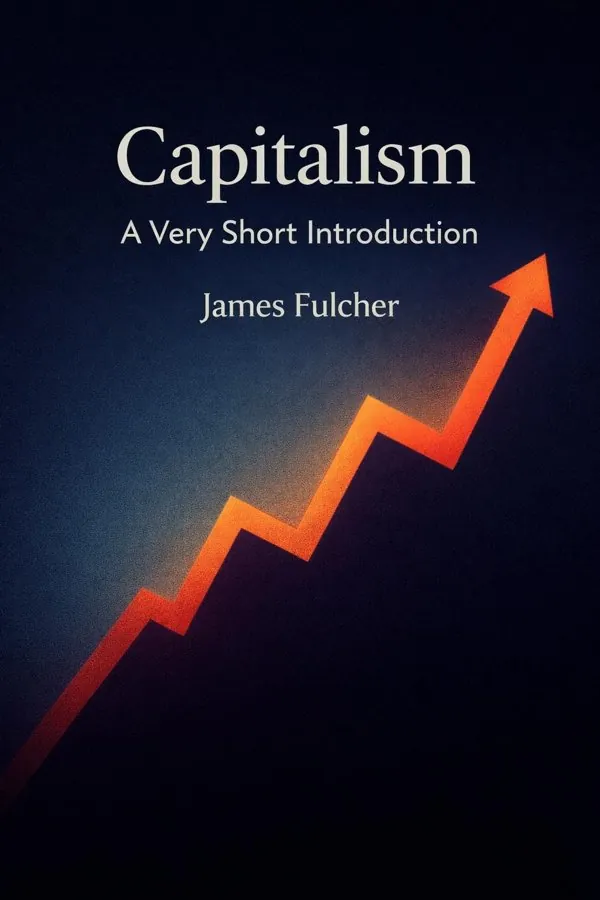
Capitalism: A Very Short Introduction: Summary & Key Insights
 10 min7 chaptersAudio available
What Is Capitalism: A Very Short Introduction About?
Capitalism: A Very Short Introduction by James Fulcher is a economics book spanning 7 pages. This concise introduction explores the nature, history, and global variations of capitalism. James Fulcher examines what capitalism is, how it emerged, and how it has evolved through industrialization, globalization, and financial crises. The book also considers the social and political consequences of capitalism and asks whether viable alternatives exist.
This FizzRead summary covers all 7 key chapters of Capitalism: A Very Short Introduction in approximately 10 minutes, distilling the most important ideas, arguments, and takeaways from James Fulcher's work. Also available as an audio summary and Key Quotes Podcast.
Capitalism: A Very Short Introduction
This concise introduction explores the nature, history, and global variations of capitalism. James Fulcher examines what capitalism is, how it emerged, and how it has evolved through industrialization, globalization, and financial crises. The book also considers the social and political consequences of capitalism and asks whether viable alternatives exist.
Who Should Read Capitalism: A Very Short Introduction?
This book is perfect for anyone interested in economics and looking to gain actionable insights in a short read. Whether you're a student, professional, or lifelong learner, the key ideas from Capitalism: A Very Short Introduction by James Fulcher will help you think differently.
- ✓Readers who enjoy economics and want practical takeaways
- ✓Professionals looking to apply new ideas to their work and life
- ✓Anyone who wants the core insights of Capitalism: A Very Short Introduction in just 10 minutes
Want the full summary?
Get instant access to this book summary and 100K+ more with Fizz Moment.
Get Free SummaryAvailable on App Store • Free to download
Key Chapters
Capitalism did not spring into existence fully formed; it evolved out of earlier modes of production and exchange. To understand its roots, we have to go back to medieval Europe, where feudal economies governed the distribution of wealth and labor. Under feudalism, production was primarily local and subsistence-based. Lords controlled land, peasants worked the soil, and obligations were defined by custom rather than contract. Yet, embedded within this system were the seeds of transformation — urban markets, monetary exchange, and merchant networks linking distant regions.
In the late Middle Ages, trade expanded dramatically. Italian city-states like Venice and Florence thrived on commerce; Northern European towns joined the Hanseatic League. Slowly, profit became an acceptable and respected motive. Merchants began reinvesting gains, and this reinvestment became the hallmark of capitalist development. As agricultural production shifted toward market-oriented goods — wool, grain, dairy — peasants were increasingly displaced or converted into wage-earning laborers. This transition away from local feudal relations toward wage work and market dependence marked the embryo stage of capitalism.
One cannot overstate the importance of property rights and contract law in this transformation. As states began codifying these principles, economic life shifted from inherited privilege toward legal ownership. The rise of banking, credit instruments, and joint-stock ventures expanded possibilities for wealth generation. By the sixteenth and seventeenth centuries, colonial exploration and long-distance trade accelerated the accumulation of capital. Silver from the Americas, spices from Asia, and slave labor from Africa knitted together an emerging world economy.
From my perspective, what makes this period remarkable is how capitalism represented a break from tradition. It replaced personal dependency with market dependency, and while this expanded freedom for some, it also created new forms of vulnerability. The very process of ‘freeing’ labor meant people had to sell their work to survive. Thus, capitalism began as both liberation and compulsion — a system promising progress through profit but grounded in unequal participation.
If the origins of capitalism were commercial, its defining transformation was industrial. The Industrial Revolution in eighteenth-century Britain revolutionized production itself. Machines replaced manual labor, factories centralized workers, and technology increased output beyond imagination. But more than machines, what truly divided pre-industrial society from industrial capitalism was scale — the systematic reinvestment of profits into production, leading to constant expansion and innovation.
At the heart of industrial capitalism lay the logic of productivity. Entrepreneurs organized labor around efficiency; time became measurable, and wages were calculated against output. This was not just a technical change but a cultural revolution. Work discipline intensified, life was synchronized to factory hours, and industrial towns grew as centers of mass labor. For many, this meant urban poverty, child labor, and grueling conditions. Yet, it also brought new forms of social mobility and scientific progress.
Industrial capitalism’s energy came from competition. Each firm had to innovate or die. That competition fueled the spread of railways, steam engines, and mass manufacturing. But competition also generated instability, leading to periodic cycles of boom and bust. The economic take-off of Britain spread outward — first to Europe, then to America and Japan — creating a global race for industrial superiority.
From my sociological viewpoint, the Industrial Revolution was not merely a technological shift but a reconfiguration of social relations. Capital ownership concentrated in fewer hands, while the ‘proletariat’ — those who sold their labor — expanded rapidly. The stratification between capital and labor became a defining feature of modern society. In this context, capitalism revealed both its dynamism and its contradiction: the same system that produces abundance simultaneously reproduces inequality.
+ 5 more chapters — available in the FizzRead app
All Chapters in Capitalism: A Very Short Introduction
About the Author
James Fulcher is a sociologist and academic who has taught at the University of Leicester and the University of Tokyo. His research focuses on the sociology of work, economic systems, and the development of capitalism.
Get This Summary in Your Preferred Format
Read or listen to the Capitalism: A Very Short Introduction summary by James Fulcher anytime, anywhere. FizzRead offers multiple formats so you can learn on your terms — all free.
Available formats: App · Audio · PDF · EPUB — All included free with FizzRead
Download Capitalism: A Very Short Introduction PDF and EPUB Summary
Key Quotes from Capitalism: A Very Short Introduction
“Capitalism did not spring into existence fully formed; it evolved out of earlier modes of production and exchange.”
“If the origins of capitalism were commercial, its defining transformation was industrial.”
Frequently Asked Questions about Capitalism: A Very Short Introduction
Capitalism: A Very Short Introduction by James Fulcher is a economics book that explores key ideas across 7 chapters. This concise introduction explores the nature, history, and global variations of capitalism. James Fulcher examines what capitalism is, how it emerged, and how it has evolved through industrialization, globalization, and financial crises. The book also considers the social and political consequences of capitalism and asks whether viable alternatives exist.
You Might Also Like

Business Adventures
John Brooks
10 min
Nudge
Richard H. Thaler, Cass R. Sunstein
10 min
The Hitchhiker"s Guide to the Galaxy
Douglas Adams
10 minThe Muqaddimah
Ibn Khaldun
10 minThe Outsiders
William N. Thorndike
10 min
A Little History of Economics
Niall Kishtainy
10 minBrowse by Category
Ready to read Capitalism: A Very Short Introduction?
Get the full summary and 100K+ more books with Fizz Moment.