
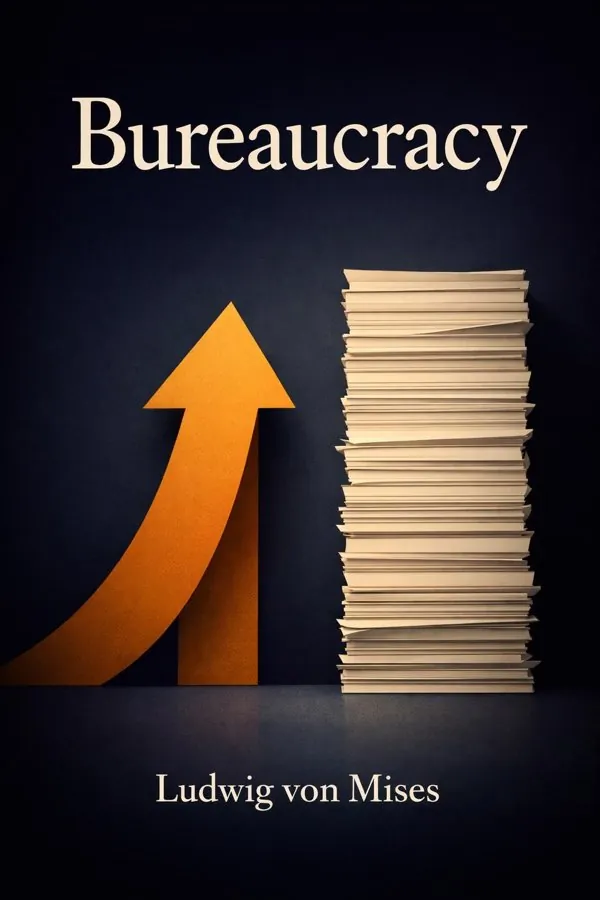
Bureaucracy: Summary & Key Insights
 10 min6 chaptersAudio available
What Is Bureaucracy About?
Bureaucracy by Ludwig von Mises is a economics book spanning 6 pages. In this classic treatise, Austrian economist Ludwig von Mises analyzes the nature and consequences of bureaucratic management. He contrasts the efficiency of profit-driven private enterprise with the rigidity of government administration, arguing that bureaucratic systems inevitably stifle innovation and individual initiative. Written during the mid-20th century, the book remains a foundational work in political economy and public administration theory.
This FizzRead summary covers all 6 key chapters of Bureaucracy in approximately 10 minutes, distilling the most important ideas, arguments, and takeaways from Ludwig von Mises's work. Also available as an audio summary and Key Quotes Podcast.
Bureaucracy
In this classic treatise, Austrian economist Ludwig von Mises analyzes the nature and consequences of bureaucratic management. He contrasts the efficiency of profit-driven private enterprise with the rigidity of government administration, arguing that bureaucratic systems inevitably stifle innovation and individual initiative. Written during the mid-20th century, the book remains a foundational work in political economy and public administration theory.
Who Should Read Bureaucracy?
This book is perfect for anyone interested in economics and looking to gain actionable insights in a short read. Whether you're a student, professional, or lifelong learner, the key ideas from Bureaucracy by Ludwig von Mises will help you think differently.
- ✓Readers who enjoy economics and want practical takeaways
- ✓Professionals looking to apply new ideas to their work and life
- ✓Anyone who wants the core insights of Bureaucracy in just 10 minutes
Want the full summary?
Get instant access to this book summary and 100K+ more with Fizz Moment.
Get Free SummaryAvailable on App Store • Free to download
Key Chapters
In examining the nature of bureaucratic management, I begin with a simple observation: that the bureaucratic apparatus operates not through the logic of profit but through strict fidelity to rules and regulations. The bureaucrat’s duty is not to innovate or to judge the economic merit of a decision but to ensure adherence to established procedures. In government administration, this is not only appropriate, it is indispensable. A public official cannot be allowed to exercise the same freedom of choice that a businessman enjoys, for every act of discretion would invite abuse, partiality, and corruption.
Thus, bureaucracy is a system designed for legal and moral regularity, not material efficiency. It functions through written directives, detailed classifications, and the hierarchical delegation of authority. Progress within such an organization depends not on creating new value but on demonstrating compliance and seniority. This explains why bureaucratic administration tends to multiply offices, forms, and procedures. Its values are those of predictability and control, not adaptability or creativity.
Yet these virtues, which are necessary in the administration of law and state functions, become serious defects when imported into areas that demand innovation and responsiveness. The bureaucrat cannot determine whether a service is truly beneficial, because there is no profit or loss measure to guide him. Without the market’s price signals, he must rely on abstract criteria or political directives — both of which tend to distort rational allocation. In this way, the very rules that make bureaucracy fair also make it economically blind.
Profit management, by contrast, is governed by the discipline of the market. In the world of private enterprise, the businessman is not guided by rules handed down from above but by the necessity of satisfying consumers more efficiently than his competitors. The test of every action is the profit or loss that results. This is not a moral judgment but an economic one, reflecting the alignment between production and the desires of the public.
This difference between the two systems is fundamental. In a market economy, the entrepreneur is constantly tested and corrected by market signals. Inefficient firms disappear; better methods are rewarded. No such process exists in bureaucratic management, because the state cannot express success or failure in numerical form. A tax bureau, a school system, or a police department must continue to operate regardless of cost, because their functions serve legal, not commercial, ends.
It is absurd to judge a court by its profitability, just as it is absurd to run a factory according to the procedures suited to a ministry. Each system is rational only within its sphere. Profit management promotes economic calculation and progress; bureaucratic management upholds justice, consistency, and restriction of arbitrary power. The social catastrophe arises when one system attempts to replace the other. When government takes over enterprises that once obeyed the market, or when business adopts bureaucratic methods, society loses the guiding principle of efficient adaptation and begins to sink into mediocrity and waste.
+ 4 more chapters — available in the FizzRead app
All Chapters in Bureaucracy
About the Author
Ludwig von Mises (1881–1973) was an Austrian economist and leading figure in the Austrian School of economic thought. He made major contributions to praxeology, monetary theory, and the critique of socialism. His works, including 'Human Action' and 'Socialism', profoundly influenced modern libertarian and free-market philosophy.
Get This Summary in Your Preferred Format
Read or listen to the Bureaucracy summary by Ludwig von Mises anytime, anywhere. FizzRead offers multiple formats so you can learn on your terms — all free.
Available formats: App · Audio · PDF · EPUB — All included free with FizzRead
Download Bureaucracy PDF and EPUB Summary
Key Quotes from Bureaucracy
“The bureaucrat’s duty is not to innovate or to judge the economic merit of a decision but to ensure adherence to established procedures.”
“Profit management, by contrast, is governed by the discipline of the market.”
Frequently Asked Questions about Bureaucracy
Bureaucracy by Ludwig von Mises is a economics book that explores key ideas across 6 chapters. In this classic treatise, Austrian economist Ludwig von Mises analyzes the nature and consequences of bureaucratic management. He contrasts the efficiency of profit-driven private enterprise with the rigidity of government administration, arguing that bureaucratic systems inevitably stifle innovation and individual initiative. Written during the mid-20th century, the book remains a foundational work in political economy and public administration theory.
You Might Also Like

Business Adventures
John Brooks
10 min
Nudge
Richard H. Thaler, Cass R. Sunstein
10 min
The Hitchhiker"s Guide to the Galaxy
Douglas Adams
10 minThe Muqaddimah
Ibn Khaldun
10 minThe Outsiders
William N. Thorndike
10 min
A Little History of Economics
Niall Kishtainy
10 minBrowse by Category
Ready to read Bureaucracy?
Get the full summary and 100K+ more books with Fizz Moment.