
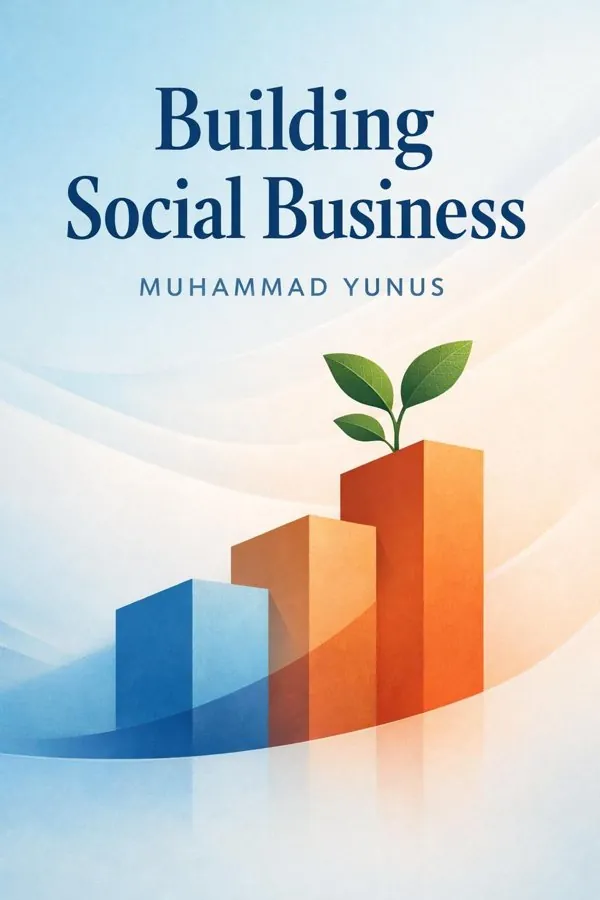
Building Social Business: The New Kind of Capitalism That Serves Humanity's Most Pressing Needs: Summary & Key Insights
 10 min5 chaptersAudio available
What Is Building Social Business: The New Kind of Capitalism That Serves Humanity's Most Pressing Needs About?
Building Social Business: The New Kind of Capitalism That Serves Humanity's Most Pressing Needs by Muhammad Yunus is a economics book spanning 5 pages. In this book, Nobel Peace Prize laureate Muhammad Yunus expands on his concept of social business—a business model designed to address social problems rather than maximize profits. He explains how social businesses can tackle issues such as poverty, healthcare, and education by combining entrepreneurial principles with a mission for social good. Drawing on real-world examples from Grameen Bank and other initiatives, Yunus outlines practical steps for creating sustainable enterprises that serve humanity’s most urgent needs.
This FizzRead summary covers all 5 key chapters of Building Social Business: The New Kind of Capitalism That Serves Humanity's Most Pressing Needs in approximately 10 minutes, distilling the most important ideas, arguments, and takeaways from Muhammad Yunus's work. Also available as an audio summary and Key Quotes Podcast.
Building Social Business: The New Kind of Capitalism That Serves Humanity's Most Pressing Needs
In this book, Nobel Peace Prize laureate Muhammad Yunus expands on his concept of social business—a business model designed to address social problems rather than maximize profits. He explains how social businesses can tackle issues such as poverty, healthcare, and education by combining entrepreneurial principles with a mission for social good. Drawing on real-world examples from Grameen Bank and other initiatives, Yunus outlines practical steps for creating sustainable enterprises that serve humanity’s most urgent needs.
Who Should Read Building Social Business: The New Kind of Capitalism That Serves Humanity's Most Pressing Needs?
This book is perfect for anyone interested in economics and looking to gain actionable insights in a short read. Whether you're a student, professional, or lifelong learner, the key ideas from Building Social Business: The New Kind of Capitalism That Serves Humanity's Most Pressing Needs by Muhammad Yunus will help you think differently.
- ✓Readers who enjoy economics and want practical takeaways
- ✓Professionals looking to apply new ideas to their work and life
- ✓Anyone who wants the core insights of Building Social Business: The New Kind of Capitalism That Serves Humanity's Most Pressing Needs in just 10 minutes
Want the full summary?
Get instant access to this book summary and 100K+ more with Fizz Moment.
Get Free SummaryAvailable on App Store • Free to download
Key Chapters
Conventional capitalism achieves growth through competition and profit maximization. It celebrates innovation but limits its moral direction. As a result, markets often fail to address issues like poverty, education, healthcare, and environmental degradation precisely because these problems do not promise high financial returns. In this book, I explain how this imbalance has created a distorted world—one that measures success purely by the accumulation of wealth while ignoring the human and ecological costs.
Nonprofit organizations attempt to fill this gap, but they face structural inefficiencies. Their survival depends on donations and grants, creating instability and dependence. On the other side, profit-driven corporations hold vast resources but seldom apply them to social missions unless there is financial incentive. Between these two extremes lies an empty space—the space where social business stands.
I argue that we need a new kind of capitalism, one that recognizes the dual nature of human beings. We are not one-dimensional profit-maximizers; we are multi-dimensional beings capable of both self-interest and love. When our economic system allows space for this duality, it can unleash enormous creativity in solving societal challenges. The social business model introduces profitability without personal gain, efficiency without exploitation, and sustainability without greed. It realigns the invisible hand of the market to point toward social good.
My vision is not to destroy capitalism but to expand it. Imagine a world where each major company allocates part of its efforts to creating social businesses designed to combat hunger, inequality, or environmental damage. Such enterprises would still function professionally—with competitive pricing, customer feedback, and innovation—but their profits would be recycled into their mission rather than distributed to owners. This small conceptual shift—from maximizing profit to maximizing impact—can transform entire economies.
+ 3 more chapters — available in the FizzRead app
All Chapters in Building Social Business: The New Kind of Capitalism That Serves Humanity's Most Pressing Needs
About the Author
Muhammad Yunus is a Bangladeshi economist and social entrepreneur best known for founding Grameen Bank and pioneering the concepts of microcredit and microfinance. He was awarded the Nobel Peace Prize in 2006 for his efforts to promote economic and social development from the grassroots level.
Get This Summary in Your Preferred Format
Read or listen to the Building Social Business: The New Kind of Capitalism That Serves Humanity's Most Pressing Needs summary by Muhammad Yunus anytime, anywhere. FizzRead offers multiple formats so you can learn on your terms — all free.
Available formats: App · Audio · PDF · EPUB — All included free with FizzRead
Download Building Social Business: The New Kind of Capitalism That Serves Humanity's Most Pressing Needs PDF and EPUB Summary
Key Quotes from Building Social Business: The New Kind of Capitalism That Serves Humanity's Most Pressing Needs
“Conventional capitalism achieves growth through competition and profit maximization.”
“A social business is neither a charity nor a conventional for-profit company.”
Frequently Asked Questions about Building Social Business: The New Kind of Capitalism That Serves Humanity's Most Pressing Needs
Building Social Business: The New Kind of Capitalism That Serves Humanity's Most Pressing Needs by Muhammad Yunus is a economics book that explores key ideas across 5 chapters. In this book, Nobel Peace Prize laureate Muhammad Yunus expands on his concept of social business—a business model designed to address social problems rather than maximize profits. He explains how social businesses can tackle issues such as poverty, healthcare, and education by combining entrepreneurial principles with a mission for social good. Drawing on real-world examples from Grameen Bank and other initiatives, Yunus outlines practical steps for creating sustainable enterprises that serve humanity’s most urgent needs.
You Might Also Like

Business Adventures
John Brooks
10 min
Nudge
Richard H. Thaler, Cass R. Sunstein
10 min
The Hitchhiker"s Guide to the Galaxy
Douglas Adams
10 minThe Muqaddimah
Ibn Khaldun
10 minThe Outsiders
William N. Thorndike
10 min
A Little History of Economics
Niall Kishtainy
10 minBrowse by Category
Ready to read Building Social Business: The New Kind of Capitalism That Serves Humanity's Most Pressing Needs?
Get the full summary and 100K+ more books with Fizz Moment.