
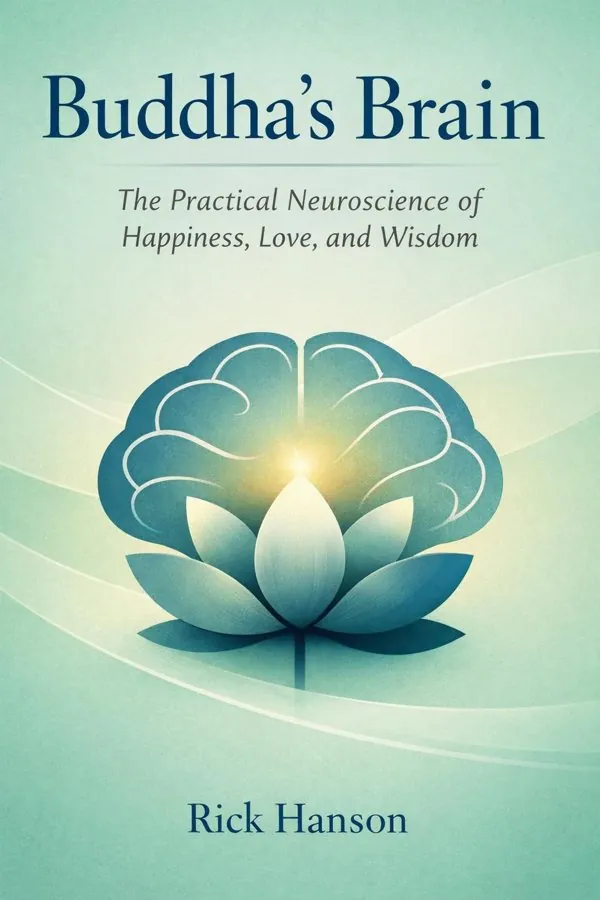
Buddha’s Brain: The Practical Neuroscience of Happiness, Love, and Wisdom: Summary & Key Insights
by Rick Hanson
 10 min11 chaptersAudio available
What Is Buddha’s Brain: The Practical Neuroscience of Happiness, Love, and Wisdom About?
Buddha’s Brain: The Practical Neuroscience of Happiness, Love, and Wisdom by Rick Hanson is a neuroscience book spanning 11 pages. Buddha’s Brain combina la neurociencia moderna con las enseñanzas budistas para mostrar cómo los pensamientos y las emociones pueden remodelar el cerebro. Rick Hanson explica cómo cultivar la atención plena, la compasión y la felicidad mediante prácticas mentales que fortalecen las conexiones neuronales positivas. El libro ofrece estrategias prácticas para reducir el estrés, mejorar el bienestar emocional y desarrollar una mente más sabia y amorosa.
This FizzRead summary covers all 11 key chapters of Buddha’s Brain: The Practical Neuroscience of Happiness, Love, and Wisdom in approximately 10 minutes, distilling the most important ideas, arguments, and takeaways from Rick Hanson's work. Also available as an audio summary and Key Quotes Podcast.
Buddha’s Brain: The Practical Neuroscience of Happiness, Love, and Wisdom
Buddha’s Brain combina la neurociencia moderna con las enseñanzas budistas para mostrar cómo los pensamientos y las emociones pueden remodelar el cerebro. Rick Hanson explica cómo cultivar la atención plena, la compasión y la felicidad mediante prácticas mentales que fortalecen las conexiones neuronales positivas. El libro ofrece estrategias prácticas para reducir el estrés, mejorar el bienestar emocional y desarrollar una mente más sabia y amorosa.
Who Should Read Buddha’s Brain: The Practical Neuroscience of Happiness, Love, and Wisdom?
This book is perfect for anyone interested in neuroscience and looking to gain actionable insights in a short read. Whether you're a student, professional, or lifelong learner, the key ideas from Buddha’s Brain: The Practical Neuroscience of Happiness, Love, and Wisdom by Rick Hanson will help you think differently.
- ✓Readers who enjoy neuroscience and want practical takeaways
- ✓Professionals looking to apply new ideas to their work and life
- ✓Anyone who wants the core insights of Buddha’s Brain: The Practical Neuroscience of Happiness, Love, and Wisdom in just 10 minutes
Want the full summary?
Get instant access to this book summary and 100K+ more with Fizz Moment.
Get Free SummaryAvailable on App Store • Free to download
Key Chapters
Our brain carries the legacy of millions of years of evolution, and understanding its layered design helps explain why we often react as we do. The most ancient part — the reptilian brain — governs survival: fight, flight, feed, and reproduction. It responds to threat instinctively, activating physiological states before conscious thought can intervene. Layered atop this lies the mammalian brain, rich in emotion and social bonds. It drives attachment, nurturing, and the complex dance of interpersonal connection. The most recent component, the human, or neocortical brain, enables reasoning, imagination, and self-reflection.
In everyday life, these systems coexist and sometimes clash. A hurtful comment might trigger the reptilian alarm of danger, while the mammalian brain leaps to protect belonging, and the neocortex searches for meaning in it all. The key to inner peace is integration — allowing the wise circuits of your prefrontal regions to soothe limbic activation and create harmony rather than competition among brain systems. Awareness of these inner dynamics empowers you to pause, observe, and respond from the most evolved part of your nature rather than from raw instinct.
Neural plasticity is the central scientific foundation of this work. Every sustained thought, emotion, and action changes the connections between neurons. The axons and dendrites of your brain adapt as you learn, and in doing so, they encode habits of mind. Often, this process happens unconsciously, reinforcing tendencies toward stress or negativity. But with understanding comes agency. By repeatedly practicing calm, gratitude, or compassion, you strengthen the networks that sustain those qualities.
It is like exercising a muscle — the more you activate positive states, the more easily they arise. Over time, this practice leads to what I call ‘self-directed brain growth.’ Meditation and mindful reflection serve as daily training sessions that sculpt neural pathways toward resilience. Science confirms this: studies show thicker cortical regions in experienced meditators and reduced activity in the amygdala during stress. The takeaway is empowering — you are not simply the product of your past conditioning; you are an active participant in redesigning your own brain toward greater peace.
+ 9 more chapters — available in the FizzRead app
All Chapters in Buddha’s Brain: The Practical Neuroscience of Happiness, Love, and Wisdom
About the Author
Rick Hanson es psicólogo, investigador y autor estadounidense especializado en neurociencia positiva y meditación. Es conocido por su trabajo sobre cómo el cerebro puede cambiar a través de la práctica mental y la atención plena. Ha enseñado en la Universidad de California, Berkeley, y es fundador del Wellspring Institute for Neuroscience and Contemplative Wisdom.
Get This Summary in Your Preferred Format
Read or listen to the Buddha’s Brain: The Practical Neuroscience of Happiness, Love, and Wisdom summary by Rick Hanson anytime, anywhere. FizzRead offers multiple formats so you can learn on your terms — all free.
Available formats: App · Audio · PDF · EPUB — All included free with FizzRead
Download Buddha’s Brain: The Practical Neuroscience of Happiness, Love, and Wisdom PDF and EPUB Summary
Key Quotes from Buddha’s Brain: The Practical Neuroscience of Happiness, Love, and Wisdom
“Our brain carries the legacy of millions of years of evolution, and understanding its layered design helps explain why we often react as we do.”
“Neural plasticity is the central scientific foundation of this work.”
Frequently Asked Questions about Buddha’s Brain: The Practical Neuroscience of Happiness, Love, and Wisdom
Buddha’s Brain: The Practical Neuroscience of Happiness, Love, and Wisdom by Rick Hanson is a neuroscience book that explores key ideas across 11 chapters. Buddha’s Brain combina la neurociencia moderna con las enseñanzas budistas para mostrar cómo los pensamientos y las emociones pueden remodelar el cerebro. Rick Hanson explica cómo cultivar la atención plena, la compasión y la felicidad mediante prácticas mentales que fortalecen las conexiones neuronales positivas. El libro ofrece estrategias prácticas para reducir el estrés, mejorar el bienestar emocional y desarrollar una mente más sabia y amorosa.
More by Rick Hanson

Hardwiring Happiness: The New Brain Science of Contentment, Calm, and Confidence
Rick Hanson
10 min
Making Great Relationships: Simple Practices for Solving Conflicts, Building Connection, and Fostering Love
Rick Hanson
10 min
Neurodharma: New Science, Ancient Wisdom, and Seven Practices of the Highest Happiness
Rick Hanson
10 min
Resilient: How to Grow an Unshakable Core of Calm, Strength, and Happiness
Rick Hanson
10 minYou Might Also Like
Anxious
Joseph LeDoux
10 min
Hallucinations
Oliver Sacks
10 min
The Biological Mind: How Brain, Body, and Environment Collaborate to Make Us Who We Are
Alan Jasanoff
10 min
The Feeling of Life Itself: Why Consciousness Is Widespread but Can't Be Computed
Christof Koch
10 min
The No-Nonsense Meditation Book
Steven Laureys
10 min
A General Theory of Love
Thomas Lewis, Fari Amini, Richard Lannon
10 minBrowse by Category
Ready to read Buddha’s Brain: The Practical Neuroscience of Happiness, Love, and Wisdom?
Get the full summary and 100K+ more books with Fizz Moment.