
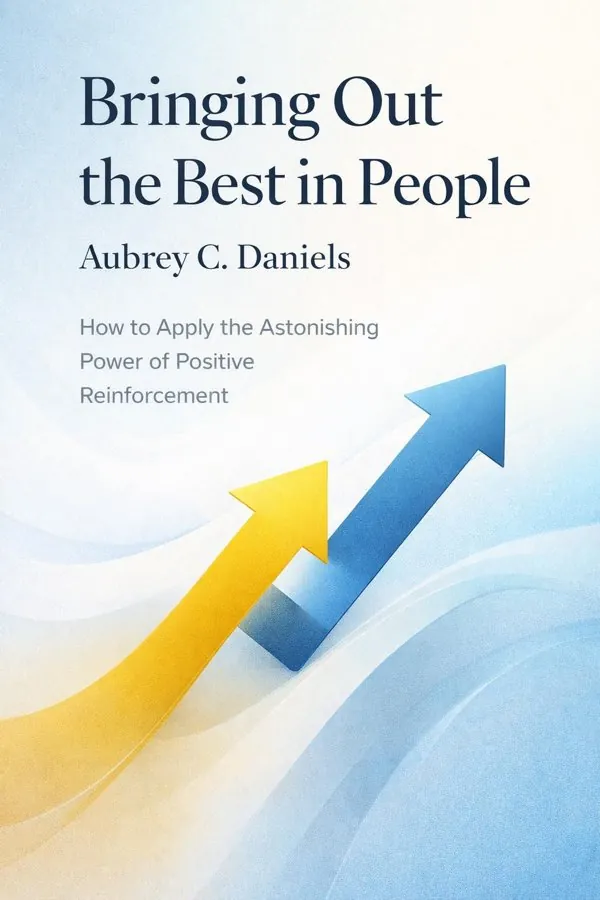
Bringing Out the Best in People: How to Apply the Astonishing Power of Positive Reinforcement: Summary & Key Insights
 10 min4 chaptersAudio available
What Is Bringing Out the Best in People: How to Apply the Astonishing Power of Positive Reinforcement About?
Bringing Out the Best in People: How to Apply the Astonishing Power of Positive Reinforcement by Aubrey C. Daniels is a leadership book spanning 4 pages. This influential management book by behavioral psychologist Aubrey C. Daniels explains how leaders can use the principles of positive reinforcement to motivate employees, improve performance, and build productive workplace cultures. Drawing on decades of research in behavioral science, Daniels demonstrates practical methods for shaping behavior, increasing engagement, and achieving measurable results through recognition and reinforcement rather than punishment or fear.
This FizzRead summary covers all 4 key chapters of Bringing Out the Best in People: How to Apply the Astonishing Power of Positive Reinforcement in approximately 10 minutes, distilling the most important ideas, arguments, and takeaways from Aubrey C. Daniels's work. Also available as an audio summary and Key Quotes Podcast.
Bringing Out the Best in People: How to Apply the Astonishing Power of Positive Reinforcement
This influential management book by behavioral psychologist Aubrey C. Daniels explains how leaders can use the principles of positive reinforcement to motivate employees, improve performance, and build productive workplace cultures. Drawing on decades of research in behavioral science, Daniels demonstrates practical methods for shaping behavior, increasing engagement, and achieving measurable results through recognition and reinforcement rather than punishment or fear.
Who Should Read Bringing Out the Best in People: How to Apply the Astonishing Power of Positive Reinforcement?
This book is perfect for anyone interested in leadership and looking to gain actionable insights in a short read. Whether you're a student, professional, or lifelong learner, the key ideas from Bringing Out the Best in People: How to Apply the Astonishing Power of Positive Reinforcement by Aubrey C. Daniels will help you think differently.
- ✓Readers who enjoy leadership and want practical takeaways
- ✓Professionals looking to apply new ideas to their work and life
- ✓Anyone who wants the core insights of Bringing Out the Best in People: How to Apply the Astonishing Power of Positive Reinforcement in just 10 minutes
Want the full summary?
Get instant access to this book summary and 100K+ more with Fizz Moment.
Get Free SummaryAvailable on App Store • Free to download
Key Chapters
For decades, workplaces have been driven by a philosophy of correction—managers look for what’s wrong, point it out, and deliver consequences that ‘motivate’ employees to improve. Yet, as behavioral science conclusively shows, punishment suppresses behavior but never teaches the desired alternative. It may stop mistakes temporarily, but it doesn’t encourage excellence. Traditional management relies on two forces: negative reinforcement (doing just enough to avoid reprimand) and fear-driven compliance. As a result, employees perform only to the level needed to stay safe.
I explain in this book that such systems fail because behavior is shaped by the consequences it produces. When the only consequence for good performance is silence, and the only consequence for mistakes is punishment, people inevitably learn to do the minimum. True influence comes from consequence patterns that reward desirable behavior—specifically, positive reinforcement.
Positive reinforcement differs from praise or reward programs in its precision. It is not a vague compliment such as “good job” or an annual bonus detached from specific actions. Instead, it is the immediate acknowledgment of a clear, measurable behavior that contributes to success. This form of reinforcement strengthens those behaviors naturally because humans, like all organisms, repeat actions that produce rewarding outcomes.
Managers who adopt reinforcement principles see a dramatic shift: employees begin seeking performance opportunities rather than avoiding mistakes. The energy in the workplace changes from defensive to expansive. Mistakes become opportunities for learning, progress becomes exciting, and the manager’s role evolves from enforcer to coach. Reinforcement turns the everyday act of management into a continuous developmental dialogue.
Through stories and studies, I illustrate how organizations moved from low productivity to excellence simply by applying reinforcement systematically. A manufacturing plant reduced defects by celebrating small wins on precision assembly. A sales department increased closing rates by reinforcing proactive client engagement instead of merely punishing missed quotas. The science is predictable—reinforce what you want more of, and you’ll get more of it. Ignore or punish, and the behavior diminishes. Excellence is shaped, not demanded.
To use reinforcement effectively, you must understand its mechanics. Every behavior is followed by a consequence; the nature of that consequence determines whether the behavior repeats. Positive reinforcement occurs when a consequence is delivered that increases the likelihood of the behavior recurring. This could be recognition, opportunity, autonomy, or any outcome an individual finds rewarding.
Three essential characteristics make reinforcement powerful: immediacy, specificity, and consistency. Immediacy means that the reinforcement follows the behavior as closely as possible—ideally, seconds or minutes later. The quicker the reinforcement, the clearer the behavioral link. Specificity means identifying exactly what behavior you are reinforcing, ensuring there’s no ambiguity. Saying “I appreciate how you handled the client’s concern calmly and found a solution fast” teaches far more than “Great work today.” Finally, consistency builds trust; reinforcement must be applied reliably so employees understand the behavioral patterns that lead to reward.
In practical terms, applying reinforcement requires observation and intent. You must watch for desirable behaviors and catch them in real time. Many managers ask, “How can I reinforce constantly?” The answer is focus. When you make a priority of observing people at their best, reinforcement becomes natural. The act of noticing is itself a form of reinforcement—you are communicating, ‘I see you, and what you’re doing matters.’
Across the chapters, I explore how reinforcement works even in complex behavioral chains. Sometimes desired outcomes involve multiple steps. The behavioral technique known as shaping allows you to reinforce successive approximations—small improvements that lead gradually to mastery. If an employee struggles with precision in reporting, you reinforce the steps of improvement rather than waiting for perfection. Eventually, consistent reinforcement builds the fully developed skill without resistance or resentment.
When applied well, positive reinforcement becomes a habitual lens through which you view performance. You start to see each employee as a collection of potential behaviors ready to be strengthened, refined, and celebrated. It transforms management into a science of encouragement—objective, measurable, and deeply human.
+ 2 more chapters — available in the FizzRead app
All Chapters in Bringing Out the Best in People: How to Apply the Astonishing Power of Positive Reinforcement
About the Author
Aubrey C. Daniels is an American psychologist, author, and consultant known as a pioneer in the application of behavioral science to business management. He founded Aubrey Daniels International, a firm specializing in performance management and workplace behavior. His work has influenced leadership practices worldwide through his advocacy of positive reinforcement and evidence-based management.
Get This Summary in Your Preferred Format
Read or listen to the Bringing Out the Best in People: How to Apply the Astonishing Power of Positive Reinforcement summary by Aubrey C. Daniels anytime, anywhere. FizzRead offers multiple formats so you can learn on your terms — all free.
Available formats: App · Audio · PDF · EPUB — All included free with FizzRead
Download Bringing Out the Best in People: How to Apply the Astonishing Power of Positive Reinforcement PDF and EPUB Summary
Key Quotes from Bringing Out the Best in People: How to Apply the Astonishing Power of Positive Reinforcement
“For decades, workplaces have been driven by a philosophy of correction—managers look for what’s wrong, point it out, and deliver consequences that ‘motivate’ employees to improve.”
“To use reinforcement effectively, you must understand its mechanics.”
Frequently Asked Questions about Bringing Out the Best in People: How to Apply the Astonishing Power of Positive Reinforcement
Bringing Out the Best in People: How to Apply the Astonishing Power of Positive Reinforcement by Aubrey C. Daniels is a leadership book that explores key ideas across 4 chapters. This influential management book by behavioral psychologist Aubrey C. Daniels explains how leaders can use the principles of positive reinforcement to motivate employees, improve performance, and build productive workplace cultures. Drawing on decades of research in behavioral science, Daniels demonstrates practical methods for shaping behavior, increasing engagement, and achieving measurable results through recognition and reinforcement rather than punishment or fear.
You Might Also Like

Extreme Ownership
Jocko Willink
10 min
Dare to Lead
Brene Brown
10 min
Leaders Eat Last
Simon Sinek
10 min
The 21 Irrefutable Laws of Leadership
John Maxwell
10 min
Start With Why
Simon Sinek
10 min
How to Lead When You're Not in Charge
Clay Scroggins
10 minBrowse by Category
Ready to read Bringing Out the Best in People: How to Apply the Astonishing Power of Positive Reinforcement?
Get the full summary and 100K+ more books with Fizz Moment.