
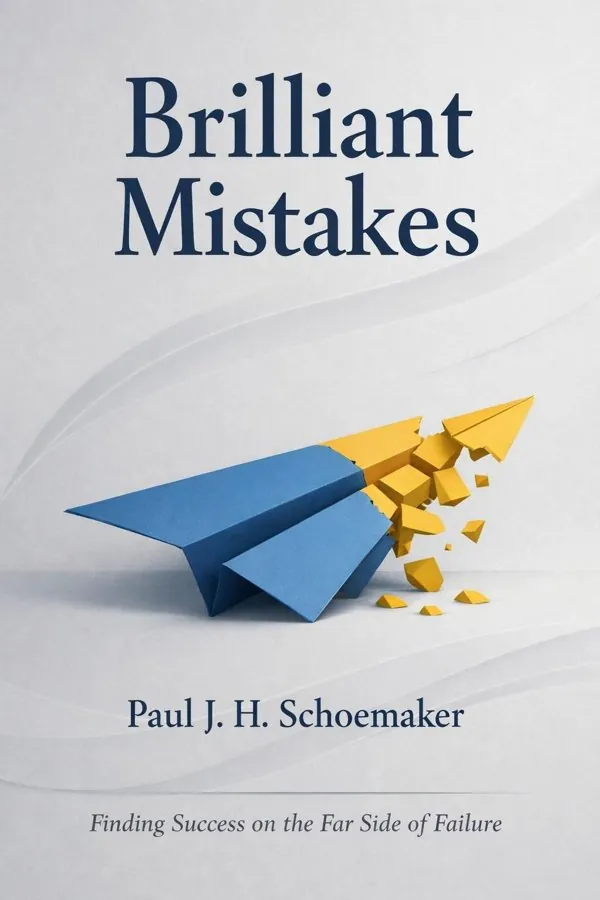
Brilliant Mistakes: Finding Success on the Far Side of Failure: Summary & Key Insights
 10 min9 chaptersAudio available
What Is Brilliant Mistakes: Finding Success on the Far Side of Failure About?
Brilliant Mistakes: Finding Success on the Far Side of Failure by Paul J. H. Schoemaker is a leadership book spanning 9 pages. Brilliant Mistakes: Finding Success on the Far Side of Failure explores how embracing and learning from mistakes can lead to innovation and success. Paul J. H. Schoemaker argues that minimizing mistakes may itself be a major mistake, and he provides frameworks for identifying when errors can be beneficial and how organizations can strategically use them to improve decision-making and performance.
This FizzRead summary covers all 9 key chapters of Brilliant Mistakes: Finding Success on the Far Side of Failure in approximately 10 minutes, distilling the most important ideas, arguments, and takeaways from Paul J. H. Schoemaker's work. Also available as an audio summary and Key Quotes Podcast.
Brilliant Mistakes: Finding Success on the Far Side of Failure
Brilliant Mistakes: Finding Success on the Far Side of Failure explores how embracing and learning from mistakes can lead to innovation and success. Paul J. H. Schoemaker argues that minimizing mistakes may itself be a major mistake, and he provides frameworks for identifying when errors can be beneficial and how organizations can strategically use them to improve decision-making and performance.
Who Should Read Brilliant Mistakes: Finding Success on the Far Side of Failure?
This book is perfect for anyone interested in leadership and looking to gain actionable insights in a short read. Whether you're a student, professional, or lifelong learner, the key ideas from Brilliant Mistakes: Finding Success on the Far Side of Failure by Paul J. H. Schoemaker will help you think differently.
- ✓Readers who enjoy leadership and want practical takeaways
- ✓Professionals looking to apply new ideas to their work and life
- ✓Anyone who wants the core insights of Brilliant Mistakes: Finding Success on the Far Side of Failure in just 10 minutes
Want the full summary?
Get instant access to this book summary and 100K+ more with Fizz Moment.
Get Free SummaryAvailable on App Store • Free to download
Key Chapters
The starting point in understanding brilliant mistakes is reframing what a mistake actually means. I argue that a mistake is not merely something to be corrected or regretted—it is an unplanned experiment. Every time we act under uncertainty, we are implicitly testing an assumption about the world. If that assumption proves wrong, the outcome is a mistake; but embedded in that outcome is precious information that was previously inaccessible.
In business, this distinction is vital. Most organizations treat errors as defects in the system, something to minimize at all costs. Of course, operational mistakes that waste resources or harm customers should not be tolerated. But when it comes to learning and innovation—areas where the future cannot be fully predicted—zero tolerance for mistakes is equivalent to zero capacity for discovery. Failure, in this context, is tuition for the school of experience.
I recall working with firms in the pharmaceutical industry, where research pipelines depend entirely on experiments that mostly fail. Each 'negative' result refines understanding and sometimes opens new paths of inquiry. Over time, such exploration yields breakthroughs that no planner could foresee. The same logic applies to entrepreneurs who test markets that don’t respond; they learn faster than competitors who never test at all. The key is to evaluate the cost of the mistake versus the potential value of its learning. A well-designed brilliant mistake minimizes downside risk while maximizing insight.
There is also a moral dimension to embracing mistakes. As leaders, we set the tone for how people interpret error—whether as shame or signal. A culture that reframes failure as part of progress frees creativity. Innovation blooms when individuals believe they will be respected not only for their successes but also for their experiments. The true value of mistakes lies in their ability to reveal blind spots—the difference between what we think we know and what is actually true.
Human cognition evolved for efficiency, not accuracy. Our minds rely on rules of thumb, biases, and shortcuts that help us make rapid judgments but often lead us astray. In this part of the book, I explore how biases such as confirmation bias, overconfidence, and hindsight distortion shape the way we perceive and respond to mistakes.
Consider the overconfidence effect: people consistently overestimate their understanding and underestimate uncertainty. This means many errors begin with conviction—we act too soon, too boldly, or with excessive certainty. Paradoxically, overconfidence both causes and conceals mistakes, since we are reluctant to question assumptions that led to them. Similarly, confirmation bias makes us favor evidence that supports what we already believe, so once a mistake occurs, we may reinterpret it to fit our narrative rather than examine its causes.
Recognizing these psychological patterns is central to cultivating brilliant mistakes. If you know how your mind tends to err, you can design decisions that expose those blind spots productively. I often encourage executives to practice perspective-taking—asking, 'What would have to be true for my belief to be false?' This opens a window into the untested spaces of reasoning. Embracing curiosity over certainty allows error to become an ally in learning.
Another key point is emotional management. Fear of humiliation or loss can paralyze action; yet excessive optimism can lead to reckless risk-taking. The art lies in balancing humility with courage, skepticism with experimentation. When the emotional tone of decision-making shifts from fear to inquiry, mistakes cease to threaten identity and begin to enrich understanding. This mindset shift—seeing error not as defeat but as discovery—is what I call the psychological foundation of brilliant mistakes.
+ 7 more chapters — available in the FizzRead app
All Chapters in Brilliant Mistakes: Finding Success on the Far Side of Failure
About the Author
Paul J. H. Schoemaker is an academic, author, and entrepreneur known for his work in decision sciences and strategic management. He is the founder and chairman of Decision Strategies International and has served as research director of the Mack Center for Technological Innovation at the Wharton School, University of Pennsylvania.
Get This Summary in Your Preferred Format
Read or listen to the Brilliant Mistakes: Finding Success on the Far Side of Failure summary by Paul J. H. Schoemaker anytime, anywhere. FizzRead offers multiple formats so you can learn on your terms — all free.
Available formats: App · Audio · PDF · EPUB — All included free with FizzRead
Download Brilliant Mistakes: Finding Success on the Far Side of Failure PDF and EPUB Summary
Key Quotes from Brilliant Mistakes: Finding Success on the Far Side of Failure
“The starting point in understanding brilliant mistakes is reframing what a mistake actually means.”
“Human cognition evolved for efficiency, not accuracy.”
Frequently Asked Questions about Brilliant Mistakes: Finding Success on the Far Side of Failure
Brilliant Mistakes: Finding Success on the Far Side of Failure by Paul J. H. Schoemaker is a leadership book that explores key ideas across 9 chapters. Brilliant Mistakes: Finding Success on the Far Side of Failure explores how embracing and learning from mistakes can lead to innovation and success. Paul J. H. Schoemaker argues that minimizing mistakes may itself be a major mistake, and he provides frameworks for identifying when errors can be beneficial and how organizations can strategically use them to improve decision-making and performance.
You Might Also Like

Extreme Ownership
Jocko Willink
10 min
Dare to Lead
Brene Brown
10 min
Leaders Eat Last
Simon Sinek
10 min
The 21 Irrefutable Laws of Leadership
John Maxwell
10 min
Start With Why
Simon Sinek
10 min
How to Lead When You're Not in Charge
Clay Scroggins
10 minBrowse by Category
Ready to read Brilliant Mistakes: Finding Success on the Far Side of Failure?
Get the full summary and 100K+ more books with Fizz Moment.