
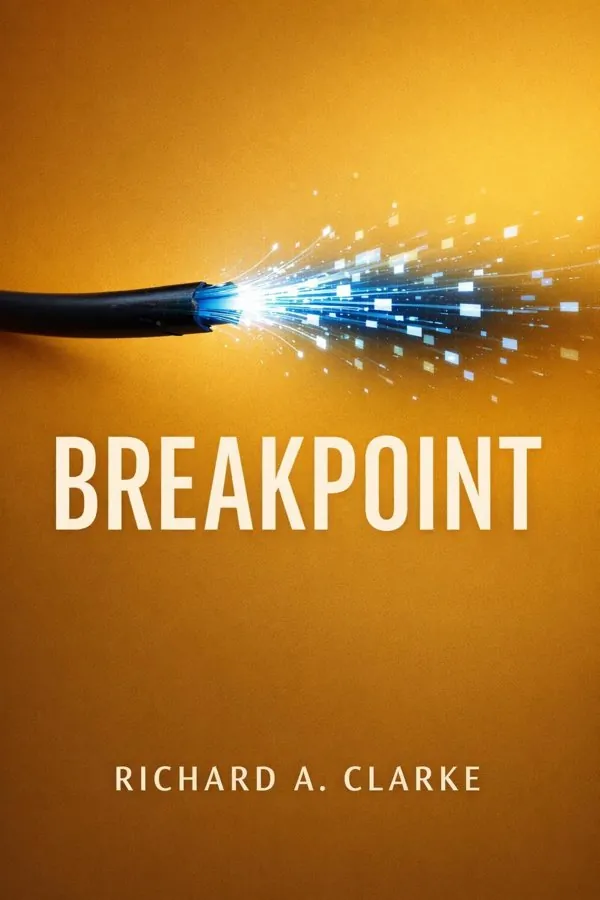
Breakpoint: Summary & Key Insights
 10 min5 chaptersAudio available
What Is Breakpoint About?
Breakpoint by Richard A. Clarke is a bestsellers book spanning 5 pages. Breakpoint is a techno-thriller novel by Richard A. Clarke, first published in 2007. The story explores cyberwarfare, biotechnology, and the vulnerabilities of modern infrastructure as the United States faces a series of devastating attacks on its digital and physical networks. Clarke, a former U.S. national security advisor, uses his insider knowledge to craft a realistic and fast-paced narrative about the intersection of technology, politics, and security.
This FizzRead summary covers all 5 key chapters of Breakpoint in approximately 10 minutes, distilling the most important ideas, arguments, and takeaways from Richard A. Clarke's work. Also available as an audio summary and Key Quotes Podcast.
Breakpoint
Breakpoint is a techno-thriller novel by Richard A. Clarke, first published in 2007. The story explores cyberwarfare, biotechnology, and the vulnerabilities of modern infrastructure as the United States faces a series of devastating attacks on its digital and physical networks. Clarke, a former U.S. national security advisor, uses his insider knowledge to craft a realistic and fast-paced narrative about the intersection of technology, politics, and security.
Who Should Read Breakpoint?
This book is perfect for anyone interested in bestsellers and looking to gain actionable insights in a short read. Whether you're a student, professional, or lifelong learner, the key ideas from Breakpoint by Richard A. Clarke will help you think differently.
- ✓Readers who enjoy bestsellers and want practical takeaways
- ✓Professionals looking to apply new ideas to their work and life
- ✓Anyone who wants the core insights of Breakpoint in just 10 minutes
Want the full summary?
Get instant access to this book summary and 100K+ more with Fizz Moment.
Get Free SummaryAvailable on App Store • Free to download
Key Chapters
It begins suddenly: a series of powerful explosions rip through major Internet hubs across the United States—those unassuming facilities where cables converge, where data silently sustains everything from global trade to emergency response. The destruction is surgical, timed, unmistakably strategic. Within hours, global communication falters. Financial systems hiccup. Satellites fail to synchronize. The illusion of invincibility in the digital era vanishes.
From my perspective, this opening is not just a spectacle of sabotage. It represents the fragility of infrastructure that was never designed to withstand coordinated physical attacks. I wanted readers to understand that the Internet’s backbone, often depicted as a nebulous cloud, actually lives in tangible places—buildings, cables, servers—all vulnerable to conventional assault. The moment those facilities explode, the world experiences the modern equivalent of losing electricity in an industrial revolution. The dependency is total.
As panic spreads, Homeland Security scrambles to understand what has happened. Intelligence agencies suspect foreign involvement—perhaps a Chinese operation, perhaps a rogue actor exploiting known vulnerabilities in American networks. The truth, however, is not immediately clear. In the confusion, jurisdictional rivalries surface. Agencies guard their data, politicians seek someone to blame, and the media churns speculation faster than evidence can be collected.
I wrote these scenes to highlight a painful truth: the machinery of response is rarely as swift or unified as the threat itself. Bureaucracy can stall even in the face of national crisis. The same systems we rely on for protection falter under their own complexity. This is the first breakpoint—the moment society realizes its own interdependence has become a liability.
Amid the chaos, Susan Connor emerges as the mind willing to look beyond the official narratives. As an NSA analyst, she has spent years studying patterns of cyber intrusion, but what she now faces cannot be explained by ordinary hacking. Her investigation follows digital breadcrumbs across compromised networks, and what she finds astonishes even her seasoned colleagues. Embedded within the wreckage of destroyed data centers are traces of biological patterns—DNA sequences integrated into software code.
This strange intersection between digital and biological systems introduces one of the book's central questions: What happens when life itself becomes programmable? Connor’s discovery suggests that the attacks were orchestrated not merely through computer networks but through biotech interfaces capable of altering machine behavior using organic data. The implication rewrites the rulebook of cyberwarfare.
Through Connor’s eyes, I wanted readers to feel both awe and unease about technological convergence. For decades, engineers have dreamed of integrating biological systems with computing architecture—biochips that mimic neurons, genetic algorithms that evolve solutions. But what if that merger were weaponized? The narrative explores that tension through forensic detail—the careful parsing of corrupted code, the revelation of synthetic DNA built to hijack control systems, the gradual uncovering of a design that seems less human than hybrid.
Connor’s persistence exposes a hidden pattern pointing toward a research collective operating beyond borders, beyond oversight. She realizes they are not simple hackers, but scientists pursuing an idea that ethics forbade long ago: the evolution of humanity through artificial enhancement. The attacks, she suspects, are not just sabotage; they are statements—a forced demonstration that the old technological order must collapse before a new one can rise.
+ 3 more chapters — available in the FizzRead app
All Chapters in Breakpoint
About the Author
Richard A. Clarke is an American former government official who served in various national security roles under several U.S. presidents. After leaving government service, he became an author and consultant, writing both nonfiction works on security policy and fiction exploring cyber and geopolitical threats.
Get This Summary in Your Preferred Format
Read or listen to the Breakpoint summary by Richard A. Clarke anytime, anywhere. FizzRead offers multiple formats so you can learn on your terms — all free.
Available formats: App · Audio · PDF · EPUB — All included free with FizzRead
Download Breakpoint PDF and EPUB Summary
Key Quotes from Breakpoint
“The destruction is surgical, timed, unmistakably strategic.”
“Amid the chaos, Susan Connor emerges as the mind willing to look beyond the official narratives.”
Frequently Asked Questions about Breakpoint
Breakpoint by Richard A. Clarke is a bestsellers book that explores key ideas across 5 chapters. Breakpoint is a techno-thriller novel by Richard A. Clarke, first published in 2007. The story explores cyberwarfare, biotechnology, and the vulnerabilities of modern infrastructure as the United States faces a series of devastating attacks on its digital and physical networks. Clarke, a former U.S. national security advisor, uses his insider knowledge to craft a realistic and fast-paced narrative about the intersection of technology, politics, and security.
You Might Also Like
The Godfather
Mario Puzo
10 min
The Handmaid's Tale
Margaret Atwood
10 min
The Hunger Games
Suzanne Collins
10 min
The Nightingale
Kristin Hannah
10 min
The Seven Husbands of Evelyn Hugo
Taylor Jenkins Reid
10 min
Backwater Justice
Fern Michaels
10 minBrowse by Category
Ready to read Breakpoint?
Get the full summary and 100K+ more books with Fizz Moment.