
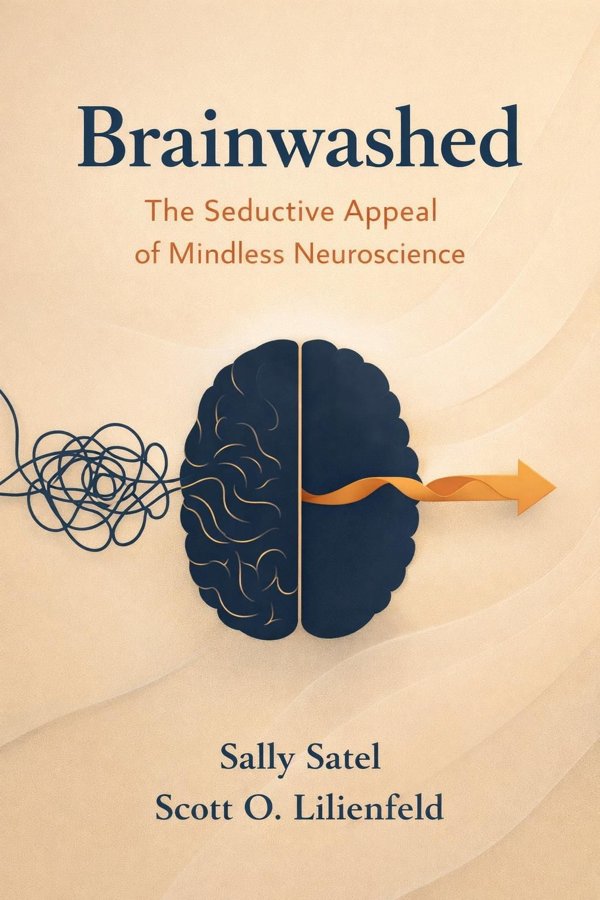
Brainwashed: The Seductive Appeal of Mindless Neuroscience: Summary & Key Insights
by Sally Satel, Scott O. Lilienfeld
 10 min10 chaptersAudio available
Key Takeaways from Brainwashed: The Seductive Appeal of Mindless Neuroscience
Every scientific revolution begins with humility, but cultural fascination often turns humility into overconfidence.
Seeing is not the same as understanding, yet brain images often make us feel as though we have witnessed truth directly.
Once a phenomenon is linked to the brain, it suddenly feels more real, more settled, and more scientific than before.
A brain scan in court can look like the modern equivalent of a confession from nature itself.
Advertisers have always wanted to know what consumers truly want, but neuroscience introduced the tantalizing idea that hidden preferences might be read directly from the brain.
What Is Brainwashed: The Seductive Appeal of Mindless Neuroscience About?
Brainwashed: The Seductive Appeal of Mindless Neuroscience by Sally Satel, Scott O. Lilienfeld is a neuroscience book spanning 10 pages. Why do colorful brain scans so easily convince us that we are looking at truth itself? In Brainwashed, psychiatrist Sally Satel and psychologist Scott O. Lilienfeld investigate the modern fascination with neuroscience and show how quickly scientific findings can be stretched beyond what the evidence actually supports. The book does not reject neuroscience. On the contrary, it respects the field’s genuine achievements in illuminating memory, emotion, injury, addiction, and mental illness. Its real target is the cultural tendency to treat the brain as the final and sufficient explanation for every human thought, failure, preference, and moral choice. That matters because brain-based claims now influence courtrooms, classrooms, marketing campaigns, public policy, and everyday self-understanding. A scan or a neuroscience label can make weak arguments seem objective, precise, and undeniable. Satel and Lilienfeld argue that this is a mistake: human beings are not just brains in isolation, but persons shaped by psychology, relationships, incentives, and culture. Drawing on psychiatry, clinical science, and critical thinking, they offer a much-needed guide to separating real insight from neurohype. The result is a sharp, accessible, and deeply relevant critique of our age of brain obsession.
This FizzRead summary covers all 10 key chapters of Brainwashed: The Seductive Appeal of Mindless Neuroscience in approximately 10 minutes, distilling the most important ideas, arguments, and takeaways from Sally Satel, Scott O. Lilienfeld's work. Also available as an audio summary and Key Quotes Podcast.
Brainwashed: The Seductive Appeal of Mindless Neuroscience
Why do colorful brain scans so easily convince us that we are looking at truth itself? In Brainwashed, psychiatrist Sally Satel and psychologist Scott O. Lilienfeld investigate the modern fascination with neuroscience and show how quickly scientific findings can be stretched beyond what the evidence actually supports. The book does not reject neuroscience. On the contrary, it respects the field’s genuine achievements in illuminating memory, emotion, injury, addiction, and mental illness. Its real target is the cultural tendency to treat the brain as the final and sufficient explanation for every human thought, failure, preference, and moral choice.
That matters because brain-based claims now influence courtrooms, classrooms, marketing campaigns, public policy, and everyday self-understanding. A scan or a neuroscience label can make weak arguments seem objective, precise, and undeniable. Satel and Lilienfeld argue that this is a mistake: human beings are not just brains in isolation, but persons shaped by psychology, relationships, incentives, and culture. Drawing on psychiatry, clinical science, and critical thinking, they offer a much-needed guide to separating real insight from neurohype. The result is a sharp, accessible, and deeply relevant critique of our age of brain obsession.
Who Should Read Brainwashed: The Seductive Appeal of Mindless Neuroscience?
This book is perfect for anyone interested in neuroscience and looking to gain actionable insights in a short read. Whether you're a student, professional, or lifelong learner, the key ideas from Brainwashed: The Seductive Appeal of Mindless Neuroscience by Sally Satel, Scott O. Lilienfeld will help you think differently.
- ✓Readers who enjoy neuroscience and want practical takeaways
- ✓Professionals looking to apply new ideas to their work and life
- ✓Anyone who wants the core insights of Brainwashed: The Seductive Appeal of Mindless Neuroscience in just 10 minutes
Want the full summary?
Get instant access to this book summary and 100K+ more with Fizz Moment.
Get Free SummaryAvailable on App Store • Free to download
Key Chapters
Every scientific revolution begins with humility, but cultural fascination often turns humility into overconfidence. Satel and Lilienfeld begin by placing modern neuroscience in historical context. Early brain science was built on painstaking observation: physicians linked strokes, injuries, and localized lesions to changes in speech, movement, or perception. These discoveries were powerful because they were specific and limited. Researchers learned that the brain matters profoundly, but they also learned that understanding behavior requires caution.
Over time, neuroscience moved from clinics and laboratories into public imagination. The brain became more than an organ of study; it became a cultural icon. Popular media started presenting neurological explanations as the deepest explanations, and once the prefix “neuro-” appeared before a field—neuroeconomics, neuromarketing, neuroeducation—it gained instant prestige. The problem is not that these interdisciplinary efforts are inherently misguided. The problem is that the authority of neuroscience can be borrowed too easily, even when the evidence is preliminary, indirect, or only loosely connected to real-world behavior.
The authors show that this drift from careful science to inflated interpretation follows a familiar pattern. A legitimate finding about neural activation is discovered under narrow conditions. Then it is generalized into claims about morality, love, politics, criminal responsibility, or consumer desire. What began as one level of explanation becomes treated as the only level that matters.
In practice, this means readers, journalists, and professionals should ask a basic question: what exactly did the study show, and what did it not show? A result about the brain is not automatically a full explanation of a person. The actionable takeaway is to treat neuroscience as one useful lens among many, not as a magic key that unlocks all human complexity.
Seeing is not the same as understanding, yet brain images often make us feel as though we have witnessed truth directly. One of the book’s most memorable themes is the seductive power of brain imaging, especially functional MRI. These scans produce vivid color-coded pictures that seem to reveal anger, deception, empathy, or craving as if thoughts themselves were glowing inside the skull. The visual impact creates an illusion of certainty.
Satel and Lilienfeld explain that these images are not photographs of thoughts. They are complex statistical constructions based on blood flow changes, averaged across time, compared against baselines, and interpreted through many methodological choices. In other words, they are meaningful scientific tools, but they are not transparent windows into the mind. Small sample sizes, noisy measurements, flexible data analysis, and overinterpretation can all distort what a scan appears to say.
This matters because people often give extra credibility to explanations that include neuroscience, even when the neuroscience adds little. A weak claim can seem stronger simply by attaching a brain image or mentioning neural circuitry. For example, an education program may advertise itself as “brain-based” without demonstrating better outcomes, or a news article may imply that a scan proves a person’s hidden motives when it only shows a broad correlation.
The authors are not dismissing imaging. Brain scans have been invaluable in studying injury, dementia, and broad networks involved in cognition and emotion. Their point is that images impress us emotionally before we evaluate them rationally. The actionable takeaway is simple: whenever a brain scan is used to support a claim, ask what was measured, how strong the evidence is, and whether the same conclusion could have been drawn without the dramatic picture.
Once a phenomenon is linked to the brain, it suddenly feels more real, more settled, and more scientific than before. Satel and Lilienfeld call attention to this tendency through concepts such as neurorealism and neurocentrism. Neurorealism is the assumption that a subjective or psychological experience becomes especially legitimate when it is shown to have a neural correlate. Neurocentrism goes further, encouraging us to think of people primarily as brains rather than as whole persons embedded in social worlds.
This framing changes how we talk about identity and behavior. Instead of saying that someone struggles with impulsivity, we may say their brain is wired a certain way. Instead of discussing motives, habits, family influences, or moral reasoning, we may jump immediately to neural explanation. The authors argue that this move can be misleading. Of course every thought has a brain basis; that is not in dispute. But identifying a neural basis does not replace psychological, developmental, and social explanations. It merely describes the same person at a different level.
A practical example appears in everyday headlines: “Scientists find the brain area for love,” “political preference,” or “religion.” Such claims imply that a fuzzy, multidimensional human experience has been pinned down to a mechanism. In reality, these findings often involve modest statistical associations in artificial settings. They may be interesting, but they rarely justify the sweeping conclusions attached to them.
The authors urge readers to resist the temptation to think that “brain-based” means “fully explained.” Human beings are biological, but they are also interpretive creatures living through language, culture, and personal history. The actionable takeaway is to translate neuro-claims back into ordinary human terms and ask whether the explanation actually improves understanding or merely sounds more authoritative.
A brain scan in court can look like the modern equivalent of a confession from nature itself. When legal decisions involve guilt, intent, future risk, or mitigation, neuroscience appears to offer objective evidence beyond unreliable testimony and competing narratives. Satel and Lilienfeld examine this growing use of neuroscience in the courtroom and argue that its promise is both real and sharply limited.
Neuroscience can be relevant in specific cases. If a defendant has a brain tumor, traumatic injury, seizure disorder, or severe impairment affecting judgment and control, medical evidence may help explain behavior. It may also contribute to sentencing decisions or treatment planning. But the authors warn against assuming that abnormal brain findings automatically settle questions of responsibility. Many people with unusual scans do not commit crimes, and many who commit crimes have no clear neurological lesion. Law concerns persons acting in contexts, not just brains producing outputs.
A central problem is that neuroscience can be rhetorically powerful even when legally weak. Jurors may be dazzled by colorful images or technical language and assign them more importance than they deserve. There is also a conceptual issue: the fact that behavior has a neural basis does not erase agency, because all behavior has a neural basis. If brain evidence is treated as exculpatory simply because it is biological, then nearly every human action would become less attributable to the person.
The legal system must balance compassion, accountability, and public safety. The authors argue that neuroscience should inform this balance, not replace it. Courts still need behavioral evidence, history, circumstances, and moral reasoning. The actionable takeaway is that brain evidence in legal settings should be judged like any expert testimony: carefully, contextually, and without mistaking mechanistic explanation for moral conclusion.
Few ideas travel faster than simple ones that promise better children, better schools, and better futures. That is why educational neuro-myths have such staying power. Satel and Lilienfeld show how neuroscience is frequently invoked in classrooms and teacher training in ways that sound modern but rest on weak evidence. Claims about left-brain versus right-brain learners, highly specific critical periods, or tailor-made teaching for supposed learning styles often gain traction because they feel scientifically grounded.
The authors do not deny that the brain is central to learning. Of course it is. But neuroscience rarely translates directly into classroom practice without passing through cognitive psychology, developmental science, and educational research. A finding about synaptic pruning or neural plasticity may be fascinating, yet it does not automatically tell teachers how to organize lessons, assess understanding, or motivate students. The bridge from lab to classroom is long and requires careful testing.
A practical example is the commercial market for “brain-based” educational products. Schools under pressure to improve outcomes may invest in programs adorned with neuroscience language, despite limited evidence that they outperform standard teaching methods. Meanwhile, well-established practices—retrieval practice, spaced repetition, clear feedback, strong classroom routines—often owe more to behavioral and cognitive research than to flashy brain claims.
The danger of neuro-myths is not only wasted money. They can also distract educators from what actually helps students learn: attention, effort, guidance, prior knowledge, emotional safety, and sustained practice. The actionable takeaway is that educators and parents should judge interventions by demonstrated learning outcomes, not by whether they are decorated with the language of neurons, hemispheres, or brain optimization.
The modern slogan that addiction is a brain disease carries both compassion and risk. Satel and Lilienfeld treat addiction as one of the most important cases where neuroscience has yielded genuine insight while also being oversimplified in public discourse. Brain research has illuminated reward pathways, craving, tolerance, cue reactivity, and impaired self-control. These findings have helped reduce moralistic views that see addiction as mere vice or bad character.
But the authors warn that the disease model can become too totalizing. If addiction is described only as a hijacked brain, people may conclude that choice, responsibility, incentives, and recovery effort hardly matter. That conclusion is false and potentially harmful. Many addicted individuals respond to consequences, social supports, treatment structures, and personal commitments. They often quit or improve through a combination of motivation, environment, habits, medication, psychotherapy, and changed circumstances.
The authors are especially concerned about language that strips agency from patients. Telling someone their brain has made the decision for them may reduce shame in the short term, but it can also reduce hope and self-efficacy. A better framework acknowledges that addiction alters the brain and makes self-control harder, while still recognizing that people remain responsive to reasons, goals, and treatment.
This balanced view has practical implications. Effective addiction care should combine biological understanding with behavioral strategies, social support, relapse planning, and accountability. Public policy should avoid the extremes of punishment alone or biology alone. The actionable takeaway is to speak about addiction in ways that are both humane and empowering: the brain is involved, deeply so, but recovery still depends on the person acting within a supportive environment.
When suffering is severe, the desire for a clean biological explanation is completely understandable. Patients and families often find relief in hearing that depression, schizophrenia, anxiety, or ADHD has a basis in the brain. Satel and Lilienfeld respect this impulse, but they argue that mental illness is frequently misunderstood when brain mechanisms are treated as complete explanations rather than partial ones.
Every mental disorder involves the brain because every mental state does. Yet psychiatry deals with symptoms expressed in thought, emotion, behavior, meaning, and relationships. Even when neuroscience identifies relevant circuits or neurotransmitters, those findings do not erase the role of trauma, family dynamics, learned patterns, culture, expectations, and life stress. A reductionist account can accidentally flatten the patient into a malfunctioning machine.
The authors also note that overly biological explanations may have mixed social effects. They can reduce blame, but they may also increase pessimism by making disorders seem fixed, permanent, or alien. Someone who believes their depression is nothing but a chemical imbalance may become less likely to value psychotherapy, exercise, social connection, sleep, purpose, or cognitive change. Likewise, clinicians may overpromise precision that neuroscience is not yet able to deliver.
An integrative approach is more faithful to the evidence. Medication can help; so can therapy, routines, relationships, and changes in circumstance. The brain is the organ through which these influences work, not a reason to ignore them. The actionable takeaway is to understand mental illness on multiple levels at once: biological, psychological, and social. This broader frame supports better treatment and preserves a fuller sense of personhood.
If every choice can be described as neural activity, what happens to concepts like responsibility, dignity, and moral judgment? Satel and Lilienfeld address the philosophical and ethical implications of neuroscience by pushing back against the idea that a mechanistic account of behavior renders person-level concepts obsolete. The brain is necessary for action, but morality concerns agents, intentions, reasons, and relationships.
A common mistake is to treat biological explanation as if it cancels normative evaluation. For example, if aggression, empathy, or dishonesty can be linked to brain systems, some may conclude that praise and blame are outdated. But explaining a behavior causally is not the same as evaluating it ethically. We can understand that stress affects parenting without concluding that parenting choices are beyond moral reflection. We can know that impulse control depends on the prefrontal cortex without abandoning the social practices that cultivate self-restraint.
The authors argue that neuroscience should deepen our humanity, not dissolve it. Greater knowledge of vulnerability, bias, and limitation can make institutions more compassionate and intelligent. It can improve treatment, refine sentencing, and support prevention. Yet it should not tempt us into seeing ourselves as passive spectators of our own brains. People deliberate, make commitments, revise habits, and respond to norms. Those realities remain true even in a thoroughly biological world.
In everyday life, this means using neuroscience to inform ethical decisions without letting it dominate them. Policies about education, criminal justice, and mental health still require values, not just scans. The actionable takeaway is to hold two truths together: humans are biological organisms, and humans are responsible persons. A mature culture needs both ideas at once.
The deepest mistake in brain hype is not loving neuroscience too much; it is expecting one kind of explanation to do all the work. Satel and Lilienfeld end with an integrative perspective that may be the book’s most constructive contribution. Human behavior can be described at many levels: neural, genetic, cognitive, emotional, developmental, interpersonal, institutional, and cultural. None of these levels is automatically the most important in every situation.
Consider a student failing exams. A neural account might examine attention networks or sleep deprivation. A psychological account might explore anxiety, motivation, and study habits. A social account might reveal family stress, poor instruction, or economic pressures. A cultural account might address expectations and opportunity. These are not competing explanations in a winner-take-all contest. They are often complementary, each highlighting causes and solutions the others would miss.
The authors urge readers to reject the prestige hierarchy that puts brain explanations at the top by default. Sometimes the most useful intervention is medical. Sometimes it is behavioral coaching, a legal reform, a better classroom, or a change in incentives. Wisdom lies in matching the level of explanation to the problem at hand.
This perspective is especially practical for professionals. Clinicians should integrate medication with psychotherapy and context. Educators should combine developmental insight with evidence-based instruction. Policymakers should examine institutions alongside biology. Readers should learn to ask not “What does the brain say?” but “What combination of explanations best helps us understand and respond?” The actionable takeaway is to prefer layered, evidence-based thinking over single-cause stories, especially when those stories are made more persuasive by the glamour of neuroscience.
All Chapters in Brainwashed: The Seductive Appeal of Mindless Neuroscience
About the Authors
Sally Satel is a psychiatrist, essayist, and lecturer at Yale University School of Medicine whose work often explores the intersection of mental health, culture, medicine, and public policy. She has written extensively on addiction, psychiatric diagnosis, and the social meaning of medical ideas. Scott O. Lilienfeld was a distinguished psychologist and professor known for his influential research on personality, psychopathology, scientific reasoning, and pseudoscience in psychology. He was widely respected for promoting critical thinking and methodological rigor in the study of mental health. Together, Satel and Lilienfeld brought a rare combination of clinical experience, psychological expertise, and skepticism toward overblown claims. In Brainwashed, their complementary strengths help readers distinguish real neuroscientific insight from the seductive but misleading allure of neurohype.
Get This Summary in Your Preferred Format
Read or listen to the Brainwashed: The Seductive Appeal of Mindless Neuroscience summary by Sally Satel, Scott O. Lilienfeld anytime, anywhere. FizzRead offers multiple formats so you can learn on your terms — all free.
Available formats: App · Audio · PDF · EPUB — All included free with FizzRead
Download Brainwashed: The Seductive Appeal of Mindless Neuroscience PDF and EPUB Summary
Key Quotes from Brainwashed: The Seductive Appeal of Mindless Neuroscience
“Every scientific revolution begins with humility, but cultural fascination often turns humility into overconfidence.”
“Seeing is not the same as understanding, yet brain images often make us feel as though we have witnessed truth directly.”
“Once a phenomenon is linked to the brain, it suddenly feels more real, more settled, and more scientific than before.”
“A brain scan in court can look like the modern equivalent of a confession from nature itself.”
“Advertisers have always wanted to know what consumers truly want, but neuroscience introduced the tantalizing idea that hidden preferences might be read directly from the brain.”
Frequently Asked Questions about Brainwashed: The Seductive Appeal of Mindless Neuroscience
Brainwashed: The Seductive Appeal of Mindless Neuroscience by Sally Satel, Scott O. Lilienfeld is a neuroscience book that explores key ideas across 10 chapters. Why do colorful brain scans so easily convince us that we are looking at truth itself? In Brainwashed, psychiatrist Sally Satel and psychologist Scott O. Lilienfeld investigate the modern fascination with neuroscience and show how quickly scientific findings can be stretched beyond what the evidence actually supports. The book does not reject neuroscience. On the contrary, it respects the field’s genuine achievements in illuminating memory, emotion, injury, addiction, and mental illness. Its real target is the cultural tendency to treat the brain as the final and sufficient explanation for every human thought, failure, preference, and moral choice. That matters because brain-based claims now influence courtrooms, classrooms, marketing campaigns, public policy, and everyday self-understanding. A scan or a neuroscience label can make weak arguments seem objective, precise, and undeniable. Satel and Lilienfeld argue that this is a mistake: human beings are not just brains in isolation, but persons shaped by psychology, relationships, incentives, and culture. Drawing on psychiatry, clinical science, and critical thinking, they offer a much-needed guide to separating real insight from neurohype. The result is a sharp, accessible, and deeply relevant critique of our age of brain obsession.
You Might Also Like

Anxious
Joseph LeDoux
10 min
Hallucinations
Oliver Sacks
10 min
The Biological Mind: How Brain, Body, and Environment Collaborate to Make Us Who We Are
Alan Jasanoff
10 min
The Feeling of Life Itself: Why Consciousness Is Widespread but Can't Be Computed
Christof Koch
10 min
The No-Nonsense Meditation Book
Steven Laureys
10 min
A General Theory of Love
Thomas Lewis, Fari Amini, Richard Lannon
10 minBrowse by Category
Ready to read Brainwashed: The Seductive Appeal of Mindless Neuroscience?
Get the full summary and 100K+ more books with Fizz Moment.