
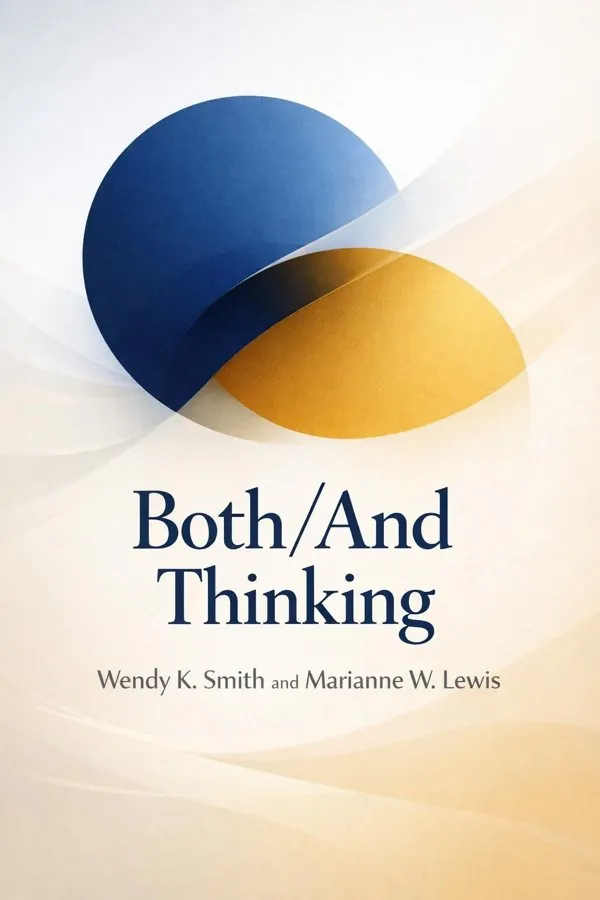
Both/And Thinking: Embracing Creative Tensions to Solve Your Toughest Problems: Summary & Key Insights
by Wendy K. Smith, Marianne W. Lewis
 10 min6 chaptersAudio available
What Is Both/And Thinking: Embracing Creative Tensions to Solve Your Toughest Problems About?
Both/And Thinking: Embracing Creative Tensions to Solve Your Toughest Problems by Wendy K. Smith and Marianne W. Lewis is a leadership book spanning 6 pages. Both/And Thinking explores how individuals and organizations can embrace paradoxes—such as stability and change, competition and cooperation, or work and life—to achieve more sustainable success. Drawing on decades of research in organizational behavior and leadership, the authors present practical frameworks for navigating complex challenges through integrative thinking rather than choosing between opposing options.
This FizzRead summary covers all 6 key chapters of Both/And Thinking: Embracing Creative Tensions to Solve Your Toughest Problems in approximately 10 minutes, distilling the most important ideas, arguments, and takeaways from Wendy K. Smith and Marianne W. Lewis's work. Also available as an audio summary and Key Quotes Podcast.
Both/And Thinking: Embracing Creative Tensions to Solve Your Toughest Problems
Both/And Thinking explores how individuals and organizations can embrace paradoxes—such as stability and change, competition and cooperation, or work and life—to achieve more sustainable success. Drawing on decades of research in organizational behavior and leadership, the authors present practical frameworks for navigating complex challenges through integrative thinking rather than choosing between opposing options.
Who Should Read Both/And Thinking: Embracing Creative Tensions to Solve Your Toughest Problems?
This book is perfect for anyone interested in leadership and looking to gain actionable insights in a short read. Whether you're a student, professional, or lifelong learner, the key ideas from Both/And Thinking: Embracing Creative Tensions to Solve Your Toughest Problems by Wendy K. Smith and Marianne W. Lewis will help you think differently.
- ✓Readers who enjoy leadership and want practical takeaways
- ✓Professionals looking to apply new ideas to their work and life
- ✓Anyone who wants the core insights of Both/And Thinking: Embracing Creative Tensions to Solve Your Toughest Problems in just 10 minutes
Want the full summary?
Get instant access to this book summary and 100K+ more with Fizz Moment.
Get Free SummaryAvailable on App Store • Free to download
Key Chapters
Our decision-making culture has been dominated by either/or logic. In business, we’re told to pick between centralization and decentralization, exploration and exploitation, short-term performance and long-term vision. In our personal lives, we’re similarly caught between professional ambition and personal satisfaction, authenticity and adaptability. Either/or thinking offers a seductive simplicity—it provides clarity and control. But as our world becomes more complex, interconnected, and fast-changing, rigid choices only deepen problems.
In our research, Marianne and I observed how organizations often overcorrect by oscillating between extremes. A company pursuing efficiency might standardize processes until innovation dies; another, chasing agility, might abandon necessary structure. The problem isn’t the goals themselves—it’s the assumption that we must choose one at the expense of the other. Such choices create vicious cycles. The suppression of one side of a paradox only fuels its return.
To illustrate, consider a global tech firm we studied that sought innovation but feared losing operational stability. Their leaders swung between experimentation and process discipline, each time alienating part of their workforce. The breakthrough came when they began viewing stability as the platform for innovation—processes that provided security were reframed as enablers of creative risk-taking. The paradox wasn’t resolved, but balanced dynamically.
This pattern shows why either/or thinking ultimately constrains growth. Binary choices limit learning because they force trade-offs that aren’t necessary. Both/and thinking, by contrast, doesn’t force resolution; it invites integration. It calls us to find harmony within tension. When we move beyond dichotomies, we open the door to a richer, more adaptive way of leading and living.
To help individuals and organizations work through complex tensions, we developed what we call the *Paradox System*. It starts with recognition—seeing paradoxes not as temporary dilemmas but as ongoing, interdependent forces that coexist. Once we name the paradox, we can navigate it through both/and strategies that sustain progress.
The Paradox System has four core elements: seeing the tension, accepting it, exploring it, and integrating it. Seeing requires awareness—a shift from denial or avoidance to recognition that opposing demands are both real and valuable. Acceptance means letting go of the urge to simplify; it’s an emotional resilience that allows tension to exist without panic. Exploration is the creative process of experimentation: what if we could meet both demands in new ways? And integration is where these experiments yield sustainable practices that work in harmony.
For instance, one retail firm faced the paradox of global consistency versus local flexibility. By using the Paradox System, leaders stopped treating these goals as mutually exclusive. Instead, they created guiding principles that offered global coherence but empowered local teams to adapt. The result wasn’t compromise; it was synergy.
The system works because it acknowledges the cyclical nature of paradoxes—they don’t disappear. Accepting this invites leaders to remain adaptive, balancing tensions continually rather than seeking final resolution. It turns leadership from a quest for certainty into a practice of dynamic equilibrium.
+ 4 more chapters — available in the FizzRead app
All Chapters in Both/And Thinking: Embracing Creative Tensions to Solve Your Toughest Problems
About the Authors
Wendy K. Smith is a professor of management at the University of Delaware, known for her research on strategic paradoxes and leadership. Marianne W. Lewis is the dean and professor of management at the University of Cincinnati’s Lindner College of Business, specializing in organizational paradoxes and innovation.
Get This Summary in Your Preferred Format
Read or listen to the Both/And Thinking: Embracing Creative Tensions to Solve Your Toughest Problems summary by Wendy K. Smith and Marianne W. Lewis anytime, anywhere. FizzRead offers multiple formats so you can learn on your terms — all free.
Available formats: App · Audio · PDF · EPUB — All included free with FizzRead
Download Both/And Thinking: Embracing Creative Tensions to Solve Your Toughest Problems PDF and EPUB Summary
Key Quotes from Both/And Thinking: Embracing Creative Tensions to Solve Your Toughest Problems
“Our decision-making culture has been dominated by either/or logic.”
“To help individuals and organizations work through complex tensions, we developed what we call the *Paradox System*.”
Frequently Asked Questions about Both/And Thinking: Embracing Creative Tensions to Solve Your Toughest Problems
Both/And Thinking: Embracing Creative Tensions to Solve Your Toughest Problems by Wendy K. Smith and Marianne W. Lewis is a leadership book that explores key ideas across 6 chapters. Both/And Thinking explores how individuals and organizations can embrace paradoxes—such as stability and change, competition and cooperation, or work and life—to achieve more sustainable success. Drawing on decades of research in organizational behavior and leadership, the authors present practical frameworks for navigating complex challenges through integrative thinking rather than choosing between opposing options.
You Might Also Like
Extreme Ownership
Jocko Willink
10 min
Dare to Lead
Brene Brown
10 min
Leaders Eat Last
Simon Sinek
10 min
The 21 Irrefutable Laws of Leadership
John Maxwell
10 min
Start With Why
Simon Sinek
10 min
How to Lead When You're Not in Charge
Clay Scroggins
10 minBrowse by Category
Ready to read Both/And Thinking: Embracing Creative Tensions to Solve Your Toughest Problems?
Get the full summary and 100K+ more books with Fizz Moment.