
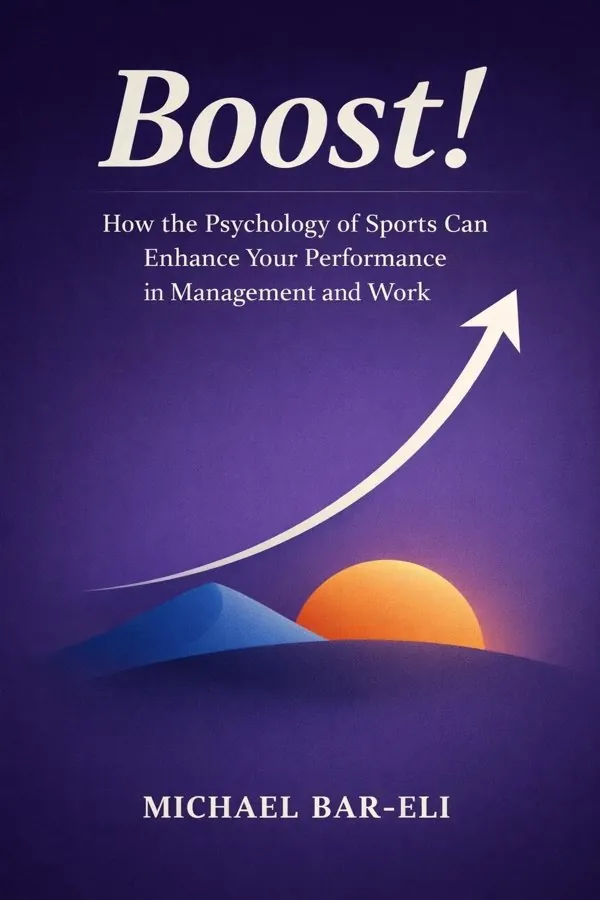
Boost!: How the Psychology of Sports Can Enhance Your Performance in Management and Work: Summary & Key Insights
 10 min8 chaptersAudio available
What Is Boost!: How the Psychology of Sports Can Enhance Your Performance in Management and Work About?
Boost!: How the Psychology of Sports Can Enhance Your Performance in Management and Work by Michael Bar-Eli is a leadership book spanning 8 pages. This book explores how principles from sports psychology can be applied to business and management. Michael Bar-Eli, a leading sports psychologist, demonstrates how motivation, focus, resilience, and teamwork—key elements in athletic success—can also drive performance and leadership in the corporate world. Drawing on decades of research and real-world examples, the book bridges the gap between sports and organizational behavior, offering practical insights for managers and professionals seeking to improve decision-making and performance under pressure.
This FizzRead summary covers all 8 key chapters of Boost!: How the Psychology of Sports Can Enhance Your Performance in Management and Work in approximately 10 minutes, distilling the most important ideas, arguments, and takeaways from Michael Bar-Eli's work. Also available as an audio summary and Key Quotes Podcast.
Boost!: How the Psychology of Sports Can Enhance Your Performance in Management and Work
This book explores how principles from sports psychology can be applied to business and management. Michael Bar-Eli, a leading sports psychologist, demonstrates how motivation, focus, resilience, and teamwork—key elements in athletic success—can also drive performance and leadership in the corporate world. Drawing on decades of research and real-world examples, the book bridges the gap between sports and organizational behavior, offering practical insights for managers and professionals seeking to improve decision-making and performance under pressure.
Who Should Read Boost!: How the Psychology of Sports Can Enhance Your Performance in Management and Work?
This book is perfect for anyone interested in leadership and looking to gain actionable insights in a short read. Whether you're a student, professional, or lifelong learner, the key ideas from Boost!: How the Psychology of Sports Can Enhance Your Performance in Management and Work by Michael Bar-Eli will help you think differently.
- ✓Readers who enjoy leadership and want practical takeaways
- ✓Professionals looking to apply new ideas to their work and life
- ✓Anyone who wants the core insights of Boost!: How the Psychology of Sports Can Enhance Your Performance in Management and Work in just 10 minutes
Want the full summary?
Get instant access to this book summary and 100K+ more with Fizz Moment.
Get Free SummaryAvailable on App Store • Free to download
Key Chapters
Motivation is where every form of performance begins. In sports, we distinguish between intrinsic motivation—the inner desire to improve, compete, and reach one’s potential—and extrinsic motivation, driven by rewards, recognition, or fear of loss. Both exist, and both matter, but long-term excellence comes from intrinsic drive.
In my research and consulting, I observed that athletes sustain effort not merely for trophies, but for mastery. This internal engagement translates seamlessly to organizational life. Employees, like athletes, perform best when they feel a sense of autonomy, purpose, and competence. As in sports, external rewards can boost short-term results, but intrinsic motivation anchors sustained high performance.
Consider the Olympic athlete training for years before a fleeting chance at glory. Such persistence arises from deeply internalized goals—personal growth, self-efficacy, and meaning. Similarly, managers who cultivate intrinsic motivation in themselves and their teams build cultures of resilience. The key is aligning personal goals with organizational purpose so that work feels less imposed and more chosen. When people see their role as meaningful, their motivation amplifies exponentially.
I often remind business leaders that motivation cannot be imposed—it must be inspired. The manager’s job is comparable to the coach’s: to create an environment where people find their own reasons to excel. Through this shared psychological space, organizations move beyond compliance toward conviction, and performance becomes not an obligation but a calling.
Athletes understand that goals are architecture for success. Without clear objectives, training lacks direction. In business, the same principle applies: goals transform potential into actionable pursuit. Sports psychology research emphasizes SMART goals—specific, measurable, attainable, relevant, and time-bound—but psychological subtleties matter just as much. Effective goals are challenging yet credible; they stimulate focus without triggering anxiety.
Athletes progress by setting proximal goals—daily or weekly targets that ladder upward to long-term aspirations. This helps sustain motivation while providing continual feedback. Managers can adopt this same incremental logic to project planning and team alignment. When leaders express vision in tangible, attainable increments, teams experience a rhythm of progress that reinforces confidence and drive.
Focus amplifies goal setting. Think of focus as the ability to maintain mental clarity amidst distractions. In high-stakes sports moments—like a penalty kick—focus isn’t about ignoring pressure; it’s about channeling attention on controllable elements. The same rule applies in business decision-making. Attentional control enhances judgment, reduces impulsivity, and minimizes errors born from emotional interference.
Throughout this book, I emphasize that focus is trained, not innate. Athletes practice mental routines—breathing control, cue words, visualization—to stabilize attention. Leaders can do the same through deliberate reflection and structured communication. Maintaining focus in meetings, negotiations, or strategic planning mirrors the athlete’s concentration under performance stress. By training focus, we train success itself.
+ 6 more chapters — available in the FizzRead app
All Chapters in Boost!: How the Psychology of Sports Can Enhance Your Performance in Management and Work
About the Author
Michael Bar-Eli is an Israeli professor of psychology and management at Ben-Gurion University of the Negev. He is internationally recognized for his research in sports psychology and decision-making, having served as a consultant to professional athletes and organizations. His work focuses on motivation, performance, and behavioral strategies that enhance success in both sports and business contexts.
Get This Summary in Your Preferred Format
Read or listen to the Boost!: How the Psychology of Sports Can Enhance Your Performance in Management and Work summary by Michael Bar-Eli anytime, anywhere. FizzRead offers multiple formats so you can learn on your terms — all free.
Available formats: App · Audio · PDF · EPUB — All included free with FizzRead
Download Boost!: How the Psychology of Sports Can Enhance Your Performance in Management and Work PDF and EPUB Summary
Key Quotes from Boost!: How the Psychology of Sports Can Enhance Your Performance in Management and Work
“Motivation is where every form of performance begins.”
“Athletes understand that goals are architecture for success.”
Frequently Asked Questions about Boost!: How the Psychology of Sports Can Enhance Your Performance in Management and Work
Boost!: How the Psychology of Sports Can Enhance Your Performance in Management and Work by Michael Bar-Eli is a leadership book that explores key ideas across 8 chapters. This book explores how principles from sports psychology can be applied to business and management. Michael Bar-Eli, a leading sports psychologist, demonstrates how motivation, focus, resilience, and teamwork—key elements in athletic success—can also drive performance and leadership in the corporate world. Drawing on decades of research and real-world examples, the book bridges the gap between sports and organizational behavior, offering practical insights for managers and professionals seeking to improve decision-making and performance under pressure.
More by Michael Bar-Eli
You Might Also Like

Extreme Ownership
Jocko Willink
10 min
Dare to Lead
Brene Brown
10 min
Leaders Eat Last
Simon Sinek
10 min
The 21 Irrefutable Laws of Leadership
John Maxwell
10 min
Start With Why
Simon Sinek
10 min
How to Lead When You're Not in Charge
Clay Scroggins
10 minBrowse by Category
Ready to read Boost!: How the Psychology of Sports Can Enhance Your Performance in Management and Work?
Get the full summary and 100K+ more books with Fizz Moment.