
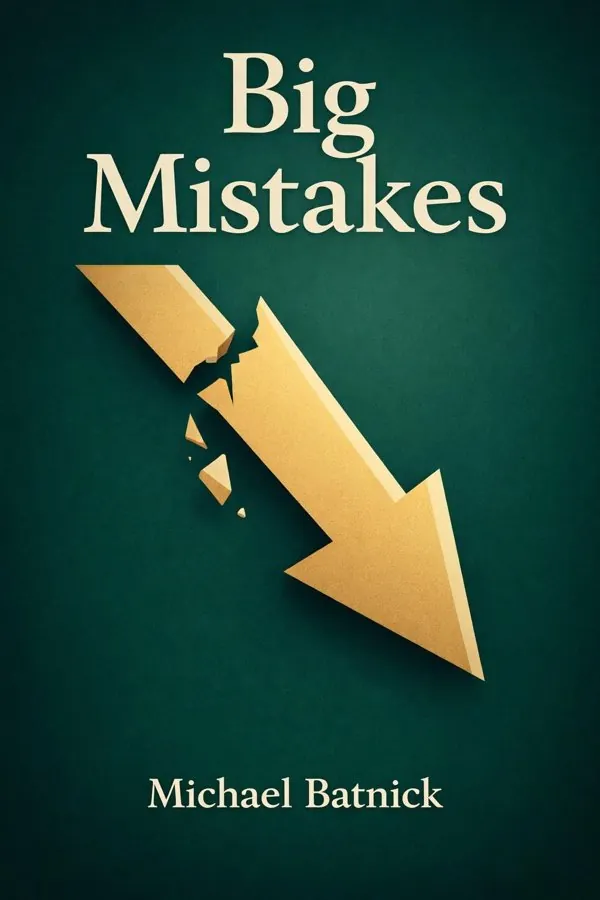
Big Mistakes: The Best Investors and Their Worst Investments: Summary & Key Insights
 10 min10 chaptersAudio available
What Is Big Mistakes: The Best Investors and Their Worst Investments About?
Big Mistakes: The Best Investors and Their Worst Investments by Michael Batnick is a finance book spanning 10 pages. Big Mistakes: The Best Investors and Their Worst Investments examines the failures of some of the most renowned investors in history, including Warren Buffett, Bill Ackman, and others. Through detailed case studies, Michael Batnick reveals how even the most successful financial minds have made costly errors, and how those experiences shaped their future strategies and philosophies. The book emphasizes the importance of learning from failure and understanding the psychological and strategic pitfalls that can lead to poor investment decisions.
This FizzRead summary covers all 10 key chapters of Big Mistakes: The Best Investors and Their Worst Investments in approximately 10 minutes, distilling the most important ideas, arguments, and takeaways from Michael Batnick's work. Also available as an audio summary and Key Quotes Podcast.
Big Mistakes: The Best Investors and Their Worst Investments
Big Mistakes: The Best Investors and Their Worst Investments examines the failures of some of the most renowned investors in history, including Warren Buffett, Bill Ackman, and others. Through detailed case studies, Michael Batnick reveals how even the most successful financial minds have made costly errors, and how those experiences shaped their future strategies and philosophies. The book emphasizes the importance of learning from failure and understanding the psychological and strategic pitfalls that can lead to poor investment decisions.
Who Should Read Big Mistakes: The Best Investors and Their Worst Investments?
This book is perfect for anyone interested in finance and looking to gain actionable insights in a short read. Whether you're a student, professional, or lifelong learner, the key ideas from Big Mistakes: The Best Investors and Their Worst Investments by Michael Batnick will help you think differently.
- ✓Readers who enjoy finance and want practical takeaways
- ✓Professionals looking to apply new ideas to their work and life
- ✓Anyone who wants the core insights of Big Mistakes: The Best Investors and Their Worst Investments in just 10 minutes
Want the full summary?
Get instant access to this book summary and 100K+ more with Fizz Moment.
Get Free SummaryAvailable on App Store • Free to download
Key Chapters
Isaac Newton wasn’t an investor by profession—he was one of history’s greatest scientists. Yet, in the early 18th century, the speculative fever surrounding the South Sea Company lured him into a universe that had no equations or laws to protect him. At first, Newton was cautious. He invested early, made a reasonable profit, and sold. But then, as the price continued to soar, he watched his friends get rich while he stood aside. Emotion overtook reason. He bought back in at much higher levels, unable to resist the herd.
The bubble burst, and Newton lost heavily. He is said to have lamented, “I can calculate the motions of heavenly bodies, but not the madness of men.” That phrase captures the essence of emotional investing—the surrender of rational analysis to collective enthusiasm. In Newton’s experience, we witness how intelligence doesn’t immunize one from bias. Behavioral forces like greed and fear are universal.
From this story, we learn that markets are social organisms; they don’t adhere to physics. When crowds converge with belief rather than analysis, prices detach from reality. Newton’s downfall symbolizes how even those who understand logic can become victims of human emotion. The lesson is enduring: discipline isn’t an intellectual trait—it’s an emotional achievement.
Benjamin Graham, the father of value investing, didn’t invent his philosophy in the comfort of success—it was forged in the fires of financial terror. During the Great Depression, Graham suffered devastating losses, as many did. But from this hardship, he distilled one of the most enduring principles in finance—the margin of safety.
Graham realized that no matter how careful you are, the world is unpredictable. Companies fail, markets crash, and investors panic. The only defense is to build a cushion—to buy securities at prices well below their intrinsic value, leaving room for error. Those who lived through the 1930s saw the fragility of forecasts; Graham’s insight was to systematize prudence.
He reconstructed rational investing amid chaos, teaching that value isn’t simply a calculation—it’s a philosophy rooted in humility. Every investment should acknowledge uncertainty. This idea shaped generations, from Buffett to modern portfolio managers. Graham’s painful learning reshaped the entire discipline, turning loss into timeless wisdom about risk control and patience.
+ 8 more chapters — available in the FizzRead app
All Chapters in Big Mistakes: The Best Investors and Their Worst Investments
About the Author
Michael Batnick is the Director of Research at Ritholtz Wealth Management, where he oversees the firm's research efforts. He is a well-known financial writer and speaker, contributing to various investment publications and co-hosting the popular financial podcast 'Animal Spirits.' His work focuses on investor behavior, market history, and the lessons that can be drawn from both success and failure in investing.
Get This Summary in Your Preferred Format
Read or listen to the Big Mistakes: The Best Investors and Their Worst Investments summary by Michael Batnick anytime, anywhere. FizzRead offers multiple formats so you can learn on your terms — all free.
Available formats: App · Audio · PDF · EPUB — All included free with FizzRead
Download Big Mistakes: The Best Investors and Their Worst Investments PDF and EPUB Summary
Key Quotes from Big Mistakes: The Best Investors and Their Worst Investments
“Isaac Newton wasn’t an investor by profession—he was one of history’s greatest scientists.”
“Benjamin Graham, the father of value investing, didn’t invent his philosophy in the comfort of success—it was forged in the fires of financial terror.”
Frequently Asked Questions about Big Mistakes: The Best Investors and Their Worst Investments
Big Mistakes: The Best Investors and Their Worst Investments by Michael Batnick is a finance book that explores key ideas across 10 chapters. Big Mistakes: The Best Investors and Their Worst Investments examines the failures of some of the most renowned investors in history, including Warren Buffett, Bill Ackman, and others. Through detailed case studies, Michael Batnick reveals how even the most successful financial minds have made costly errors, and how those experiences shaped their future strategies and philosophies. The book emphasizes the importance of learning from failure and understanding the psychological and strategic pitfalls that can lead to poor investment decisions.
You Might Also Like
Browse by Category
Ready to read Big Mistakes: The Best Investors and Their Worst Investments?
Get the full summary and 100K+ more books with Fizz Moment.