
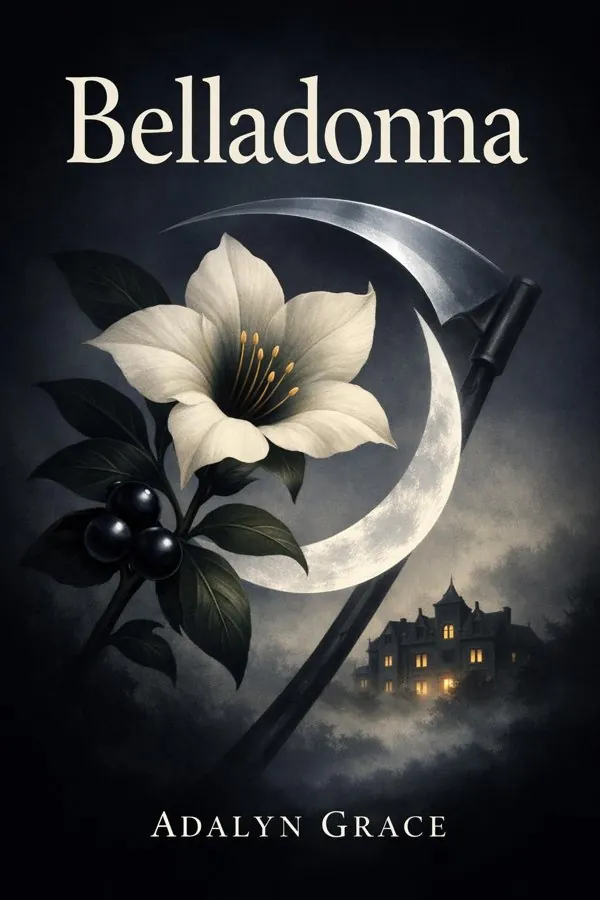
Belladonna: Summary & Key Insights
by Adalyn Grace
 10 min9 chaptersAudio available
Key Takeaways from Belladonna
Nothing sharpens desire quite like the awareness that life can vanish without warning.
What makes someone seem strange can also become the source of their greatest strength.
The most unforgettable places are rarely pure; they are beautiful because they are breaking.
Control rarely appears all at once; it begins the moment someone stops accepting the story they have been handed.
The deepest intimacy often develops not in safety, but in the willingness to approach what once terrified us.
What Is Belladonna About?
Belladonna by Adalyn Grace is a bestsellers book. Some stories ask what it means to live; Belladonna dares to ask what it means to live while Death walks beside you. Adalyn Grace’s gothic fantasy follows Signa Farrow, an orphaned heiress who has spent her life surviving one guardian after another, each more interested in her inheritance than her well-being. But Signa is not an ordinary young woman: she can see spirits, survive poison, and sense that Death himself has always lingered near her. When she is sent to the crumbling Thorn Grove estate, she finds a household unraveling under grief, suspicion, and the threat of murder. To uncover the truth, she must work with the very figure she has long feared and resented. What unfolds is a richly atmospheric blend of mystery, romance, supernatural intrigue, and emotional awakening. Belladonna matters because it transforms familiar gothic elements into a story about agency, desire, mortality, and the courage to claim one’s own fate. Grace, known for lush worldbuilding and emotionally charged fantasy, brings sharp pacing and moody elegance to a novel that feels both classic and fresh.
This FizzRead summary covers all 9 key chapters of Belladonna in approximately 10 minutes, distilling the most important ideas, arguments, and takeaways from Adalyn Grace's work. Also available as an audio summary and Key Quotes Podcast.
Belladonna
Some stories ask what it means to live; Belladonna dares to ask what it means to live while Death walks beside you. Adalyn Grace’s gothic fantasy follows Signa Farrow, an orphaned heiress who has spent her life surviving one guardian after another, each more interested in her inheritance than her well-being. But Signa is not an ordinary young woman: she can see spirits, survive poison, and sense that Death himself has always lingered near her. When she is sent to the crumbling Thorn Grove estate, she finds a household unraveling under grief, suspicion, and the threat of murder. To uncover the truth, she must work with the very figure she has long feared and resented. What unfolds is a richly atmospheric blend of mystery, romance, supernatural intrigue, and emotional awakening. Belladonna matters because it transforms familiar gothic elements into a story about agency, desire, mortality, and the courage to claim one’s own fate. Grace, known for lush worldbuilding and emotionally charged fantasy, brings sharp pacing and moody elegance to a novel that feels both classic and fresh.
Who Should Read Belladonna?
This book is perfect for anyone interested in bestsellers and looking to gain actionable insights in a short read. Whether you're a student, professional, or lifelong learner, the key ideas from Belladonna by Adalyn Grace will help you think differently.
- ✓Readers who enjoy bestsellers and want practical takeaways
- ✓Professionals looking to apply new ideas to their work and life
- ✓Anyone who wants the core insights of Belladonna in just 10 minutes
Want the full summary?
Get instant access to this book summary and 100K+ more with Fizz Moment.
Get Free SummaryAvailable on App Store • Free to download
Key Chapters
Nothing sharpens desire quite like the awareness that life can vanish without warning. At the heart of Belladonna is a haunting truth: mortality is not merely an ending, but the force that gives human choices their meaning. Signa Farrow has spent her life unusually close to death. She survives poisons that would kill others, sees spirits, and repeatedly encounters loss. Because of this, death is not abstract to her; it is personal, intimate, and impossible to ignore. That intimacy reshapes the way she understands fear, love, and belonging.
The novel explores mortality through atmosphere and character rather than philosophy alone. Thorn Grove is a house suspended between life and decay, full of beauty tinged with rot, wealth shadowed by grief, and family ties corroded by secrets. By placing Signa in a world where death is visible and conversational, Adalyn Grace turns what most people avoid into something that must be faced directly. The result is a story that asks readers to consider whether denying death actually keeps us from fully living.
In practical terms, this idea applies far beyond fantasy. People often postpone difficult conversations, meaningful risks, or heartfelt commitments because they assume there will be more time. Belladonna pushes against that illusion. Signa’s growth begins when she stops seeing survival as enough and starts asking what kind of life she wants to claim. Her journey suggests that when we acknowledge life’s fragility, we become more honest about what matters.
Actionable takeaway: Identify one decision you have delayed out of habit or fear, and take a concrete step on it this week as if time truly mattered.
What makes someone seem strange can also become the source of their greatest strength. Signa’s abilities isolate her for much of her life. She can see spirits, communicate with forces others cannot, and endure poison in ways that make her appear unnatural. In the social world she inhabits, difference is dangerous. It invites suspicion, ridicule, and exploitation. Yet Belladonna gradually reveals that the traits that separate Signa from others are not curses alone; they are also tools that allow her to perceive truths everyone else misses.
This reversal is one of the novel’s most compelling themes. Signa begins by trying to fit into the expectations imposed on her: be agreeable, be marriageable, be grateful, and above all, be normal. But normality offers her little protection. The more she suppresses her instincts and unusual gifts, the more vulnerable she becomes to manipulation. Only when she accepts her difference does she gain the confidence to investigate the mystery at Thorn Grove and take control of her future.
This idea resonates in everyday life. Many people hide the very qualities that could distinguish them: sensitivity, intensity, unconventional thinking, or a perspective shaped by hardship. In school, work, and relationships, there is pressure to smooth away anything that feels unusual. Belladonna reminds readers that difference can be clarifying. The person who notices what others overlook may be the one best equipped to solve the real problem.
Actionable takeaway: Make a list of one quality you usually downplay and one situation where that trait could actually be an advantage, then use it deliberately.
The most unforgettable places are rarely pure; they are beautiful because they are breaking. Belladonna uses gothic imagery to show that elegance and ruin often live side by side. Thorn Grove is lavish yet sickly, grand yet burdened by sorrow. Its gowns, gardens, and candlelit rooms create a sense of enchantment, but beneath that surface lie illness, suspicion, and emotional rot. Adalyn Grace does not treat these contrasts as decorative. Instead, she makes them central to the novel’s emotional logic.
This matters because the book refuses simplistic divisions between what looks lovely and what is actually safe, or what appears dark and what may be unexpectedly truthful. Signa is drawn into a world where polished manners conceal selfish motives, while frightening supernatural presences sometimes offer more honesty than the living. The visual richness of the setting mirrors the novel’s deeper idea: people and places can contain both tenderness and corruption, desire and danger, glamour and grief.
Readers can apply this insight by becoming more discerning about appearances. In real life, charm, status, or external polish often distract from harmful dynamics. Likewise, something initially uncomfortable, unfamiliar, or emotionally messy may contain real value. Belladonna encourages us to look past first impressions and examine what sustains a person, institution, or relationship beneath its surface.
The novel’s gothic mood also demonstrates how art can help us hold contradictions without forcing them into easy categories. Beauty does not erase pain; pain does not eliminate beauty. Both can exist together, and often do.
Actionable takeaway: The next time something seems perfect or alarming at first glance, pause and ask what lies underneath the surface impression before making your judgment.
Control rarely appears all at once; it begins the moment someone stops accepting the story they have been handed. Signa enters Thorn Grove as a young woman who has been moved, managed, and underestimated for most of her life. Adults make decisions around her. Guardians treat her inheritance as leverage. Society imagines her future in narrow terms: marry well, behave properly, and remain compliant. Yet Belladonna is fundamentally a story about her shift from passive survivor to active investigator.
That transformation does not begin with brute power. It begins with curiosity. Why is Blythe truly ill? Why does the household seem to orbit unspoken fear? Why do facts fail to align with appearances? Why has Death remained close to her for so long? By asking these questions, Signa disrupts systems that depend on silence. Her agency grows each time she refuses easy explanations and gathers her own evidence.
This theme is especially relevant in everyday life, where people often feel trapped by roles, assumptions, or inherited narratives. We may accept workplace cultures, family expectations, or self-definitions simply because they have been repeated long enough. Belladonna suggests that agency starts not with having all the answers, but with doubting what seems too convenient. Better questions expose hidden motives and create new options.
Practical application can be simple. If a situation feels off, move from vague discomfort to specific inquiry. Ask what evidence supports the story you are being told. Ask who benefits from your silence. Ask what you would do if you trusted your perception.
Actionable takeaway: Choose one area of your life where you feel powerless and write down three sharper questions about it; use those questions to guide your next decision.
The deepest intimacy often develops not in safety, but in the willingness to approach what once terrified us. One of Belladonna’s most distinctive achievements is its romance, which is inseparable from fear, mortality, and vulnerability. Signa’s relationship with Death begins in tension. He is a figure she associates with abandonment, grief, and the many losses that have shaped her life. Yet as the story unfolds, her understanding of him becomes more complex. What she first experiences as dread gradually opens into recognition, fascination, and emotional closeness.
This progression gives the romance its emotional force. Rather than presenting love as a simple refuge, the novel shows it as a confrontation with one’s deepest assumptions. Signa must reckon with what she believes about herself, about worthiness, and about whether closeness inevitably leads to pain. Death, in turn, is not a mere symbol but a presence through which the book explores longing, patience, and the paradox of tenderness emerging from darkness.
In real life, this theme can be understood psychologically. Many people avoid intimacy because it activates old wounds: fear of rejection, betrayal, dependence, or loss. Belladonna suggests that fear does not always signal danger; sometimes it marks the threshold of transformation. The question is not whether vulnerability feels risky, but whether the risk is rooted in truth or in old defenses.
The novel also reminds readers that healthy connection requires seeing beyond categories. Signa’s bond forms when she allows complexity to replace certainty. That shift is often necessary in real relationships as well.
Actionable takeaway: Notice one fear that makes you pull away from connection, and name whether it reflects a present reality or an old protective pattern.
A family can be destroyed as much by what it refuses to say as by any visible act of harm. Belladonna wraps its mystery around a household already weakened by grief, mistrust, and concealed motives. At Thorn Grove, illness is not merely physical; it spreads through secrecy. Characters hide desires, resentments, and truths in order to preserve status or avoid scandal, but the cost of that silence is enormous. The estate becomes a stage where emotional repression enables literal danger.
Adalyn Grace uses the murder mystery structure to reveal how secrecy functions. Lies are not isolated acts; they shape the emotional climate of an entire home. People misread one another because information is withheld. Care is complicated by suspicion. Vulnerable individuals are left unprotected because those with power prioritize appearances over honesty. The question of who is responsible for the poisoning matters, but so does the broader portrait of how a family becomes susceptible to harm in the first place.
This idea is highly practical. In many real families, workplaces, and communities, damaging patterns persist because no one names them clearly. Addiction, financial instability, favoritism, manipulation, or quiet cruelty often survive in the spaces where politeness replaces truth. Belladonna shows that silence can look civilized while functioning as neglect.
At the same time, the novel does not imply that honesty is easy. Revealing the truth can disrupt relationships, expose vulnerability, and threaten comfort. But the story argues that concealment extracts a greater price over time. Healing requires confronting what has been hidden.
Actionable takeaway: Think of one recurring problem in a close relationship or group that everyone tiptoes around, and consider one respectful but honest conversation that could begin to address it.
When others define you for too long, discovering yourself can feel like an act of rebellion. Signa’s life has been shaped by external labels: orphan, burden, heiress, potential wife, oddity. Each guardian or social setting assigns her a role based on usefulness, reputation, or convenience. Belladonna tracks her struggle to move beyond these imposed identities and decide who she is on her own terms.
This is not a straightforward coming-of-age arc in which self-knowledge arrives through simple confidence. Instead, Grace portrays identity as something complicated by inheritance, trauma, desire, and power. Signa is torn between social respectability and inner truth, between the future others plan for her and the future her instincts point toward. Her supernatural connection to death intensifies the question: if you are fundamentally unlike the people around you, how do you belong without betraying yourself?
The novel’s answer is subtle but powerful. Identity is not granted by lineage, approval, or conventional acceptance. It emerges through choice. Signa becomes more fully herself each time she stops seeking permission to trust her perceptions, use her abilities, and pursue the relationships and truths that matter to her.
This theme speaks directly to modern readers navigating family pressure, career expectations, cultural scripts, or personal reinvention. It is easy to confuse being understood with being authentic. Belladonna suggests they are not the same. Sometimes becoming yourself requires disappointing those who preferred the simpler version of you.
Actionable takeaway: Write a short sentence beginning with “I have been told I am…” and then another beginning with “I choose to be…”; compare them and act on the second.
We often treat desire as something irrational, but sometimes it reveals truths logic reaches only later. Belladonna is charged with longing: longing for safety, for love, for answers, for freedom from prescribed roles. Signa’s desires are not always tidy or socially acceptable, yet they function as signals directing her toward what is real. Her attraction, suspicion, curiosity, and hunger for belonging all help her navigate a world where appearances constantly deceive.
This theme is especially effective because the novel refuses to separate emotional and intellectual insight. Signa does not solve the mystery by becoming detached. She solves it by learning to trust the information carried in her instincts and emotional reactions, then testing those feelings against evidence. Desire in this sense is not blind impulse. It is a form of attentiveness. It tells her where meaning lives, where danger lingers, and where she is most alive.
In daily life, people often dismiss desire because they fear it will seem selfish, reckless, or impractical. Yet the absence of desire can leave us trapped in routines that look sensible but feel deadening. Belladonna reminds readers to distinguish between destructive impulse and life-giving longing. The question is not whether we desire, but whether we understand what our desires are trying to tell us.
This can apply to work, creativity, relationships, and personal growth. The project you cannot stop thinking about, the conversation you keep avoiding, or the environment that consistently drains you may all contain information worth examining.
Actionable takeaway: Notice one recurring desire in your life and ask what deeper need or truth it points to before you either suppress it or follow it.
Destiny feels fixed only until someone dares to challenge the story surrounding it. Belladonna is filled with the language of inevitability: Signa seems shadowed by death, bound to inheritance, and constrained by a society that has already imagined her role. Yet the novel repeatedly undercuts the idea that fate is merely something that happens to us. Instead, it suggests that fate is transformed when hidden truths are revealed and acted upon with courage.
Signa cannot choose every condition of her life. She cannot erase her past, her gifts, or the dangers gathering around Thorn Grove. What she can choose is whether to remain passive inside those conditions. By investigating the poisoning, confronting deception, and embracing the parts of herself she once feared, she shifts the meaning of what once seemed predetermined. Courage in the book is not loud heroism; it is the steady willingness to see clearly and move anyway.
This is a valuable framework for readers who feel trapped by circumstance. Many aspects of life are indeed inherited or imposed: background, timing, other people’s actions, and social constraints. Belladonna does not deny that. But it insists that truth-telling and brave action can open pathways where resignation sees only walls. Often the turning point is not a miracle but a refusal to keep participating in falsehood.
The novel’s suspense works because every revelation alters what seemed inevitable. That same principle can guide real life: what appears fixed may depend on information you have not yet uncovered or a step you have not yet taken.
Actionable takeaway: Think of one situation you call “just how things are,” then ask what truth you may be avoiding that could change your options.
All Chapters in Belladonna
About the Author
Adalyn Grace is a bestselling fantasy author known for crafting immersive worlds, romantic tension, and richly atmospheric stories. Before publishing novels, she worked in live theater and later in the publishing world, experiences that helped shape her strong sense of drama, pacing, and visual storytelling. She gained wide attention for her young adult fantasy writing, especially books that combine high emotional stakes with dark enchantment and memorable heroines. Belladonna further established her as a standout voice in modern fantasy by blending gothic mystery, paranormal romance, and coming-of-age themes into a distinctive, highly readable novel. Grace’s work often appeals to readers who love lush settings, dangerous secrets, and emotionally charged plots. Her storytelling style is elegant, accessible, and particularly effective at balancing suspense, romance, and fantasy.
Get This Summary in Your Preferred Format
Read or listen to the Belladonna summary by Adalyn Grace anytime, anywhere. FizzRead offers multiple formats so you can learn on your terms — all free.
Available formats: App · Audio · PDF · EPUB — All included free with FizzRead
Download Belladonna PDF and EPUB Summary
Key Quotes from Belladonna
“Nothing sharpens desire quite like the awareness that life can vanish without warning.”
“What makes someone seem strange can also become the source of their greatest strength.”
“The most unforgettable places are rarely pure; they are beautiful because they are breaking.”
“Control rarely appears all at once; it begins the moment someone stops accepting the story they have been handed.”
“The deepest intimacy often develops not in safety, but in the willingness to approach what once terrified us.”
Frequently Asked Questions about Belladonna
Belladonna by Adalyn Grace is a bestsellers book that explores key ideas across 9 chapters. Some stories ask what it means to live; Belladonna dares to ask what it means to live while Death walks beside you. Adalyn Grace’s gothic fantasy follows Signa Farrow, an orphaned heiress who has spent her life surviving one guardian after another, each more interested in her inheritance than her well-being. But Signa is not an ordinary young woman: she can see spirits, survive poison, and sense that Death himself has always lingered near her. When she is sent to the crumbling Thorn Grove estate, she finds a household unraveling under grief, suspicion, and the threat of murder. To uncover the truth, she must work with the very figure she has long feared and resented. What unfolds is a richly atmospheric blend of mystery, romance, supernatural intrigue, and emotional awakening. Belladonna matters because it transforms familiar gothic elements into a story about agency, desire, mortality, and the courage to claim one’s own fate. Grace, known for lush worldbuilding and emotionally charged fantasy, brings sharp pacing and moody elegance to a novel that feels both classic and fresh.
You Might Also Like

The Godfather
Mario Puzo
10 min
The Handmaid's Tale
Margaret Atwood
10 min
The Hunger Games
Suzanne Collins
10 min
The Nightingale
Kristin Hannah
10 min
The Seven Husbands of Evelyn Hugo
Taylor Jenkins Reid
10 min
Backwater Justice
Fern Michaels
10 minBrowse by Category
Ready to read Belladonna?
Get the full summary and 100K+ more books with Fizz Moment.