
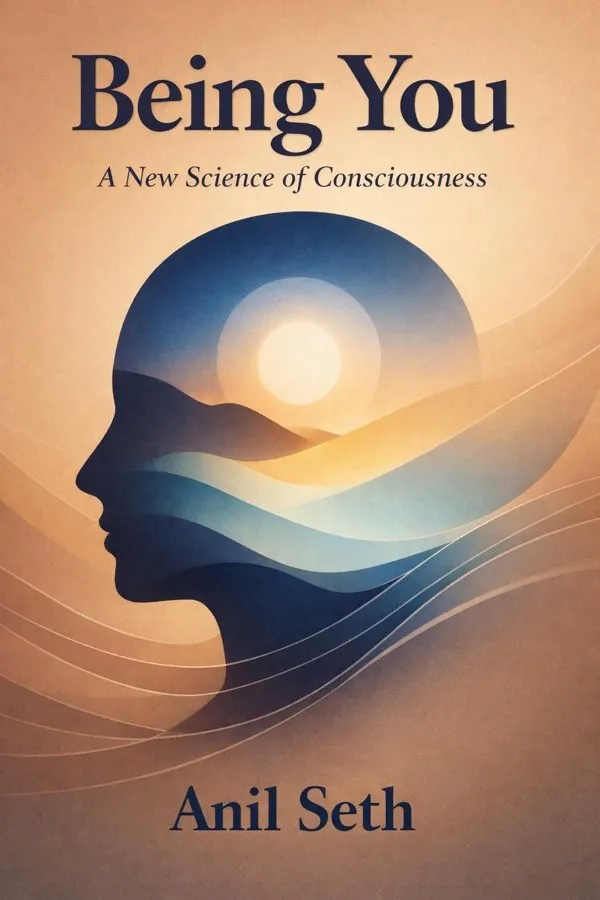
Being You: A New Science of Consciousness: Summary & Key Insights
by Anil Seth
 10 min10 chaptersAudio available
What Is Being You: A New Science of Consciousness About?
Being You: A New Science of Consciousness by Anil Seth is a neuroscience book spanning 10 pages. In this groundbreaking work, neuroscientist Anil Seth explores the nature of consciousness and the self. Drawing on cutting-edge research in neuroscience, psychology, and philosophy, Seth argues that our experience of being a conscious self is a kind of controlled hallucination generated by the brain. He explains how perception, emotion, and the sense of self arise from predictive processes in the brain, offering a new framework for understanding what it means to be conscious.
This FizzRead summary covers all 10 key chapters of Being You: A New Science of Consciousness in approximately 10 minutes, distilling the most important ideas, arguments, and takeaways from Anil Seth's work. Also available as an audio summary and Key Quotes Podcast.
Being You: A New Science of Consciousness
In this groundbreaking work, neuroscientist Anil Seth explores the nature of consciousness and the self. Drawing on cutting-edge research in neuroscience, psychology, and philosophy, Seth argues that our experience of being a conscious self is a kind of controlled hallucination generated by the brain. He explains how perception, emotion, and the sense of self arise from predictive processes in the brain, offering a new framework for understanding what it means to be conscious.
Who Should Read Being You: A New Science of Consciousness?
This book is perfect for anyone interested in neuroscience and looking to gain actionable insights in a short read. Whether you're a student, professional, or lifelong learner, the key ideas from Being You: A New Science of Consciousness by Anil Seth will help you think differently.
- ✓Readers who enjoy neuroscience and want practical takeaways
- ✓Professionals looking to apply new ideas to their work and life
- ✓Anyone who wants the core insights of Being You: A New Science of Consciousness in just 10 minutes
Want the full summary?
Get instant access to this book summary and 100K+ more with Fizz Moment.
Get Free SummaryAvailable on App Store • Free to download
Key Chapters
When we speak about consciousness, we often conflate many different states: being awake, being aware, being self-aware. In my research, I’ve learned to treat these distinctions carefully. Wakefulness is a precondition — a kind of biological readiness. Awareness refers to the state of perceiving — of being open to sensory input and internal states. And selfhood, that deeply personal sense of being someone, is the culmination of immense neural synthesis. Consciousness, then, is not one thing. It is a spectrum of processes, each contributing to the story your brain tells about being you.
The scientific approach to consciousness must begin with clarity. Rather than asking why subjective experience exists — an abstract and divisive question — I suggest asking how specific mechanisms generate the richness of conscious experience. This framing moves us away from metaphysical paralysis toward empirical exploration. The structure of consciousness emerges from countless integrated operations in the brain: perception, attention, emotion, memory, and interoception. Each is a thread that weaves together the tapestry we call experience.
Importantly, defining consciousness means acknowledging its gradations. Consciousness is not an on/off switch. It fluctuates, fades, and reappears in sleep, in anesthesia, and in various neurological conditions. These transitions remind us that consciousness belongs in the domain of biology — not beyond it. To be conscious is to be alive in a particular way, with a nervous system constructing a world for itself and for the organism it serves.
At the heart of *Being You* lies the idea that perception is a process of prediction. The brain does not merely register information passively; it actively constructs hypotheses about what is out there. You could think of it as a prediction machine that continuously generates models of the world and updates them through sensory feedback. The neuroscientific framework underpinning this idea is called predictive processing, and it fundamentally reshapes how we understand perception.
In traditional views, perception starts with the world impressing itself upon our senses, traveling inward to the brain for interpretation. Predictive processing reverses this. It suggests perception begins with the brain’s best guess — a set of expectations formed from prior experience. Incoming sensory signals are then compared against these predictions, and only the differences — the prediction errors — flow upward to refine future expectations. This iterative dance between top-down prediction and bottom-up sensory correction is what gives rise to our stable experience of reality.
This model isn’t merely theoretical. It explains countless perceptual phenomena, from simple illusions to profound cognitive biases. When you see a familiar face in a crowd or recognize a melody after just a few notes, your brain isn’t awaiting full data — it’s predicting, filling gaps, and corralling uncertain sensory signals into coherent experiences. Understanding the brain as a prediction machine transforms our conception of consciousness from passive perception to active inference. It shows how intimately our inner world is shaped by expectation.
+ 8 more chapters — available in the FizzRead app
All Chapters in Being You: A New Science of Consciousness
About the Author
Anil Seth is a British neuroscientist and professor of cognitive and computational neuroscience at the University of Sussex. He is known for his research on consciousness, perception, and the brain’s predictive mechanisms. Seth is also the co-director of the Sackler Centre for Consciousness Science and a prominent science communicator.
Get This Summary in Your Preferred Format
Read or listen to the Being You: A New Science of Consciousness summary by Anil Seth anytime, anywhere. FizzRead offers multiple formats so you can learn on your terms — all free.
Available formats: App · Audio · PDF · EPUB — All included free with FizzRead
Download Being You: A New Science of Consciousness PDF and EPUB Summary
Key Quotes from Being You: A New Science of Consciousness
“When we speak about consciousness, we often conflate many different states: being awake, being aware, being self-aware.”
“At the heart of *Being You* lies the idea that perception is a process of prediction.”
Frequently Asked Questions about Being You: A New Science of Consciousness
Being You: A New Science of Consciousness by Anil Seth is a neuroscience book that explores key ideas across 10 chapters. In this groundbreaking work, neuroscientist Anil Seth explores the nature of consciousness and the self. Drawing on cutting-edge research in neuroscience, psychology, and philosophy, Seth argues that our experience of being a conscious self is a kind of controlled hallucination generated by the brain. He explains how perception, emotion, and the sense of self arise from predictive processes in the brain, offering a new framework for understanding what it means to be conscious.
You Might Also Like
Anxious
Joseph LeDoux
10 min
Hallucinations
Oliver Sacks
10 min
The Biological Mind: How Brain, Body, and Environment Collaborate to Make Us Who We Are
Alan Jasanoff
10 min
The Feeling of Life Itself: Why Consciousness Is Widespread but Can't Be Computed
Christof Koch
10 min
The No-Nonsense Meditation Book
Steven Laureys
10 min
A General Theory of Love
Thomas Lewis, Fari Amini, Richard Lannon
10 minBrowse by Category
Ready to read Being You: A New Science of Consciousness?
Get the full summary and 100K+ more books with Fizz Moment.