
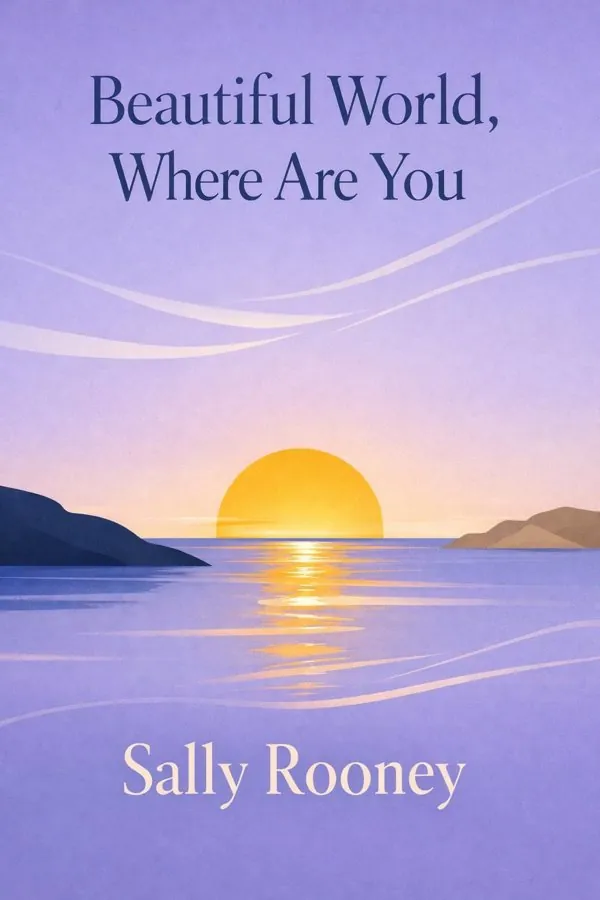
Beautiful World, Where Are You: Summary & Key Insights
by Sally Rooney
 10 min9 chaptersAudio available
Key Takeaways from Beautiful World, Where Are You
Sometimes what unsettles us most is not catastrophe, but ordinary life continuing without ceremony.
The most difficult love is often not unrequited love, but love delayed by fear.
When people cannot make sense of the world aloud, they often turn to writing.
In a culture that often celebrates irony, distance, and self-protection, tenderness can look almost radical.
Love is never separate from material life, no matter how much romantic culture pretends otherwise.
What Is Beautiful World, Where Are You About?
Beautiful World, Where Are You by Sally Rooney is a bestsellers book spanning 4 pages. Beautiful World, Where Are You is Sally Rooney’s intimate, searching novel about four young adults trying to build meaningful lives while feeling overshadowed by personal fragility, economic pressure, and cultural decline. The story centers on Alice, a famous novelist recovering from a breakdown; Felix, a warehouse worker she impulsively invites into her life; Eileen, Alice’s longtime friend, who feels stalled and emotionally exposed; and Simon, a familiar, nearly lifelong presence whose closeness to Eileen carries both comfort and risk. Through shifting third-person narration and long, intellectually charged emails between Alice and Eileen, Rooney explores how people think, desire, argue, withdraw, and reach for one another in a damaged world. What makes the novel matter is not plot alone, but the precision with which it captures modern consciousness: loneliness in an age of constant contact, moral anxiety in a time of crisis, and the stubborn need for tenderness despite disillusionment. Rooney, celebrated for Conversations with Friends and Normal People, brings her characteristic emotional intelligence and social acuity to a novel that asks whether beauty, love, and goodness can still be found when history itself feels unstable.
This FizzRead summary covers all 9 key chapters of Beautiful World, Where Are You in approximately 10 minutes, distilling the most important ideas, arguments, and takeaways from Sally Rooney's work. Also available as an audio summary and Key Quotes Podcast.
Beautiful World, Where Are You
Beautiful World, Where Are You is Sally Rooney’s intimate, searching novel about four young adults trying to build meaningful lives while feeling overshadowed by personal fragility, economic pressure, and cultural decline. The story centers on Alice, a famous novelist recovering from a breakdown; Felix, a warehouse worker she impulsively invites into her life; Eileen, Alice’s longtime friend, who feels stalled and emotionally exposed; and Simon, a familiar, nearly lifelong presence whose closeness to Eileen carries both comfort and risk. Through shifting third-person narration and long, intellectually charged emails between Alice and Eileen, Rooney explores how people think, desire, argue, withdraw, and reach for one another in a damaged world. What makes the novel matter is not plot alone, but the precision with which it captures modern consciousness: loneliness in an age of constant contact, moral anxiety in a time of crisis, and the stubborn need for tenderness despite disillusionment. Rooney, celebrated for Conversations with Friends and Normal People, brings her characteristic emotional intelligence and social acuity to a novel that asks whether beauty, love, and goodness can still be found when history itself feels unstable.
Who Should Read Beautiful World, Where Are You?
This book is perfect for anyone interested in bestsellers and looking to gain actionable insights in a short read. Whether you're a student, professional, or lifelong learner, the key ideas from Beautiful World, Where Are You by Sally Rooney will help you think differently.
- ✓Readers who enjoy bestsellers and want practical takeaways
- ✓Professionals looking to apply new ideas to their work and life
- ✓Anyone who wants the core insights of Beautiful World, Where Are You in just 10 minutes
Want the full summary?
Get instant access to this book summary and 100K+ more with Fizz Moment.
Get Free SummaryAvailable on App Store • Free to download
Key Chapters
Sometimes what unsettles us most is not catastrophe, but ordinary life continuing without ceremony. Alice stands at such a threshold. A successful novelist whose fame has brought money and visibility but not peace, she retreats to a coastal town after a breakdown and psychiatric hospitalization. She is not simply burned out; she is estranged from herself. Into this fragile period comes Felix, a warehouse worker she meets on a dating app and then impulsively invites to travel with her to Rome. Their connection is uneasy from the start, marked by class difference, mutual suspicion, sexual tension, and a constant testing of sincerity. Yet that discomfort is exactly the point.
Alice is used to being seen as exceptional, either envied or scrutinized. Felix, by contrast, is grounded in the routines of labor, blunt speech, and practical survival. He does not flatter her artistic identity, and he does not instinctively enter the emotional language she prefers. Through him, Alice encounters something Rooney treats seriously: the moral and emotional significance of the ordinary. Their relationship asks whether intimacy can emerge not from ideal compatibility, but from patience with awkwardness, misreading, and uneven power.
This dynamic has a practical resonance far beyond the novel. Many people discover that the relationships most capable of changing them are not the ones that confirm their self-image, but the ones that challenge it. Alice and Felix show how easy it is to confuse vulnerability with incompatibility, or discomfort with failure. They also reveal how class can shape speech, confidence, and expectation, even when attraction is genuine.
The takeaway is simple but demanding: if you want real connection, look beyond polish and fantasy. Pay attention to how people show up in ordinary moments, because intimacy is often built there first.
The most difficult love is often not unrequited love, but love delayed by fear. Eileen and Simon embody this tension with painful clarity. They have known each other for years, and their bond is shaped by shared history, familiar rhythms, and a depth of understanding that neither quite finds elsewhere. But this familiarity does not make love easier. If anything, it raises the stakes. To move from friendship, habit, and intermittent intimacy into genuine commitment would require both of them to risk the one thing they each know how to preserve: emotional control.
Eileen lives in Dublin, working at a literary magazine and carrying a diffuse but constant sense of inadequacy. She feels professionally diminished, romantically uncertain, and spiritually restless. Simon, outwardly stable and warm, seems more capable of moving through the world with confidence, yet he too is constrained by expectation, faith, and the burden of being needed. Their relationship is charged not because they lack feeling, but because they have too much history to hide inside illusion.
Rooney uses them to explore a truth many readers will recognize: sometimes people hesitate not because they are unsure what they feel, but because they know exactly what they feel and fear its consequences. Eileen worries about humiliation, asymmetry, and wanting more than she can safely ask for. Simon represents a kind of goodness and steadiness that she longs for, but also doubts she can fully receive.
In real life, this pattern appears whenever people keep profound relationships in suspended form: texting instead of speaking plainly, revisiting old dynamics, or mistaking ambiguity for emotional sophistication. The result is often prolonged uncertainty that feels safer than honesty but hurts more over time.
The actionable lesson is this: when a relationship matters, ambiguity is not always kindness. Name what you want before fear turns intimacy into a permanent maybe.
When people cannot make sense of the world aloud, they often turn to writing. The long email exchanges between Alice and Eileen are among the novel’s defining features, and they do far more than relay information. They create a parallel emotional and intellectual space where the two friends can think together about art, money, religion, capitalism, climate collapse, beauty, and the fatigue of living in late modernity. These letters are not decorative interruptions to the plot. They are the novel’s philosophical bloodstream.
Through correspondence, Rooney shows the difference between performance and reflection. In face-to-face life, Alice and Eileen often manage impressions, absorb social pressure, and conceal vulnerability. In writing, they become more searching, articulate, contradictory, and honest. Their emails expose the hunger many contemporary people feel to connect private emotion with public crisis. They ask: how should one care about friendship, sex, work, and happiness while also knowing the world is structured by inequality and decline? Can personal joy feel moral in a time of collective damage?
This matters because many readers live with the same split consciousness. We move between everyday tasks and a steady awareness of war, ecological threat, economic injustice, and cultural exhaustion. Rooney does not solve this tension. Instead, she dignifies the act of thinking about it with another person. The letters become a model of friendship as shared inquiry rather than mere support.
Practically speaking, this invites a useful habit. Meaningful conversation does not always emerge spontaneously from busy life. Sometimes it needs form: an email, a long message, a regular exchange, a dedicated hour. Deep friendship can be sustained by intentional reflection, not only by proximity.
Take this forward by creating one space in your life where thought is not rushed. Write to someone you trust about what you actually believe, fear, and hope. Clarity often begins in correspondence.
In a culture that often celebrates irony, distance, and self-protection, tenderness can look almost radical. The latter movement of Beautiful World, Where Are You suggests that emotional survival may depend less on certainty than on small, repeated acts of care. As the characters move through misunderstandings, jealousy, confession, illness, sexual complexity, and the strain of seeing one another clearly, what emerges is not a grand resolution but a quieter truth: people remain alive to one another through gentleness.
The reunions and recalibrations in the novel are powerful because they resist dramatic fantasy. Rooney is not interested in love as total rescue. Instead, she shows that relationships become sustaining when people choose to stay present despite imperfection. Alice and Felix must decide whether difference can coexist with loyalty. Eileen and Simon must confront whether long-suppressed feeling can be given a stable shape. Friendship, too, demands work: forgiveness, curiosity, and the refusal to reduce another person to their worst moment.
This idea has practical force. Many people search for emotional security in flawless compatibility, mutual mind-reading, or complete ideological agreement. Rooney offers a more durable model. Survival in difficult times may depend on relational practices that are modest but profound: checking in, listening without immediate correction, apologizing specifically, allowing change, and accepting that closeness includes disappointment.
Tenderness here is not softness without boundaries. It is the disciplined willingness to treat another person as fully real, especially when their needs or flaws complicate your own narrative. In that sense, tenderness becomes ethical as well as emotional.
The takeaway is actionable: do not wait for relationships to feel perfect before acting lovingly. Offer one concrete form of care today, because endurance is often built through ordinary tenderness rather than dramatic declarations.
Love is never separate from material life, no matter how much romantic culture pretends otherwise. One of Rooney’s sharpest achievements in this novel is her attention to class, not as background decoration but as a force that shapes desire, embarrassment, conversation, and self-worth. Alice is wealthy because of literary success; Felix works in a warehouse and experiences the world through a more precarious relationship to labor and status. Eileen works in a cultural field with little glamour and less security. Simon occupies yet another social position, one marked by competence, education, and social ease. These differences matter in every room they enter.
Class shows up not only in housing, travel, and money, but in language itself. Who feels entitled to speak confidently? Who assumes their tastes are legitimate? Who expects to be judged? Felix’s discomfort around Alice’s world is not simple resentment, and Alice’s awkwardness around his life is not solved by attraction. Their interactions reveal how economic and cultural inequality can distort sincerity even when both people are trying to connect.
This insight applies broadly. In friendships and relationships, people often underestimate how strongly class background influences habits that seem personal: how one handles bills, conflict, leisure, education, ambition, and shame. Misunderstandings can arise when one person reads caution as coldness, or directness as hostility, without recognizing the different social training behind those styles.
Rooney’s novel encourages readers to become more attentive to the hidden structures beneath interpersonal tension. Instead of asking only, Why did that conversation feel strange? it may help to ask, What assumptions about money, worth, or belonging were operating here?
The actionable takeaway is to make the implicit explicit. In close relationships, talk honestly about work, money, comfort, and insecurity. Naming class realities does not ruin intimacy; it often makes deeper intimacy possible.
Success can solve external problems while intensifying internal dislocation. Alice’s experience as a famous novelist captures this paradox with unusual precision. She has achieved the kind of recognition many people imagine would bring freedom: financial ease, public admiration, cultural influence. Yet rather than making her feel more real, success seems to have made her life more estranged from itself. She becomes an object of projection, interpretation, and market value. Her breakdown suggests not weakness alone, but the psychic toll of being continuously read.
Rooney treats fame not as glamorous excess but as a distorted form of exposure. Alice is not merely tired; she is split between the person she experiences privately and the symbolic role others assign to her. This is why ordinary contact becomes so important and so difficult. She longs to be met outside the scripts attached to her public identity, but she also cannot entirely escape them. Even her attempts at intimacy are shadowed by imbalance: she has more money, more visibility, and more narrative power than most people around her.
This theme reaches beyond celebrity. Many readers know a less dramatic version of the same problem. Professional success, social media presence, or a highly managed persona can create distance from genuine feeling. You become skilled at being perceived, but less practiced at being known. Achievement then begins to hollow out rather than stabilize identity.
The novel offers no simplistic rejection of ambition. Instead, it asks what forms of life can protect the self from being consumed by performance. Rest, privacy, friendship, and unspectacular routine emerge as necessary counterweights.
The takeaway is practical: if your role in the world is overshadowing your inner life, create spaces where you are not optimizing, branding, or proving. Identity needs relationships and habits that are not built for display.
Romantic relationships often dominate fiction, but Rooney insists that friendship can be just as structurally important to a life. The bond between Alice and Eileen is not always easy, yet it provides something rare: a place where each can be witnessed across time. Their friendship contains affection, envy, misalignment, curiosity, and deep trust. It is neither idealized nor disposable. Instead, it functions as a kind of moral home, a relationship in which one’s changing self can still be recognized.
What makes this friendship especially compelling is that it includes intellectual seriousness. Alice and Eileen do not merely update each other on events; they think together. They use each other as interlocutors in trying to understand history, art, faith, sexuality, exhaustion, and the ethics of living now. In this sense, friendship becomes more than emotional support. It becomes a practice of co-interpretation, a way of resisting isolation by building shared meaning.
This has strong real-world relevance. Adult friendship is often devalued or squeezed by work, romance, and logistics. People assume that good friends should effortlessly remain close, when in reality friendship usually requires intention. It needs communication, forgiveness for uneven timing, and a willingness to let the other person change without treating change as betrayal.
Rooney also shows that friendship can survive asymmetry. Alice’s fame and Eileen’s insecurity create strain, but the relationship endures because both continue to reach back toward honesty. That persistence matters.
The actionable lesson is to treat friendship as central rather than supplementary. Invest in one friendship with the seriousness usually reserved for career or romance: schedule time, ask deeper questions, and let shared thought become part of shared care.
A persistent anxiety runs through the novel: is it morally acceptable to pursue personal happiness when the world appears to be in decline? Through the characters’ conversations and choices, Rooney explores a distinctly contemporary form of guilt. Alice and Eileen are acutely aware of climate crisis, capitalism, historical violence, and cultural exhaustion. They do not live in ignorance. The problem is that awareness itself can become paralyzing. If the world is unjust and perhaps deteriorating, then pleasure may begin to feel trivial, compromised, or even obscene.
This conflict is one of the book’s most resonant contributions. Many people today live with a double consciousness: they go on dates, answer emails, make dinner, and care about friendships while also carrying a constant sense of planetary emergency. The question is not whether public crises matter, but how private life can remain meaningful in their presence. Rooney refuses easy consolation, yet she suggests that love, beauty, sex, friendship, and domesticity are not necessarily denials of reality. They can be part of how human beings remain capable of care at all.
That distinction is crucial. There is a difference between escapism that ignores suffering and nourishment that enables ethical life. If people lose the capacity for joy, intimacy, and attention, their political seriousness may collapse into despair or abstraction. The novel therefore frames private tenderness not as betrayal of the world, but as one condition for continuing within it.
The actionable takeaway is to reject all-or-nothing morality. Stay informed and ethically engaged, but do not punish yourself for moments of beauty, rest, or attachment. A sustainable conscience makes room for both grief and gladness.
The title Beautiful World, Where Are You sounds like a lament, but the novel’s answer is subtler than despair. Beauty is not presented as a stable feature of civilization, a grand aesthetic ideal, or a reward for innocence. Instead, it appears intermittently in flawed human contact: a difficult conversation that becomes honest, a body received without contempt, a friendship that survives distance, a gesture of care that interrupts loneliness. Rooney suggests that beauty has not disappeared; it has become harder to notice because people often search for it at the wrong scale.
This is one reason the novel pays such close attention to awkwardness, contradiction, and emotional half-failure. The characters are not exemplary. They can be evasive, self-absorbed, cruel, jealous, or frightened. Yet precisely within these limitations, moments of grace occur. Someone says the true thing. Someone stays. Someone allows themselves to be known. Beauty emerges not from purity but from relation.
For readers, this reframes what it means to live well. Modern life encourages us to imagine meaning as something spectacular: a perfect career, a transformative romance, a morally unambiguous identity, a coherent worldview. Rooney offers a more durable possibility. Meaning may be located in ordinary acts of recognition that do not cure history but make existence more inhabitable.
In practical terms, this means training attention differently. Instead of waiting for life to become unequivocally beautiful, notice where beauty is already occurring in incomplete forms: in conversation, care, routine, and moments of mutual vulnerability.
The actionable takeaway is to practice small-scale attention. Each day, identify one ordinary interaction that held sincerity, warmth, or truth. Beauty often arrives quietly, and it is easier to sustain when we learn how to see it.
All Chapters in Beautiful World, Where Are You
About the Author
Sally Rooney is an Irish novelist and screenwriter born in 1991 in Castlebar, County Mayo. She studied English at Trinity College Dublin, where she was also active in debate and began developing the sharp analytical style that would later shape her fiction. Rooney rose to international prominence with Conversations with Friends and became a literary phenomenon with Normal People, praised for its emotional precision, social intelligence, and subtle treatment of class and intimacy. Her work often examines how young adults navigate love, work, money, status, and moral uncertainty in contemporary life. Beautiful World, Where Are You continues these concerns while expanding her focus to questions of art, history, faith, and political anxiety. Rooney is widely regarded as one of the defining literary voices of her generation.
Get This Summary in Your Preferred Format
Read or listen to the Beautiful World, Where Are You summary by Sally Rooney anytime, anywhere. FizzRead offers multiple formats so you can learn on your terms — all free.
Available formats: App · Audio · PDF · EPUB — All included free with FizzRead
Download Beautiful World, Where Are You PDF and EPUB Summary
Key Quotes from Beautiful World, Where Are You
“Sometimes what unsettles us most is not catastrophe, but ordinary life continuing without ceremony.”
“The most difficult love is often not unrequited love, but love delayed by fear.”
“When people cannot make sense of the world aloud, they often turn to writing.”
“In a culture that often celebrates irony, distance, and self-protection, tenderness can look almost radical.”
“Love is never separate from material life, no matter how much romantic culture pretends otherwise.”
Frequently Asked Questions about Beautiful World, Where Are You
Beautiful World, Where Are You by Sally Rooney is a bestsellers book that explores key ideas across 9 chapters. Beautiful World, Where Are You is Sally Rooney’s intimate, searching novel about four young adults trying to build meaningful lives while feeling overshadowed by personal fragility, economic pressure, and cultural decline. The story centers on Alice, a famous novelist recovering from a breakdown; Felix, a warehouse worker she impulsively invites into her life; Eileen, Alice’s longtime friend, who feels stalled and emotionally exposed; and Simon, a familiar, nearly lifelong presence whose closeness to Eileen carries both comfort and risk. Through shifting third-person narration and long, intellectually charged emails between Alice and Eileen, Rooney explores how people think, desire, argue, withdraw, and reach for one another in a damaged world. What makes the novel matter is not plot alone, but the precision with which it captures modern consciousness: loneliness in an age of constant contact, moral anxiety in a time of crisis, and the stubborn need for tenderness despite disillusionment. Rooney, celebrated for Conversations with Friends and Normal People, brings her characteristic emotional intelligence and social acuity to a novel that asks whether beauty, love, and goodness can still be found when history itself feels unstable.
More by Sally Rooney

You Might Also Like

The Godfather
Mario Puzo
10 min
The Handmaid's Tale
Margaret Atwood
10 min
The Hunger Games
Suzanne Collins
10 min
The Nightingale
Kristin Hannah
10 min
The Seven Husbands of Evelyn Hugo
Taylor Jenkins Reid
10 min
Backwater Justice
Fern Michaels
10 minBrowse by Category
Ready to read Beautiful World, Where Are You?
Get the full summary and 100K+ more books with Fizz Moment.