
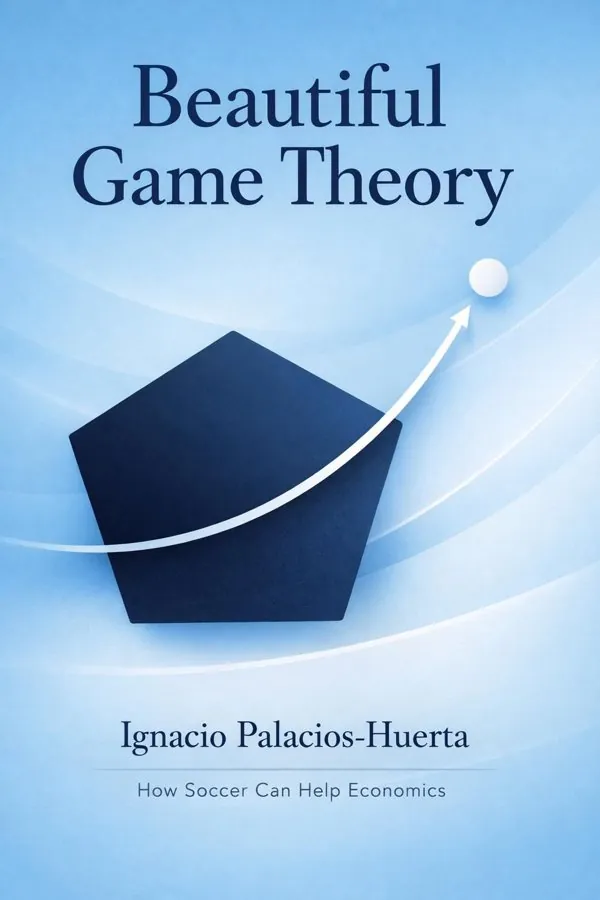
Beautiful Game Theory: How Soccer Can Help Economics: Summary & Key Insights
 10 min9 chaptersAudio available
What Is Beautiful Game Theory: How Soccer Can Help Economics About?
Beautiful Game Theory: How Soccer Can Help Economics by Ignacio Palacios-Huerta is a economics book spanning 9 pages. Beautiful Game Theory aplica la teoría de juegos al fútbol para explorar cómo las decisiones estratégicas en el deporte pueden revelar principios fundamentales de la economía y el comportamiento humano. El autor utiliza datos de partidos y experimentos naturales para mostrar cómo los jugadores, entrenadores y árbitros actúan racionalmente bajo presión, ofreciendo una perspectiva única sobre la racionalidad y la toma de decisiones en contextos competitivos.
This FizzRead summary covers all 9 key chapters of Beautiful Game Theory: How Soccer Can Help Economics in approximately 10 minutes, distilling the most important ideas, arguments, and takeaways from Ignacio Palacios-Huerta's work. Also available as an audio summary and Key Quotes Podcast.
Beautiful Game Theory: How Soccer Can Help Economics
Beautiful Game Theory aplica la teoría de juegos al fútbol para explorar cómo las decisiones estratégicas en el deporte pueden revelar principios fundamentales de la economía y el comportamiento humano. El autor utiliza datos de partidos y experimentos naturales para mostrar cómo los jugadores, entrenadores y árbitros actúan racionalmente bajo presión, ofreciendo una perspectiva única sobre la racionalidad y la toma de decisiones en contextos competitivos.
Who Should Read Beautiful Game Theory: How Soccer Can Help Economics?
This book is perfect for anyone interested in economics and looking to gain actionable insights in a short read. Whether you're a student, professional, or lifelong learner, the key ideas from Beautiful Game Theory: How Soccer Can Help Economics by Ignacio Palacios-Huerta will help you think differently.
- ✓Readers who enjoy economics and want practical takeaways
- ✓Professionals looking to apply new ideas to their work and life
- ✓Anyone who wants the core insights of Beautiful Game Theory: How Soccer Can Help Economics in just 10 minutes
Want the full summary?
Get instant access to this book summary and 100K+ more with Fizz Moment.
Get Free SummaryAvailable on App Store • Free to download
Key Chapters
Before delving into soccer’s field of strategy, we must understand the backbone of game theory. At its core lies the analysis of strategic interaction — situations in which each participant’s outcome depends not only on their own choices but on the decisions made by others. Economists call these relationships ‘games,’ though they encompass everything from auctions and markets to voting and conflict. In soccer, the game is literal but also metaphorical: each player must anticipate others’ moves, balancing his own best response against theirs.
Central to game theory is the idea of equilibrium, particularly the Nash equilibrium, in which all participants adopt strategies that, given others’ choices, leave no one with incentive to deviate. This equilibrium defines mutual rationality — a harmony of self-interest where each player optimizes knowing everyone else does too. Viewed from the stands, we might call these tactical patterns; from the economist’s lens, they form mathematical equilibria.
Soccer illustrates these interactions so vividly: strikers adapt to goalkeepers’ tendencies, teams modify formations based on rivals’ strengths, and coaches design tactics balancing risk and reward much as traders or CEOs would. Every dive, pass, and feint carries informational value. The field becomes a microcosm of strategic reasoning.
In that sense, game theory offers a universal language connecting the logic of sport to the fabric of economics. It provides predictive power, explaining why rational players diversify strategies, why no single action dominates indefinitely, and why uncertainty itself becomes part of optimal play. This foundation will let us interpret soccer not merely as performance but as an unfolding set of equilibrium experiments — raw data for testing how rational behavior operates in reality.
Among all soccer scenarios, penalty kicks stand as the purest embodiment of a strategic game — a duel in which two players face off, each with mutually exclusive goals. The striker must decide whether to kick left or right, high or low; the goalkeeper must decide whether to dive left or right. Each player knows that the other observes tendencies, past patterns, and expectations. It is an instance of imperfect information and high stakes — exactly what game theory seeks to model.
In my research, we collected thousands of professional penalty kicks and analyzed them using the principles of mixed-strategy equilibrium. The mixed strategy is a condition where, instead of choosing one deterministic action, rational players randomize their choices across available options in precise proportions that keep their opponent indifferent. If the striker always chooses left, the keeper quickly learns and adjusts; likewise, if the goalkeeper always dives right, the striker exploits it. But when both randomize optimally, neither can improve their outcome by unilateral deviation — the essence of equilibrium.
Empirical data from elite competitions, including World Cups and domestic leagues, reveal a striking conformity to theoretical prediction. Players’ actual distributions of shot directions mirror those required for mixed-strategy equilibrium. Statistical tests confirm that neither strikers nor goalkeepers could improve success by altering ratios. It’s not luck; it’s rational play under immense pressure.
What this teaches is profound: even in emotionally charged moments, players behave as economists would predict rational agents should. Through years of practice and competition, human intuition converges toward mathematically optimal strategy. The penalty box thus becomes an experimental laboratory — the world’s grandest natural experiment in decision theory.
+ 7 more chapters — available in the FizzRead app
All Chapters in Beautiful Game Theory: How Soccer Can Help Economics
About the Author
Ignacio Palacios-Huerta es un economista español especializado en teoría de juegos y economía del comportamiento. Ha sido profesor en la London School of Economics y en la Universidad de Brown, y es conocido por su trabajo innovador que conecta el deporte con la economía experimental.
Get This Summary in Your Preferred Format
Read or listen to the Beautiful Game Theory: How Soccer Can Help Economics summary by Ignacio Palacios-Huerta anytime, anywhere. FizzRead offers multiple formats so you can learn on your terms — all free.
Available formats: App · Audio · PDF · EPUB — All included free with FizzRead
Download Beautiful Game Theory: How Soccer Can Help Economics PDF and EPUB Summary
Key Quotes from Beautiful Game Theory: How Soccer Can Help Economics
“Before delving into soccer’s field of strategy, we must understand the backbone of game theory.”
“Among all soccer scenarios, penalty kicks stand as the purest embodiment of a strategic game — a duel in which two players face off, each with mutually exclusive goals.”
Frequently Asked Questions about Beautiful Game Theory: How Soccer Can Help Economics
Beautiful Game Theory: How Soccer Can Help Economics by Ignacio Palacios-Huerta is a economics book that explores key ideas across 9 chapters. Beautiful Game Theory aplica la teoría de juegos al fútbol para explorar cómo las decisiones estratégicas en el deporte pueden revelar principios fundamentales de la economía y el comportamiento humano. El autor utiliza datos de partidos y experimentos naturales para mostrar cómo los jugadores, entrenadores y árbitros actúan racionalmente bajo presión, ofreciendo una perspectiva única sobre la racionalidad y la toma de decisiones en contextos competitivos.
You Might Also Like

Business Adventures
John Brooks
10 min
Nudge
Richard H. Thaler, Cass R. Sunstein
10 min
The Hitchhiker"s Guide to the Galaxy
Douglas Adams
10 minThe Muqaddimah
Ibn Khaldun
10 minThe Outsiders
William N. Thorndike
10 min
A Little History of Economics
Niall Kishtainy
10 minBrowse by Category
Ready to read Beautiful Game Theory: How Soccer Can Help Economics?
Get the full summary and 100K+ more books with Fizz Moment.