
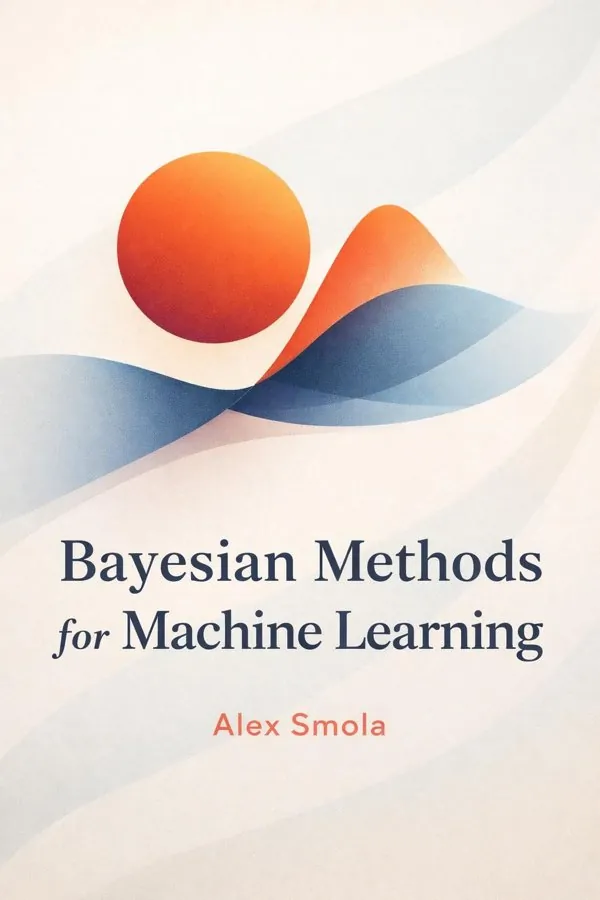
Bayesian Methods for Machine Learning: Summary & Key Insights
by Alex Smola
 10 min8 chaptersAudio available
What Is Bayesian Methods for Machine Learning About?
Bayesian Methods for Machine Learning by Alex Smola is a ai_ml book spanning 8 pages. This book provides a comprehensive introduction to Bayesian approaches in machine learning, covering probabilistic models, inference techniques, and applications in data analysis and pattern recognition. It emphasizes the theoretical foundations and practical implementations of Bayesian inference for modern machine learning tasks.
This FizzRead summary covers all 8 key chapters of Bayesian Methods for Machine Learning in approximately 10 minutes, distilling the most important ideas, arguments, and takeaways from Alex Smola's work. Also available as an audio summary and Key Quotes Podcast.
Bayesian Methods for Machine Learning
This book provides a comprehensive introduction to Bayesian approaches in machine learning, covering probabilistic models, inference techniques, and applications in data analysis and pattern recognition. It emphasizes the theoretical foundations and practical implementations of Bayesian inference for modern machine learning tasks.
Who Should Read Bayesian Methods for Machine Learning?
This book is perfect for anyone interested in ai_ml and looking to gain actionable insights in a short read. Whether you're a student, professional, or lifelong learner, the key ideas from Bayesian Methods for Machine Learning by Alex Smola will help you think differently.
- ✓Readers who enjoy ai_ml and want practical takeaways
- ✓Professionals looking to apply new ideas to their work and life
- ✓Anyone who wants the core insights of Bayesian Methods for Machine Learning in just 10 minutes
Want the full summary?
Get instant access to this book summary and 100K+ more with Fizz Moment.
Get Free SummaryAvailable on App Store • Free to download
Key Chapters
Before we can reason about learning, we must revisit what probability itself means. I start by grounding the reader in the axioms of probability and the distinction between frequentist and Bayesian perspectives. Frequentist statistics interprets probability as relative frequency, while Bayesian reasoning treats it as a degree of belief. This distinction is crucial: in Bayesian inference, all unknowns—parameters, predictions, model structures—are expressed probabilistically.
From this base, we explore the machinery of inference. The prior represents our initial assumptions. The likelihood captures how probable the observed data are under different model parameters. Combining both yields the posterior, embodying all that we know after observing data. The elegance lies in Bayes’ theorem—it formalizes learning as a simple ratio, yet behind that simplicity stands an immense depth of reasoning.
I illustrate these ideas through examples such as coin bias estimation and noisy measurement problems. In both, Bayesian inference allows smooth transitions between uncertainty and certainty as data accumulates. It demonstrates why strong priors can protect against overfitting when data are limited, and how broader priors invite exploration when information is plentiful.
The conclusion of this chapter emphasizes that Bayesian inference is not just a statistical technique—it’s a philosophy of learning. Once you internalize that models are hypotheses weighted by probability, rather than rigid formulas, you start designing algorithms that mirror the natural process of human reasoning.
In practice, Bayesian updating often leads to complex integrals that cannot be solved in closed form. But there exists a powerful shortcut: conjugate priors. In this section, I delve into families of prior distributions that produce posteriors of the same functional form, simplifying computation dramatically.
For example, a Gaussian prior combined with a Gaussian likelihood yields another Gaussian posterior. Similarly, a Beta prior pairs neatly with a Binomial likelihood, and a Dirichlet prior aligns with the Multinomial distribution. These relationships are not arbitrary; they emerge from the algebraic harmony between exponential families and their conjugates.
By working through examples, I show how conjugate analysis builds intuition. In parameter estimation for linear regression, the normal-inverse-Gamma prior enables analytical posterior updates. Such tractability allows us to compute predictive distributions without resorting to numerical approximation, which in turn helps us understand how uncertainty propagates through the model.
While conjugate priors make life easier, they don’t restrict creativity. They form the foundation that later supports approximate methods when closed forms are impossible. My emphasis here is to encourage an appreciation for these elegant mathematical symmetries—they represent the balance between expressiveness and practicality that defines Bayesian modeling.
+ 6 more chapters — available in the FizzRead app
All Chapters in Bayesian Methods for Machine Learning
About the Author
Alex Smola is a computer scientist known for his contributions to machine learning, kernel methods, and probabilistic modeling. He has held research positions at institutions such as the Australian National University, NICTA, and Carnegie Mellon University.
Get This Summary in Your Preferred Format
Read or listen to the Bayesian Methods for Machine Learning summary by Alex Smola anytime, anywhere. FizzRead offers multiple formats so you can learn on your terms — all free.
Available formats: App · Audio · PDF · EPUB — All included free with FizzRead
Download Bayesian Methods for Machine Learning PDF and EPUB Summary
Key Quotes from Bayesian Methods for Machine Learning
“Before we can reason about learning, we must revisit what probability itself means.”
“In practice, Bayesian updating often leads to complex integrals that cannot be solved in closed form.”
Frequently Asked Questions about Bayesian Methods for Machine Learning
Bayesian Methods for Machine Learning by Alex Smola is a ai_ml book that explores key ideas across 8 chapters. This book provides a comprehensive introduction to Bayesian approaches in machine learning, covering probabilistic models, inference techniques, and applications in data analysis and pattern recognition. It emphasizes the theoretical foundations and practical implementations of Bayesian inference for modern machine learning tasks.
You Might Also Like
Life 3.0
Max Tegmark
10 min
Superintelligence
Nick Bostrom
10 min
TensorFlow in Action
Thushan Ganegedara
10 min
AI Made Simple: A Beginner’s Guide to Generative AI, ChatGPT, and the Future of Work
Rajeev Kapur
10 min
AI Snake Oil
Arvind Narayanan, Sayash Kapoor
10 min
AI Superpowers: China, Silicon Valley, and the New World Order
Kai-Fu Lee
10 minBrowse by Category
Ready to read Bayesian Methods for Machine Learning?
Get the full summary and 100K+ more books with Fizz Moment.