
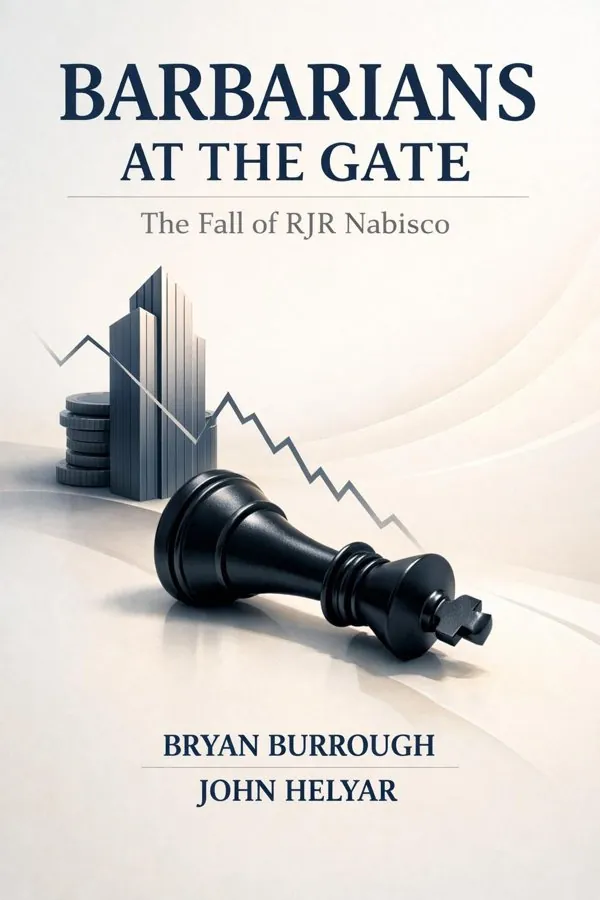
Barbarians at the Gate: The Fall of RJR Nabisco: Summary & Key Insights
by Bryan Burrough, John Helyar
 10 min9 chaptersAudio available
Key Takeaways from Barbarians at the Gate: The Fall of RJR Nabisco
Every financial era creates its own mythology, and the 1980s myth was that debt, if used boldly enough, could unlock hidden corporate value.
Big companies often look strongest just before their contradictions become impossible to ignore.
Charisma in leadership is most dangerous when it disguises weak discipline as visionary confidence.
The most explosive corporate battles often begin with a simple, seductive idea: why let public shareholders own the upside when management can take it for itself?
Competition reveals character, and in the RJR Nabisco battle it revealed how quickly finance can shift from analysis to combat.
What Is Barbarians at the Gate: The Fall of RJR Nabisco About?
Barbarians at the Gate: The Fall of RJR Nabisco by Bryan Burrough, John Helyar is a finance book spanning 8 pages. Barbarians at the Gate is one of the great business narratives of the modern era: a gripping, deeply reported account of the battle to buy RJR Nabisco in the late 1980s, when leveraged buyouts, junk bonds, and executive excess came to symbolize the spirit of Wall Street. Bryan Burrough and John Helyar reconstruct the famous deal with the pace of a thriller and the precision of investigative journalism, showing how CEOs, bankers, lawyers, and buyout firms turned a corporate transaction into an ego-driven war. At the center stands Ross Johnson, the charismatic RJR Nabisco chief executive whose attempt to buy his own company set off a ferocious contest involving KKR and the biggest names in finance. But this is more than a story about one deal. It is a revealing study of incentives, governance failures, financial innovation, and the way power can detach leaders from the people and institutions they are supposed to serve. Burrough and Helyar, both accomplished financial journalists, bring uncommon authority, access, and narrative control to a book that remains essential reading for anyone who wants to understand corporate America, Wall Street culture, and the true cost of unchecked ambition.
This FizzRead summary covers all 9 key chapters of Barbarians at the Gate: The Fall of RJR Nabisco in approximately 10 minutes, distilling the most important ideas, arguments, and takeaways from Bryan Burrough, John Helyar's work. Also available as an audio summary and Key Quotes Podcast.
Barbarians at the Gate: The Fall of RJR Nabisco
Barbarians at the Gate is one of the great business narratives of the modern era: a gripping, deeply reported account of the battle to buy RJR Nabisco in the late 1980s, when leveraged buyouts, junk bonds, and executive excess came to symbolize the spirit of Wall Street. Bryan Burrough and John Helyar reconstruct the famous deal with the pace of a thriller and the precision of investigative journalism, showing how CEOs, bankers, lawyers, and buyout firms turned a corporate transaction into an ego-driven war. At the center stands Ross Johnson, the charismatic RJR Nabisco chief executive whose attempt to buy his own company set off a ferocious contest involving KKR and the biggest names in finance. But this is more than a story about one deal. It is a revealing study of incentives, governance failures, financial innovation, and the way power can detach leaders from the people and institutions they are supposed to serve. Burrough and Helyar, both accomplished financial journalists, bring uncommon authority, access, and narrative control to a book that remains essential reading for anyone who wants to understand corporate America, Wall Street culture, and the true cost of unchecked ambition.
Who Should Read Barbarians at the Gate: The Fall of RJR Nabisco?
This book is perfect for anyone interested in finance and looking to gain actionable insights in a short read. Whether you're a student, professional, or lifelong learner, the key ideas from Barbarians at the Gate: The Fall of RJR Nabisco by Bryan Burrough, John Helyar will help you think differently.
- ✓Readers who enjoy finance and want practical takeaways
- ✓Professionals looking to apply new ideas to their work and life
- ✓Anyone who wants the core insights of Barbarians at the Gate: The Fall of RJR Nabisco in just 10 minutes
Want the full summary?
Get instant access to this book summary and 100K+ more with Fizz Moment.
Get Free SummaryAvailable on App Store • Free to download
Key Chapters
Every financial era creates its own mythology, and the 1980s myth was that debt, if used boldly enough, could unlock hidden corporate value. Barbarians at the Gate begins in a decade shaped by deregulation, aggressive dealmaking, and the rise of Wall Street as a cultural force. Leveraged buyouts, once a niche strategy, became the preferred weapon for investors who believed that bloated public companies could be bought, restructured, and made more efficient. Cheap credit, junk bonds, and the growing prestige of financial engineering made even enormous companies seem vulnerable.
The book shows that this was not simply a technical shift in corporate finance. It was a change in values. Executives began to think less like long-term stewards and more like players in a high-stakes marketplace where companies could be traded, dismantled, or reassembled for profit. Boards often struggled to keep pace. Bankers and lawyers gained influence. Vanity, urgency, and rivalry were amplified by the sheer amount of money available.
RJR Nabisco became the perfect target because it represented old industrial America entering a new financial age. Its stable cash flows made it attractive to buyout firms, while its sprawling structure made it easy to argue that hidden value could be extracted. The broader lesson extends beyond the 1980s. Whenever a market becomes enthralled by a new financial technique, participants start to treat complexity as wisdom and risk as sophistication.
A practical way to apply this insight is to question the mood of any boom period. When everyone is celebrating a new tool, ask who benefits, what assumptions are being ignored, and what happens if financing conditions change. Actionable takeaway: whenever a strategy seems unstoppable because “this time is different,” examine the incentives and debt behind it before admiring the brilliance on the surface.
Big companies often look strongest just before their contradictions become impossible to ignore. RJR Nabisco was formed by combining R.J. Reynolds, a tobacco powerhouse with immense cash generation, and Nabisco, a famous food business built on consumer brands. On paper, the merger promised diversification, scale, and strategic flexibility. In practice, it produced a sprawling organization with conflicting cultures, competing priorities, and an identity problem.
The tobacco side generated the profits that made the company valuable, yet it carried mounting legal, regulatory, and reputational risks. The food side offered mainstream consumer respectability but lacked the same financial power. This imbalance created tension. Was the company a dependable cash machine, a packaged-goods empire, or a defensive structure designed to mask the vulnerability of its cigarette business? The answer changed depending on who was speaking and what they were trying to justify.
Burrough and Helyar show how conglomerates can encourage a dangerous illusion: that scale itself is strategy. A large portfolio may look resilient, but if the parts do not fit operationally or culturally, management can lose focus. Investors then begin to wonder whether the whole is worth less than the pieces. That suspicion attracts raiders, activists, or buyout firms.
The idea remains relevant. Many modern companies acquire businesses to chase growth, diversify risk, or impress markets. But integration is hard, and complexity can destroy accountability. A practical test is to ask whether each division strengthens the others or merely coexists under a shared logo. Actionable takeaway: when evaluating any business, look beyond size and ask whether its parts create real strategic coherence or simply hide unresolved weaknesses.
Charisma in leadership is most dangerous when it disguises weak discipline as visionary confidence. Ross Johnson, the CEO at the center of Barbarians at the Gate, was witty, socially gifted, and highly skilled at navigating elite corporate circles. He projected ease in situations where others felt pressure, and that personal style helped him rise. He understood power, knew how to cultivate loyalty, and moved comfortably in a culture where executive image mattered almost as much as results.
But the book portrays Johnson as more than a colorful personality. He becomes a case study in the gap between performance theater and genuine stewardship. He enjoyed the perks of power and embraced a managerial culture that rewarded lavish spending, private jets, and executive insulation. His authority rested not on being a master operator in the traditional sense, but on his ability to survive, charm, and position himself advantageously within the system.
That matters because modern organizations often confuse confidence with competence. Leaders who communicate well, dominate rooms, and appear relaxed under scrutiny can win support even when strategic thinking is shallow or self-serving. Johnson’s ascent shows how boards and stakeholders can become overly dependent on a leader’s persona, especially when the company is large enough to blur accountability.
In practical terms, this chapter is a reminder to separate style from substance. When assessing leaders, ask hard questions: What operational improvements can they point to? How do they allocate capital? Do they bear downside risk alongside employees and shareholders? Actionable takeaway: never judge leadership by charisma alone; evaluate whether the leader’s incentives, decisions, and track record show real stewardship rather than polished self-presentation.
The most explosive corporate battles often begin with a simple, seductive idea: why let public shareholders own the upside when management can take it for itself? Ross Johnson’s proposal to pursue a leveraged buyout of RJR Nabisco set the entire drama in motion. His pitch rested on a logic common in buyout culture: the market was undervaluing the company, so management could purchase it, use debt to finance the transaction, and later enjoy the gains from restructuring or resale.
On one level, this argument can seem rational. If a company is truly undervalued and leadership has a credible improvement plan, a buyout may align management with ownership. But the book makes clear that this logic becomes ethically fraught when insiders exploit superior information, personal influence, and weak board oversight. Johnson’s role as sitting CEO created an unavoidable conflict. Was he acting for shareholders, or trying to capture value that rightly belonged to them?
This tension appears in many contexts today. Founders taking companies private, executives negotiating compensation during mergers, and insiders buying distressed assets all face similar questions. Information asymmetry is not automatically unethical, but it demands process safeguards. Independent committees, competing bids, and transparent evaluation matter because they limit the ability of insiders to convert fiduciary responsibility into private opportunity.
The practical lesson is straightforward: governance matters most when incentives are most distorted. Whenever an insider-led transaction is proposed, the real question is not whether the idea sounds clever, but whether the process protects those without direct power. Actionable takeaway: in any major decision involving insiders, insist on independent review, competitive alternatives, and a structure that minimizes conflicts before trusting the stated rationale.
Competition reveals character, and in the RJR Nabisco battle it revealed how quickly finance can shift from analysis to combat. Once Johnson’s buyout proposal became public, rival bidders rushed in, most notably Kohlberg Kravis Roberts, or KKR. What followed was a breathtaking contest of escalating offers, frantic negotiation, legal maneuvering, and strategic leaks. The company became less a business than a prize, and every participant had to decide whether to maximize value, protect status, or simply avoid defeat.
The bidding war demonstrates an important principle: once a process turns adversarial, information becomes a weapon. Bankers tried to shape perceptions. Executives signaled confidence or panic. Bidders adjusted terms not only to improve economics but to influence the board’s interpretation of risk. Numbers mattered, but narrative mattered too. Which bid was more credible? Which financing package was truly secure? Which management team could be trusted?
This is highly relevant beyond mergers. In job negotiations, fundraising, property sales, and strategic partnerships, the highest headline offer is not always the best outcome. Terms, certainty, timing, and trust all affect real value. Burrough and Helyar show that sophisticated actors know how to frame these tradeoffs to their advantage.
A practical application is to resist being dazzled by top-line numbers. Ask what assumptions support the offer, what conditions can collapse, and who bears the downside if the plan fails. During any competitive process, emotional escalation can push people to overbid or make concessions they later regret. Actionable takeaway: when a negotiation turns into a contest, slow down and compare not just price, but credibility, incentives, and execution risk before declaring a winner.
Corporate governance sounds abstract until millions of dollars expose who people really believe they serve. One of the book’s deepest themes is the collision between greed, personal loyalty, and fiduciary duty. Directors owed shareholders the best outcome. Executives claimed to care about the company’s future. Bankers were supposedly advisers. Yet each group carried hidden motives, personal alliances, and financial incentives that distorted decision-making.
Johnson and his allies framed their intentions in ways that made self-interest appear aligned with broader benefit. Boards hesitated between trust and suspicion. Advisers delivered analyses that were never fully separate from fee opportunities or institutional loyalties. The result was not pure villainy, but something more realistic and more troubling: a system in which nearly everyone could justify questionable behavior because the norms of the era rewarded it.
This is why the RJR Nabisco story still matters. Most failures in governance do not begin with obvious corruption. They begin when insiders stop distinguishing clearly between what benefits them and what benefits those they represent. The same pattern can be seen in executive compensation design, private equity fees, board interlocks, and even nonprofit governance.
A useful modern application is to examine incentives before listening to rhetoric. If a decision-maker gains personally from a recommendation, their judgment may still be valuable, but it must be tested independently. Good governance does not rely on good intentions alone. It relies on structures that make opportunism harder and accountability clearer. Actionable takeaway: whenever responsibility is shared among boards, executives, and advisers, map each party’s incentives explicitly before deciding whose judgment to trust.
Debt can create discipline, but in excess it turns discipline into fragility. KKR’s eventual victory in the RJR Nabisco contest cemented the firm’s reputation as the dominant buyout player of its time. The triumph was not merely about offering a higher or more credible bid. It reflected KKR’s deeper understanding of how to structure massive leveraged transactions, manage lender confidence, and persuade boards that it could actually complete what it promised.
The book explains the logic behind the buyout model. By financing acquisitions with borrowed money, firms could purchase large companies with relatively little equity. If cash flow remained strong, the debt could be serviced, assets could be sold, operations tightened, and equity returns magnified. But leverage works both ways. It punishes mistakes, magnifies downturns, and can force decisions that prioritize debt repayment over long-term corporate health.
RJR Nabisco was especially suited to this approach because its tobacco business generated immense cash. Yet that same fact raises the central question of the deal: was leverage creating value, or simply redistributing it through financial pressure, fees, and risk transfer? That question remains central to modern private equity, real estate investing, and even household borrowing.
The practical lesson is not that debt is inherently bad. Used carefully, it can increase efficiency and focus. Used aggressively, it can lock organizations into short-termism and vulnerability. Before taking on leverage, decision-makers should test whether revenues are truly resilient, whether assumptions are conservative, and whether the downside is survivable. Actionable takeaway: treat debt as a force multiplier, and never use it at a level that requires everything to go right.
Financial deals are often described in abstract terms, but numbers on a spreadsheet eventually become pressure on real people. One of the enduring strengths of Barbarians at the Gate is that it exposes the human cost hidden behind the glamour of boardrooms and financing packages. While executives, bankers, and buyout firms debated value and strategy, employees, middle managers, and long-term stakeholders had little control over decisions that could reshape their livelihoods.
Leveraged buyouts frequently promise efficiency. In practice, that often means asset sales, layoffs, budget cuts, and a relentless focus on cash generation. Even when a company survives, its culture can be transformed. Managers become cautious. Innovation may slow. Long-term investments are postponed because debt obligations dominate attention. The people who built the business or depended on its stability are rarely at the center of the headline story.
This theme broadens the book’s relevance. In any restructuring, merger, or acquisition, leaders tend to discuss “synergies” or “optimization.” Those words can conceal severe disruption. The RJR Nabisco saga reminds readers to ask who bears the adjustment costs when elite decision-makers pursue financial victories.
A practical application is to expand how we evaluate business success. A transaction should not be judged only by acquisition price or investor return, but also by operational resilience, employee consequences, and the durability of the enterprise after the deal closes. This does not mean avoiding hard decisions. It means counting all the costs. Actionable takeaway: when assessing any major corporate move, look beyond shareholder gains and ask how the plan affects employees, customers, and the company’s long-term capacity to thrive.
The end of a bidding war is not the end of the story; it is the moment when reality begins to test the fantasy. After KKR’s victory, RJR Nabisco entered a new phase marked by debt burdens, operational challenges, and the inevitable gap between deal excitement and post-deal execution. The book’s closing movement reveals a broader truth about financial manias: the transaction that wins headlines may also trap its victor inside the consequences of its own ambition.
The RJR Nabisco saga came to symbolize the excesses of the 1980s because it condensed so many of the era’s defining habits into one event: executive entitlement, banker opportunism, debt-fueled bravado, and the belief that complex finance could outrun common sense. Yet the authors do not reduce the story to caricature. They show a system in which smart, experienced people became vulnerable to momentum, ego, and institutional incentives.
That makes the book timeless. Every generation develops new versions of the same temptation: technology bubbles, housing booms, SPAC frenzies, crypto euphoria, or any environment in which capital becomes abundant and restraint unfashionable. The details change, but the psychology repeats.
For readers today, the lasting lesson is to focus less on whether financial innovation is clever and more on whether it creates durable value. Success built on leverage, secrecy, and inflated confidence often carries hidden fragility. Actionable takeaway: after any celebrated deal or trend, ask the question everyone avoids in euphoric moments: what must remain true for this to work, and what happens if those assumptions fail?
All Chapters in Barbarians at the Gate: The Fall of RJR Nabisco
About the Authors
Bryan Burrough and John Helyar were prominent American business journalists whose reporting helped define modern financial nonfiction. Burrough built his reputation through work at The Wall Street Journal and later Vanity Fair, where he became known for deeply reported narratives on finance, crime, and power. Helyar wrote for major publications including The Wall Street Journal and Fortune, earning respect for his sharp coverage of business and corporate strategy. Together, they brought exceptional reporting access, narrative discipline, and financial literacy to Barbarians at the Gate, widely considered one of the finest business books ever written. Their collaboration stands out for transforming a complex leveraged buyout into a vivid, character-driven account of corporate ambition, dealmaking, and the culture of Wall Street in the 1980s.
Get This Summary in Your Preferred Format
Read or listen to the Barbarians at the Gate: The Fall of RJR Nabisco summary by Bryan Burrough, John Helyar anytime, anywhere. FizzRead offers multiple formats so you can learn on your terms — all free.
Available formats: App · Audio · PDF · EPUB — All included free with FizzRead
Download Barbarians at the Gate: The Fall of RJR Nabisco PDF and EPUB Summary
Key Quotes from Barbarians at the Gate: The Fall of RJR Nabisco
“Every financial era creates its own mythology, and the 1980s myth was that debt, if used boldly enough, could unlock hidden corporate value.”
“Big companies often look strongest just before their contradictions become impossible to ignore.”
“Charisma in leadership is most dangerous when it disguises weak discipline as visionary confidence.”
“The most explosive corporate battles often begin with a simple, seductive idea: why let public shareholders own the upside when management can take it for itself?”
“Competition reveals character, and in the RJR Nabisco battle it revealed how quickly finance can shift from analysis to combat.”
Frequently Asked Questions about Barbarians at the Gate: The Fall of RJR Nabisco
Barbarians at the Gate: The Fall of RJR Nabisco by Bryan Burrough, John Helyar is a finance book that explores key ideas across 9 chapters. Barbarians at the Gate is one of the great business narratives of the modern era: a gripping, deeply reported account of the battle to buy RJR Nabisco in the late 1980s, when leveraged buyouts, junk bonds, and executive excess came to symbolize the spirit of Wall Street. Bryan Burrough and John Helyar reconstruct the famous deal with the pace of a thriller and the precision of investigative journalism, showing how CEOs, bankers, lawyers, and buyout firms turned a corporate transaction into an ego-driven war. At the center stands Ross Johnson, the charismatic RJR Nabisco chief executive whose attempt to buy his own company set off a ferocious contest involving KKR and the biggest names in finance. But this is more than a story about one deal. It is a revealing study of incentives, governance failures, financial innovation, and the way power can detach leaders from the people and institutions they are supposed to serve. Burrough and Helyar, both accomplished financial journalists, bring uncommon authority, access, and narrative control to a book that remains essential reading for anyone who wants to understand corporate America, Wall Street culture, and the true cost of unchecked ambition.
You Might Also Like



Browse by Category
Ready to read Barbarians at the Gate: The Fall of RJR Nabisco?
Get the full summary and 100K+ more books with Fizz Moment.